
SaaS Platform · Commercial Real Estate
Taking hours of manual assembly out of every appraisal report
A document automation platform for commercial appraisers, built to reach into Google Workspace rather than pull teams out of it.
Binny Chanchal, Founder & Principal Architect
The system
One platform, two add-ons, and the seam that holds them together
StartDeck automates commercial appraisal reports. It is not one product but three codebases: a central platform that owns identity, data, and billing, and two independent Google Workspace add-ons that do the actual editing work inside Docs and Sheets.
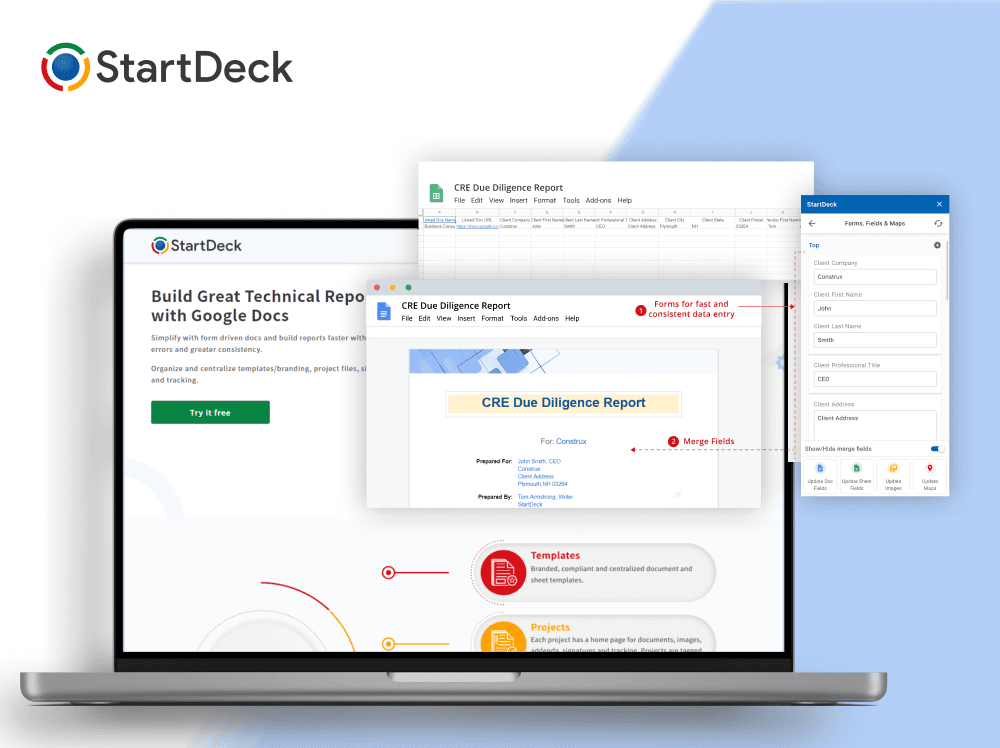
The add-ons never call each other. What connects them is a shared spreadsheet: one prepares the data, the other renders it into the report. That seam is the architecture, and everything interesting follows from it.
System shape
- Core platform. REST API and PWA. Projects, templates, teams, billing, eSignature, per-tenant data warehouse.
- StartDeck Writer. Google Docs add-on, Apps Script. Merge fields, content library, map rendering.
- StartDeck Tables & Maps. Google Sheets add-on, Apps Script. Comp database, schema sync, map definition.
- Shared surface: the linked spreadsheet. Tables writes it, Writer reads it.
- Client
- StartDeck
- Engagement
- Product engineering, MVP through production
- Domain
- Commercial real estate valuation
- Delivery
- Working software in weeks; full MVP in six months
- Stack
- REST API, PWA, BigQuery, Google Workspace APIs, OAuth 2.0
Problem
A commercial appraisal is a legal instrument. It carries a valuation that lenders and courts rely on, and it is assembled largely by hand: comparable-property data gathered and re-keyed, narrative sections rewritten from the last engagement, tables formatted one row at a time. Appraisers were losing hours per report to work that was both repetitive and, precisely because it was repetitive, easy to get wrong.
The obvious product was a purpose-built application that owned the whole workflow. That was the wrong product. Appraisal teams already lived in Google Workspace. Their templates, their internal review cycles, their client deliverables all ran through Docs, Sheets, and Drive. Anything that required them to leave it would have been evaluated once and abandoned.
The hard constraint was set before the first line of code: automate the report without relocating the people who write it.
Approach
The architecture below was settled before build started. That sequencing is why working software reached the client within the first weeks of the engagement, with the full MVP delivered at six months: the early sprints were spent building, not renegotiating structure.
StartDeck is the hub of a hub-and-spoke system. It owns everything durable, including projects, templates, teams, identity, billing, and the appraisal database, and exposes a deliberately separate API surface for the two Workspace add-ons, isolated from the API the web application uses.
Comparable-property data, one warehouse per tenant. Commercial real estate datasets are large, irregular, and queried across geography, property type, date range, and unit economics simultaneously. That is a workload that suits a warehouse, not a transactional database. Each customer gets their own BigQuery dataset, and dataset ownership is modelled polymorphically because it genuinely varies: an account can belong to an individual appraiser or to a firm, and billing and access follow that distinction.
Identity, deliberately segmented. End users, the platform's own access to company-owned Drive assets holding shared templates, and the Workspace add-ons are authenticated separately rather than sharing one set of credentials. A customer's Drive permissions and the platform's own never sit in the same trust boundary.
eSignature brought in-house. Third-party signature services charged per envelope and owned the moment a report becomes final. We built the signing engine into the platform instead: the document is rendered to per-page HTML, signature fields are merged into it server-side, and the result is reassembled into a signed PDF.
One piece of that pipeline needed an older operating system toolchain than the main application could run. Rather than compromise the main image, it lives in its own small service container. An unglamorous decision that kept a hard dependency from dictating the rest of the stack.
AI where it earns its place. An AI layer sits over the knowledge base, giving appraisers answers drawn from StartDeck's own material rather than generic prose. Assistants are configurable by administrators rather than hardcoded, so the behaviour can be tuned without a deploy.
From the client
“They demonstrated stellar excellent project management and responsive communication. I have worked with Duskbyte for many years and have had a consistently positive experience.”
Results for StartDeck
- 50 to 70% faster document creation
- 100% of third-party eSignature costs eliminated
- 60% faster onboarding
- Working software in weeks, full platform in six months
Tech & integrations
Beyond this client
Adoption is an architectural requirement, not a marketing one. The decision that shaped every subsequent one was refusing to move appraisers out of Google Workspace. It made the engineering harder and the product viable.
If your users already have a workflow they trust, the integration surface is the product. Budget for it accordingly.
The seam
The two add-ons
The add-ons never call each other. What connects them is a shared spreadsheet: one prepares the data, the other renders it into the report. That seam is the architecture, and everything interesting follows from it.
Three codebases, one client: a SaaS platform and two Google Workspace add-ons that extend it into the tools their customers already use.
Questions
Common questions
- How long does it take to build a Google Workspace integrated SaaS?
- Six months from engagement to delivered MVP for this platform, covering the core application, a per-tenant data warehouse, billing, eSignature, and two Workspace add-ons.
- Should you build eSignature in-house or use DocuSign?
- Third-party services charge per envelope and own the moment a document becomes final. Building in-house is worth it when signing is core to the product: render the document to per-page HTML, merge signature fields server-side, reassemble as a signed PDF.
- Why give each customer their own BigQuery dataset?
- Large, irregular datasets queried across several dimensions at once suit a warehouse rather than a transactional database. Per-tenant datasets keep billing, access, and tenancy boundaries aligned with how accounts are actually owned.
Platform metrics as reported by the client. Add-on performance figures are deliberately omitted pending verification against a production-scale report.
More like this
Related work
Have something like this to build?
Book a call and tell us where you're stuck. We'll tell you honestly what it takes.