
DevOps is often framed as a speed upgrade, but in enterprise SaaS the real value is control. Safer releases, clearer rollback, and better observability reduce operational risk first, with speed following as a result.
DevOps is often sold as a speed upgrade: deploy more often, ship faster, move quicker.
In enterprise SaaS, that framing breaks down quickly.
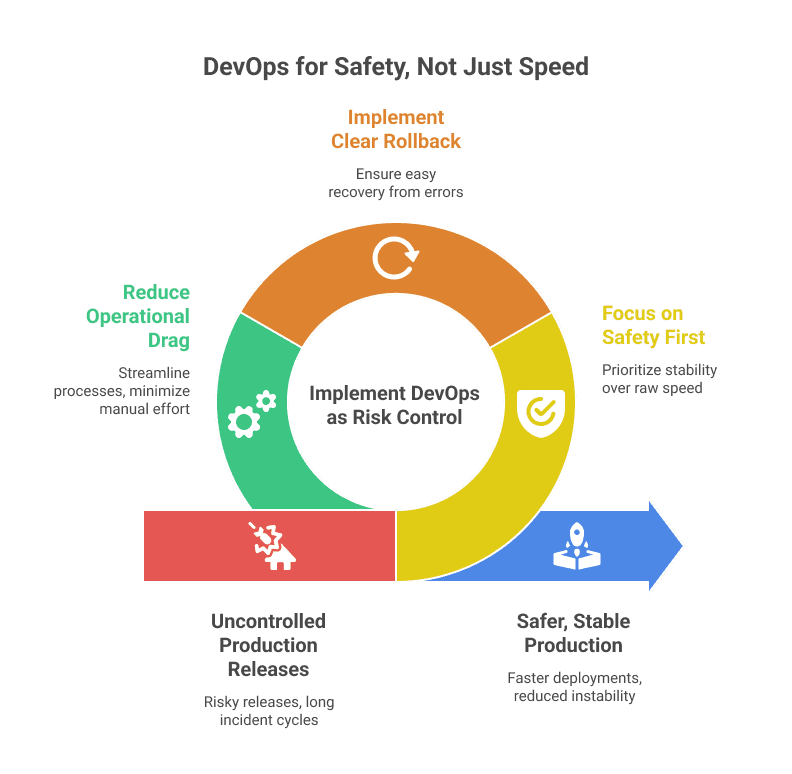
Most teams aren’t blocked by how fast they can deploy. They’re blocked by the cost of being wrong in production—long incident cycles, risky releases, unclear rollback, and operational drag that accumulates as “normal”.
DevOps didn’t make this team faster. It made them safer.
And that’s the point.
When DevOps is implemented as risk control, speed tends to follow naturally. When it’s implemented as “more throughput”, it often amplifies the very instability teams are trying to escape.
Related reading: Why stability is a competitive advantage
The misconception: “DevOps makes us faster”
Many teams already deploy “fast”.
But the releases are:
- Hard to roll back
- Stressful to ship
- Expensive to fix when wrong
- Difficult to observe
- Dependent on specific people to “make it work”
That isn’t slow delivery. That’s unsafe delivery.
Speed without control isn’t an advantage—it’s just a faster way to create operational debt.
The real constraint: uncontrolled change
Enterprise SaaS systems fail in predictable ways when change is uncontrolled:
- A small config tweak triggers a cascading outage
- A schema change breaks downstream jobs
- An innocuous dependency update causes latency spikes
- A release “works in staging” but production traffic patterns behave differently
- A hotfix resolves the symptom while the root cause stays unknown
In these environments, the bottleneck isn’t shipping. It’s:
- Detecting failures quickly
- Containing impact
- Recovering cleanly
- Learning without blame or guesswork
This is why “DevOps as speed” rarely holds up in regulated or data-heavy systems. The primary goal is not velocity. It’s predictable change with bounded risk.
If you’re also planning a cloud move, this becomes even more important: When cloud migration is the wrong first step
A better framing: DevOps as change risk management
A practical definition:
DevOps is the operating model that makes change safe, observable, reversible, and repeatable.
This sounds simple, but it forces different priorities.
Instead of asking “How do we deploy faster?”, the guiding question becomes:
How do we limit blast radius and recover cleanly?
When that question leads, you stop chasing tools and start building capabilities.
What “safer” looks like in real systems
Below are the outcomes that matter in enterprise SaaS. They’re also the outcomes leadership actually cares about.
1) Smaller blast radius
- Smaller, isolated releases
- Feature flags and controlled exposure
- Service boundaries that limit cascading failure
- Backward-compatible changes by default
- Signal: failures impact fewer users and fewer components.
2) Faster detection
- Meaningful telemetry (not dashboards that nobody watches)
- Clear SLOs/SLIs tied to user experience
- Alerting that is actionable, not noisy
- Correlation between deploys and incidents
- Signal: you learn a release is unhealthy quickly, without waiting for customers.
3) Reliable rollback (or roll-forward)
- Rollback is a practiced action, not a hope
- Versioning and compatibility strategies exist (APIs, schemas, events)
- Database changes are reversible or staged safely
- Release pipelines support rapid recovery paths
4) Repeatable deployments
- The deploy process is consistent, automated, and audited
- Environment differences are controlled and explainable
- “It works on my machine” is irrelevant
- Deployments don’t depend on a specific person
- Signal: the system is operable by the team, not by heroes.
5) Evidence-based operations
- Post-incident reviews produce concrete improvements
- Runbooks exist for known failure modes
- Changes are measured (lead time, change failure rate, MTTR)
- Decisions are made from real signals, not intuition
Signal: production becomes less mysterious over time
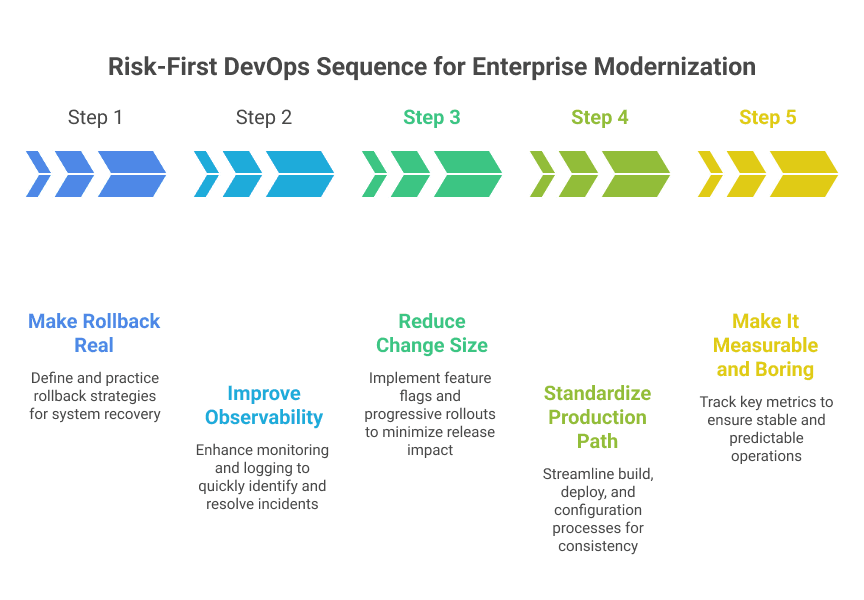
The “risk-first” DevOps sequence
This is the sequence that typically works in enterprise modernization. It avoids the classic mistake of installing new tooling on top of fragile operations.
Step 1 — Make rollback real
Before chasing faster deploys, prove you can recover:
- Define rollback strategy per system type (stateless services vs stateful pipelines)
- Ensure backward compatibility (APIs/events)
- Introduce safe database migration patterns
- Practice rollback in a controlled exercise
If rollback is unreliable, the system cannot tolerate speed.
Step 2 — Improve observability where it reduces incident time
Observability isn’t “more tools”. It’s the ability to answer:
- What changed?
- What broke?
- Who is impacted?
- What is the fastest safe recovery?
Prioritize:
- deploy annotations + correlation IDs
- error budgets / SLOs for critical journeys
- service-level dashboards tied to alerts
- log/trace structure that supports debugging
Step 3 — Reduce change size and exposure
This is where feature flags, canaries, and progressive delivery become useful.
The goal is not “more releases”. It’s lower consequence per release.
- progressive rollout by tenant / cohort
- kill switches for risky features
- controlled traffic shifting where appropriate
Step 4 — Standardize the path to production
Once safety controls exist, streamline the pipeline:
- consistent build & deploy across services
- explicit environment config management
- policy-as-code for controls that matter (security, approvals, auditability)
This is where teams often experience “speed”—but it’s a side effect of reduced uncertainty.
Step 5 — Make it measurable and boring
The best DevOps outcome is boring operations.
Track:
- lead time to change
- deployment frequency (as a result, not a target)
- change failure rate
- MTTR
- incident frequency and impact
Boring is not complacent. Boring is controlled.
Why tooling-first DevOps fails
DevOps initiatives stall when the focus becomes:
- “We need Kubernetes” (before we can roll back safely)
- “We need CI/CD” (without defining what safe means)
- “We need to deploy daily” (without observability)
- “We need platform engineering” (without clear operational pain points)
Tools matter, but they’re not the first step. In enterprise systems, the order matters:
Safety → repeatability → throughput
If you reverse that, you get faster incidents, not faster delivery.
A practical checklist: “Are we doing DevOps as risk control?”
Use this as a quick internal diagnostic.
Release safety
- We can roll back a service change in minutes
- Database migrations follow a safe pattern (expand/contract, staged changes)contract, staged changes)
- Feature flags exist for risky user-facing changes
- We can deploy without relying on a single person
Detection and diagnosis
- Deploys are correlated with key service metrics
- Alerts are actionable (low noise, clear thresholds)
- We have SLIs/SLOs for critical customer journeys
- Logs/traces support root-cause investigation
Blast radius control - Releases can be scoped by tenant / cohort / percentage
- Critical systems have circuit breakers / timeouts / bulkheads
- Service boundaries prevent cascading failures
- Rollouts are progressive by default
Operating discipline
- Incident reviews produce concrete follow-ups that get done
- Runbooks exist for known failure modes
- We track MTTR and change failure rate over time
- DR is tested as an exercise, not a document
If you checked fewer than ~70% of these, “moving faster” will likely increase risk.
### Where this fits in enterprise modernization
Risk-first DevOps is not a separate initiative. It’s a foundation for modernization:
- You can refactor safely because rollback is real
- You can migrate incrementally because you can observe and recover
- You can integrate systems without creating fragile release dependencies
- You can improve security because controls become consistent and auditable
This is also why many cloud migrations fail to deliver: cloud doesn’t create operational maturity. It exposes the lack of it.
See also: Modernizing without downtime: what actually works
Start with clarity
If you’re trying to modernize a production enterprise system, the right first step is not “new tooling”.
It’s understanding where risk lives today, and sequencing improvements so that change becomes safe and repeatable.
If you want a structured, decision-grade assessment, start here:
Primary: SaaS Modernization & Cloud Readiness Audit
Secondary: How we work