
Many cloud migration programs become expensive because they optimize for relocation before they optimize for control. In mature platforms, the real question is not whether the workload runs in the cloud. It is whether the platform becomes easier to change, easier to recover, and easier to govern once it gets there.
Cloud migration is often discussed as if the destination explains the value.
It usually does not.
For mature SaaS platforms and operational systems, cloud migration is not the goal in itself. The real goal is control: control over how change is introduced, how risk is contained, how recovery works, how environments are governed, and how the platform behaves under pressure.
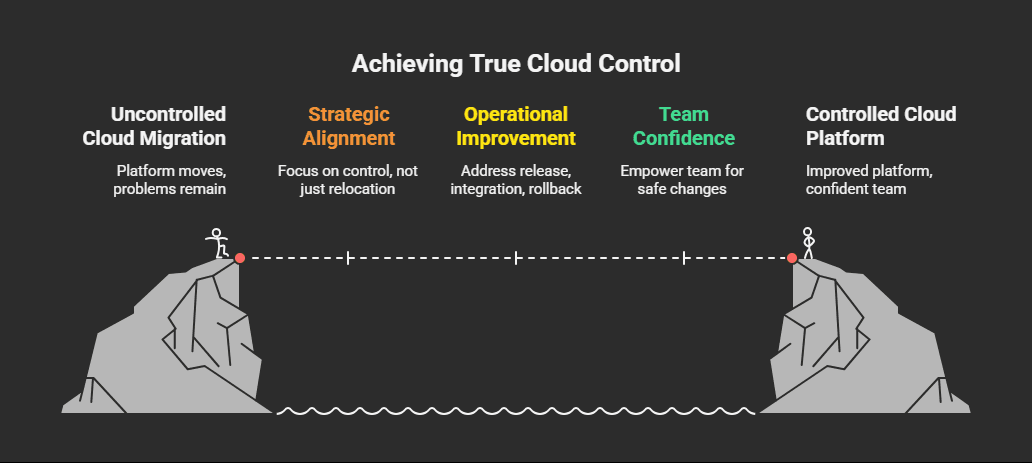
That distinction matters because many migrations are approved on strategic language and then executed as infrastructure relocation programs. The platform moves, but the operating problems stay where they were.
The release process is still brittle.
The integration map is still unclear.
The rollback path is still weak.
The data model is still tightly coupled.
The team still lacks confidence in what can be changed safely.
At that point, the business may have achieved migration without actually improving the platform.
That is the mistake.
The Mistake Most Teams Make
Most failed cloud migrations are not really cloud failures.
They are control failures.
A leadership team decides the platform should move because the hosting model is aging, the current environment is expensive, a datacenter exit is coming, or the board wants a cleaner modernization story. Those pressures are often real. But the response becomes “move the platform” instead of “improve the system’s operating control.”
That sounds subtle, but it changes everything.
When migration becomes the headline objective, teams tend to preserve too much of the current operating model. They rehost fragile services. They carry forward unclear dependencies. They keep manual release patterns. They move tightly coupled components together because the platform cannot yet tolerate separation. They inherit the same instability inside a more complex environment.
The result is familiar:
- the infrastructure looks newer
- the delivery process still feels risky
- the incidents are harder to trace
- the costs are less predictable than expected
- the modernization story sounds stronger than the underlying reality
Cloud is not what fixes that.
Judgment does.
What “Control” Actually Means
For a mature platform, control is not an abstract governance term. It is operational reality.
Control means the team can answer practical questions with confidence:
Can we deploy without guessing what else might break?
Can we isolate failures instead of taking broad collateral damage?
Can we see what changed, who changed it, and how to reverse it?
Can we separate environments, workloads, permissions, and dependencies cleanly enough to reduce blast radius?
Can we recover quickly when something goes wrong?
Can we understand the cost impact of architectural decisions before they spread?
That is the kind of improvement technical leadership can defend internally.
It is also the kind of improvement that users, operations teams, and support teams actually feel.
A cloud migration that increases those forms of control can be high value.
A cloud migration that leaves them unchanged is often just a more expensive version of the same uncertainty.
Where Cloud Migration Actually Helps
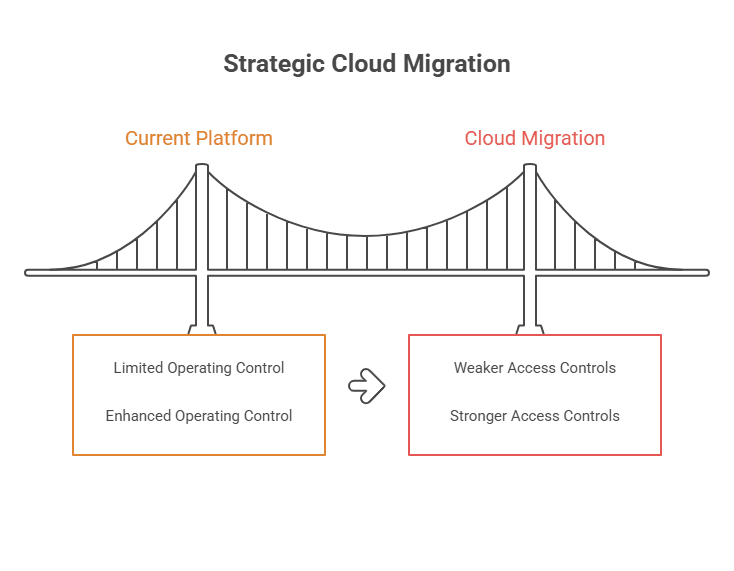
Cloud migration becomes strategically useful when it enables better operating control than the current platform can reasonably achieve where it is.
That may mean giving the team clearer environment boundaries, stronger access controls, more reliable infrastructure automation, improved observability, safer backup and recovery patterns, or better ways to segment workloads by risk and criticality.
In those situations, the move is not valuable because it is “cloud.” It is valuable because it creates conditions that are harder to establish in the current environment.
This is where phased cloud transformation tends to make more sense than broad migration theater.
It works well when:
The current hosting model blocks resilience
Some teams are still operating in environments where backup discipline is weak, recovery paths are unclear, provisioning is inconsistent, or infrastructure changes depend too heavily on tribal knowledge.
In that case, cloud can improve the operating baseline.
But again, the value is not relocation. The value is repeatability, containment, and clearer recovery behavior.
The platform needs cleaner failure boundaries
Shared environments, flat infrastructure patterns, and broad privilege models often make mature systems harder to operate than they need to be.
A better cloud architecture can create separation between workloads, environments, accounts, services, or data domains in a way that reduces blast radius and improves governance.
That is a control gain.
The team needs more predictable infrastructure change
If infrastructure updates are still handled manually, inconsistently, or without reliable review paths, the environment itself becomes a source of operational drift.
Cloud can help here when it is paired with stronger infrastructure discipline, clearer ownership, and release controls.
Without that, the hosting location changes but the operating model does not.
The move supports a wider modernization sequence
Sometimes migration is not the first step, but it is still an important step.
Once a team has reduced delivery fragility, clarified dependencies, and established better release confidence, moving selected parts of the platform can make the next phase easier.
That is very different from migrating first and hoping clarity appears later.
Where Cloud Migration Becomes Expensive Theater
Cloud migration becomes dangerous when it is used to signal progress without improving how the platform is actually controlled.
That usually happens when the business is trying to solve one of these problems:
- slow delivery
- release anxiety
- architecture fragility
- integration sprawl
- poor rollback confidence
- weak environment governance
- limited observability
- rising operational risk
Those are real issues. But they are not solved automatically by moving infrastructure.
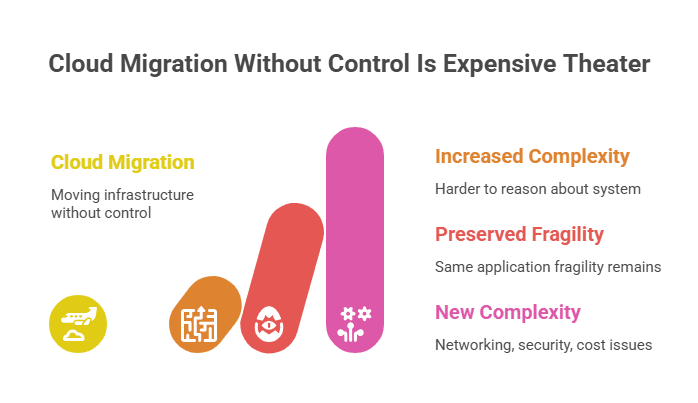
If the platform still has brittle release patterns, tightly coupled services, shared data assumptions, weak test confidence, and poorly understood dependencies, a migration can make the system harder to reason about before it makes it better.
That is one reason lift-and-shift thinking often disappoints mature platform teams.
It preserves too much.
It preserves the same application fragility.
The same ownership confusion.
The same change risk.
The same operational workarounds.
It just does so in an environment that can introduce new complexity around networking, security boundaries, service composition, cost allocation, and platform operations.
Nothing about that is automatically wrong.
It is only wrong when the team mistakes movement for improvement.
The Better Question to Ask
Instead of asking, “How fast can we migrate this platform?”
Ask, “What kind of control do we need to gain, and what sequence gives us the best chance of gaining it?”
That shifts the conversation from relocation to decision quality.
For some teams, the right answer is to move first because the current environment is a hard blocker.
For others, the right answer is to stabilize releases, reduce coupling, improve observability, or untangle critical integrations before migrating anything substantial.
For many, the right answer is mixed:
- some workloads move early
- some dependencies are redesigned first
- some services stay put temporarily
- some modernization work must happen before any migration creates real value
That is why cloud migration should be treated as part of a platform roadmap, not as a standalone success category.
What Mature Teams Usually Need First
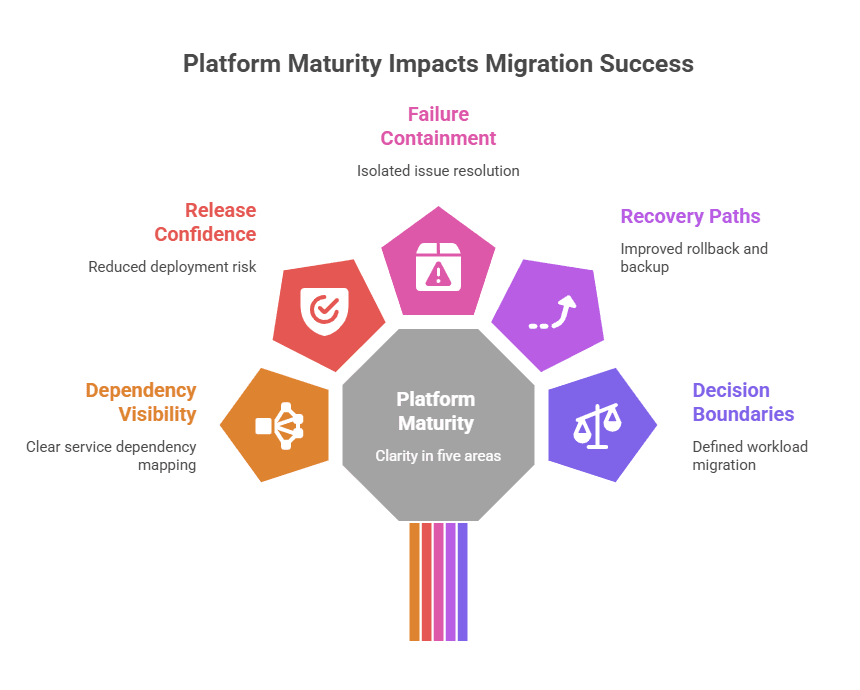
Before a major migration, most mature platforms benefit from more clarity in five areas.
1. Dependency visibility
If the team cannot clearly map service dependencies, data flows, external integrations, operational jobs, and hidden coupling, migration planning becomes optimistic by default.
And optimistic migration plans usually become expensive ones.
2. Release confidence
If every deployment already feels risky, moving the environment does not reduce that risk. It often adds another layer to it.
Release confidence matters because migration introduces change on top of existing change.
That is why release discipline in production systems is often more important than migration velocity.
3. Failure containment
A platform that cannot isolate issues well in its current environment will rarely become easier to operate simply because it now runs in cloud infrastructure.
Containment has to be designed.
4. Recovery paths
Recovery planning matters more than migration ambition.
A strong modernization sequence improves rollback options, backup confidence, restore confidence, and incident handling before the business becomes overexposed to the next phase of change.
5. Decision boundaries
Not every workload needs to move at the same time. Not every service needs the same hosting model. Not every legacy component should be modernized on the same timeline.
Strong teams define what should move now, what should move later, and what should remain stable until a clearer trigger exists.
That is not hesitation.
That is control.
A Better Migration Sequence
In practice, a more defensible cloud migration path often looks like this:
First, reduce avoidable delivery risk.
Then clarify architecture constraints and operational dependencies.
Then define the control model the future platform actually needs.
Then move the parts of the system where migration creates a meaningful control gain.
Then continue modernization in phases, with evidence from each step informing the next one.
That sequence is less dramatic than broad migration narratives.
It is also more survivable.
And for serious systems, survivability matters more than headline velocity.
Questions Worth Asking Before You Migrate
Before committing to a larger cloud program, leadership teams should be able to answer a few uncomfortable questions clearly:
What specific forms of control will improve in the first phase?
Which risks will remain even after migration?
What becomes easier to recover, govern, or isolate after the move?
Which dependencies make rehosting premature?
Which parts of the platform are operationally sensitive enough to require a different sequence?
How will we know whether the migration improved the platform, rather than simply relocating it?
Those questions tend to produce better roadmaps than broad strategy language ever will.
The Real Objective
Cloud migration can be a smart move.
Sometimes it is overdue.
Sometimes it unlocks resilience.
Sometimes it creates cleaner governance boundaries.
Sometimes it gives the platform room to evolve in ways the current environment no longer supports.
But none of that makes migration the goal.
The goal is a platform that is easier to operate, easier to change, easier to recover, and easier to govern under real business pressure.
That is what technical leadership is usually trying to buy.
Control first.
Migration second.
Everything gets clearer after that.