Modernizing Real Estate & PropTech Platforms Without Disrupting Data Integrity
April 7, 2026
8
min read
Modernization Strategy
Modernizing a real estate or PropTech platform is rarely just a codebase problem. It is usually a data integrity problem, a workflow problem, and a sequencing problem at the same time. The teams that get this right do not start with a rewrite. They start by protecting the records, workflows, and operational trust the business already depends on.
Real estate and PropTech modernization is often framed as a platform upgrade problem.
In practice, it is usually a data integrity problem first.
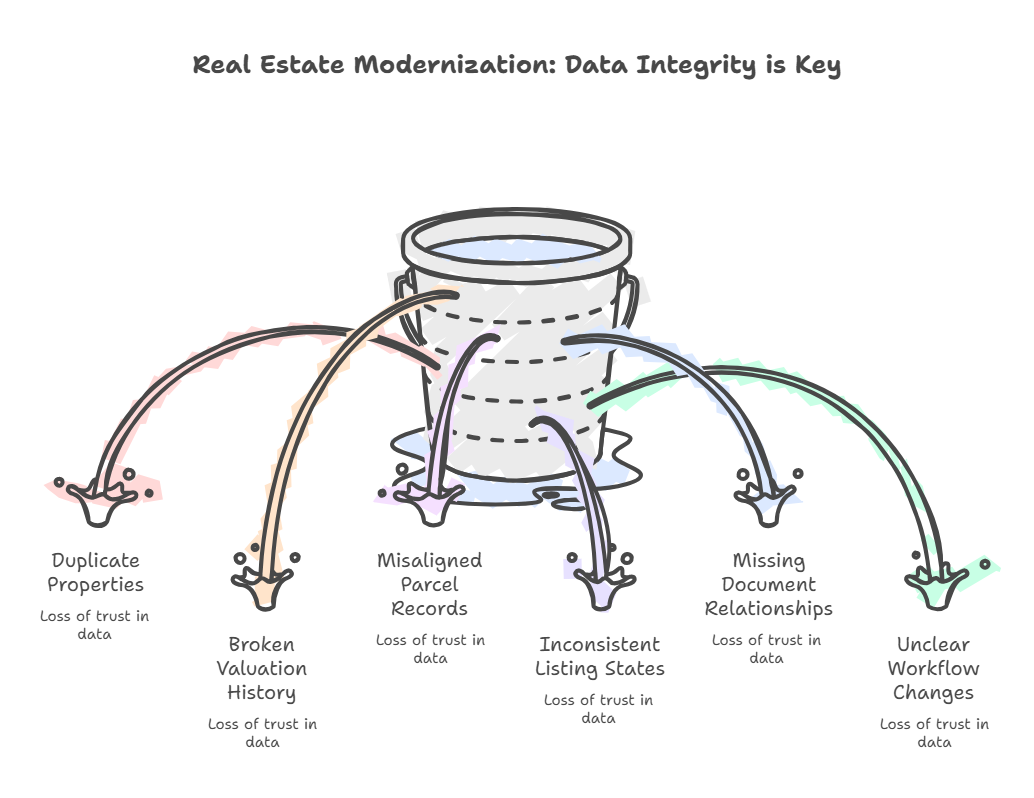
That distinction matters more than it seems. A platform can survive an awkward user interface for a while. It can survive technical debt longer than most teams want to admit. What it does not survive well is loss of trust in the underlying data: duplicate properties, broken valuation history, misaligned parcel records, inconsistent listing states, missing document relationships, or workflows that no longer make it clear who changed what and why.
That is where many modernization efforts quietly fail.
The discussion should not begin with, “How do we rebuild this stack?” It should begin with, “What parts of this platform act as operational truth, and how do we modernize around them without corrupting that truth?”
That is the real question for teams running real estate, appraisal, and PropTech platforms, especially when the platform already carries years of workflow history, ingestion logic, records, edge cases, and operational dependencies.
The Mistake Most Teams Make
A common mistake in mature PropTech systems is treating modernization as an application-layer initiative when the real risk sits in the data layer and workflow layer.
The team wants better performance, cleaner architecture, newer frameworks, improved search, more automation, or a more flexible portal experience. All of that may be valid. But the platform has usually grown around years of operational behavior:
listing ingestion and normalization
parcel and address matching
valuation logic and assumptions
document collection and review workflows
homeowner or agent portal activity
internal admin actions and exception handling
audit expectations across case histories and record changes
downstream exports, reporting, and third-party sync
By the time a platform reaches this stage, data is no longer just content moving through screens. It is operational evidence. It explains what happened, when it happened, who changed it, and what the system believed to be true at each step.
When teams modernize without respecting that, they create a dangerous gap between “the new system works” and “the business can still trust the records.”
Those are not the same thing.
This is also why mature platforms usually need a clearer enterprise SaaS modernization path before they need rewrite energy. The visible product surface is rarely where the highest-risk change sits.
Why Data Integrity Gets Damaged During Modernization
The damage usually does not come from one dramatic migration failure.
It comes from a series of smaller decisions that seem reasonable in isolation.
1. Identity gets blurred
Real estate systems often rely on imperfect identifiers: parcel numbers, MLS IDs, assessor references, internal property IDs, address strings, owner names, or imported third-party keys.
When a modernization effort changes ingestion logic, matching rules, or normalization steps without carefully preserving identity resolution, the platform starts creating duplicates, false merges, or broken lineage.
The problem is rarely visible on day one. It shows up later as support friction, reporting inconsistencies, valuation disputes, and administrative confusion.
2. Historical state is overwritten instead of preserved
Many mature PropTech platforms need more than the latest value. They need record history.
That may include valuation changes, appeal stages, listing state transitions, document revisions, reviewer actions, status updates, ownership changes, or workflow decisions tied to dates and users.
A modernization effort that cleans up schemas but weakens historical traceability often makes the platform look simpler while making it operationally weaker.
In production, “current state only” is rarely enough.
3. Workflow logic is tighter than anyone remembers
A lot of real estate platforms are held together by admin-side routines that never made it into formal architecture diagrams.
An operations lead knows which status can be advanced manually. A reviewer knows which missing document can be tolerated temporarily. A support team knows which imported record should never be auto-merged. A finance or compliance stakeholder knows which adjustments must remain traceable.
When teams modernize user-facing pieces without mapping these operational dependencies first, data integrity issues start appearing as workflow breakage rather than database errors.
That is why modernization in this category needs to be approached as an operating-risk problem, not just a product refresh. It is also why Duskbyte’s How We Work and How We Engage framing matters here: assess first, sequence carefully, and reduce blast radius before broad implementation.
Where Modernization Actually Belongs First
The strongest modernization work in PropTech rarely starts with the most visible part of the product.
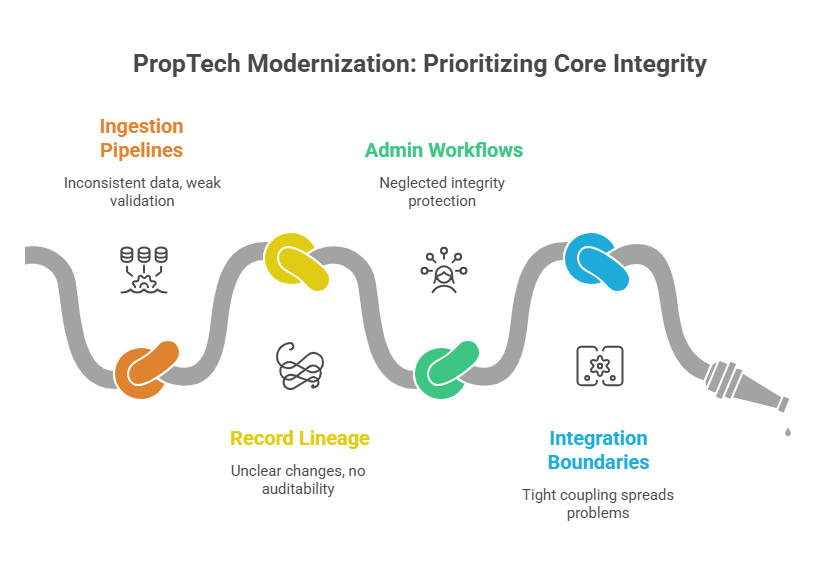
It starts where integrity, observability, and control are weakest.
Ingestion and normalization pipelines
If MLS, IDX, RESO, assessor, CRM, or document feeds are entering the platform with inconsistent normalization, weak validation, or unclear retry behavior, that is usually a better first target than redesigning the portal.
A cleaner frontend on top of unstable ingestion still produces unstable outcomes.
Record lineage and auditability
If the system cannot clearly show how a property record changed over time, which source updated it, which user overrode it, or why a status changed, the platform is already fragile.
Modernization should strengthen event history, audit logs, change attribution, and historical reconstruction before it promises speed.
Admin workflows and exception handling
In mature property platforms, the admin side is often where integrity is protected.
That means queues, review flows, conflict handling, assignment logic, approval states, document checks, reconciliation screens, and manual override controls deserve more architectural attention than they usually get.
This is not glamorous work. It is the work that prevents silent drift.
Integration boundaries
When everything is tightly coupled to everything else, data integrity problems spread fast.
A small change in listing sync can affect search. A schema change can affect reports. A new status model can affect notifications, approvals, exports, and downstream analytics.
Teams should modernize these boundaries deliberately: clearer contracts, safer sync patterns, retry visibility, failure isolation, and better reconciliation paths.
That is usually more valuable than broad rewrite energy.
Need a safer modernization path for your platform?
If your real estate or PropTech platform needs to evolve but the risk around data integrity, workflow dependencies, and production continuity is still unclear, the safest next step is usually not a rewrite. It is a structured assessment of what can change safely, what must be protected, and how modernization should be sequenced.
The SaaS Modernization & Cloud Readiness Audit helps CTOs, platform leaders, and engineering teams identify data-risk exposure, architecture constraints, workflow fragility, and phased modernization priorities before deeper platform changes begin.
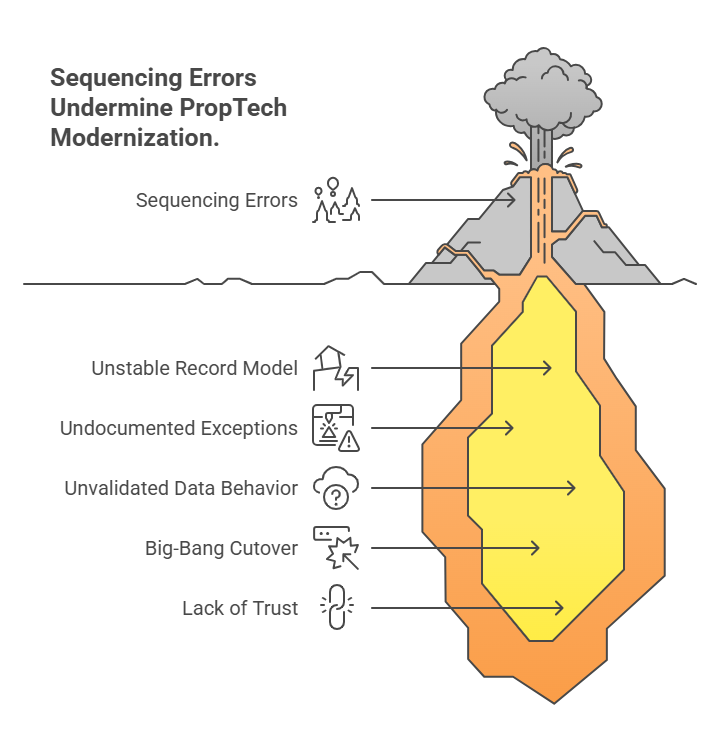
There are a few sequencing errors that show up repeatedly in this category.
Rebuilding the portal before stabilizing the record model
This creates a cleaner experience on top of unstable truth.
Replacing workflow screens before documenting operational exceptions
This removes the informal controls people were relying on, even if the old UX was clumsy.
Migrating storage or infrastructure before validating data behavior
Cloud movement does not fix reconciliation issues, lineage gaps, or state ambiguity. That is one reason a platform may need a clearer modernization roadmap before broader infrastructure change.
Running a big-bang cutover across records, workflows, and integrations at once
This makes rollback harder and diagnosis slower.
The problem is not that teams are moving too slowly.
The problem is that they often move too broadly before they understand where trust is actually being preserved in the current system.
That is one reason Why Most SaaS Rewrites Fail remains especially relevant for operational platforms. In PropTech, failure often looks less like visible downtime and more like uncertainty in the data, confusion in the operations layer, and diminished confidence in the system-of-record.
What Better Modernization Looks Like
A stronger approach usually has five characteristics.
1. Protect system-of-record behavior before changing presentation layers
Be explicit about which services or tables hold operational truth, which data is derived, which fields are authoritative, and which corrections must remain reversible.
2. Separate correction from overwrite
Not every change should erase the previous state. In many real estate workflows, the difference between “new information arrived” and “the previous information was wrong” matters operationally.
3. Make reconciliation a first-class capability
If external feeds, documents, or records can drift, the platform needs visible reconciliation paths rather than hidden assumptions.
4. Modernize in slices that can be verified
A safer pattern is to modernize one bounded workflow at a time: ingestion validation, document lineage, admin queue handling, status audit trails, or reporting consistency.
Each slice should be testable against real operational outcomes.
5. Preserve human accountability
Automation is useful in property operations, but blind automation is dangerous. Modernization should improve operational accountability, not erase it.
That means clear approval states, visible exception queues, change attribution, and audit-ready records.
This is also where a more disciplined approach to modernization matters. Incremental change only works when the slices are chosen carefully enough that the business can verify them without destabilizing adjacent workflows.
A Useful Test for Leadership Teams
Before approving a PropTech modernization initiative, leadership should be able to answer a few hard questions:
Can we explain where record truth lives today?
Can we trace how a property, valuation, case, or document state changes over time?
Do we know which workflows depend on informal operational knowledge rather than explicit system rules?
Can we isolate a modernization slice without destabilizing adjacent data flows?
Do we have a rollback-safe path if a sync rule, mapping layer, or workflow assumption proves wrong?
If those answers are still vague, the right next step is rarely “build faster.”
It is usually “map the platform more honestly.”
That is the difference between modernization as motion and modernization as control.
Why This Matters in Real Estate Platforms Specifically
Real estate systems are unusually sensitive to trust breakdown because the platform often sits between multiple parties, multiple records, and multiple interpretations of what is true.
A homeowner sees one thing. An admin sees another. A third-party feed says something slightly different. A document trail introduces exceptions. A valuation or review workflow adds another layer of judgment.
When that complexity grows over time, the platform does not just need cleaner code. It needs stronger integrity boundaries.
That is why the most credible modernization work in this space is not framed as speed, novelty, or stack replacement.
It is framed as controlled change in systems where data accuracy, workflow clarity, and operational continuity carry real cost.
That is also why the strongest positioning here is not generic “PropTech development.” It is risk-aware modernization for mature platforms with real records, real users, and real operational exposure. For the right buyer, that fits naturally inside Duskbyte’s broader enterprise SaaS modernization and real estate / appraisal / PropTech platform narrative.
Closing Thought
For mature real estate and PropTech platforms, modernization should improve trust before it improves aesthetics.
If the team cannot preserve record lineage, workflow clarity, and reconciliation confidence, then the modernization is not complete no matter how modern the stack looks on paper.
The goal is not to make the platform look newer.
The goal is to make it easier to change without making the data less believable.
Modernize with more clarity and less data risk
If your platform has grown through years of integrations, workflow exceptions, historical records, and admin-side controls, the safest next step is usually not a rewrite plan. It is a structured assessment of data integrity risk, workflow dependencies, and change sequencing.
Our SaaS Modernization & Cloud Readiness Audit helps CTOs, platform leaders, and engineering teams define what should change now, what should wait, and how to modernize without disrupting the records and operational trust the business already depends on.
We use cookies to enhance your browsing experience, serve personalised ads or content, and analyse our traffic. By clicking "Accept All", you consent to our use of cookies. Cookie Policy
.svg)