
The real lesson from the AWS UAE region incident is not just that outages happen. It is that single-region confidence can create a false sense of safety, and critical workloads need a clearer strategy for resilience across regions.
A recent AWS disruption in the Middle East (UAE) Region (me-central-1) is a useful reminder that cloud resilience is not just about uptime within a region. It is about what happens when the assumptions behind that design are tested. AWS’s public status updates initially described the event as a localized power issue affecting a single Availability Zone, mec1-az2. Reuters and other reports later said AWS disclosed physical damage to facilities in the UAE and Bahrain during drone strikes, expanding the incident from a routine outage into a wider resilience lesson.
For engineering leaders, the core lesson is straightforward:
High availability inside one region is not the same as business continuity across regions.
What Happened in the AWS UAE Region
AWS first communicated the issue as a single-AZ power event in mec1-az2, with impact to compute and related infrastructure in the UAE region. Public reporting then added important context: AWS said facilities in the UAE and Bahrain had been damaged, which led to power disruption and broader service impact.
The exact trigger matters less than what it reveals:
- cloud infrastructure still depends on physical facilities,
- physical events can widen the blast radius,
- and a single-region design can become a business risk faster than many teams expect.
Why This Incident Matters Beyond AWS
Many teams treat multi-AZ deployment as their primary resilience strategy. That is a strong baseline, and for many ordinary failures it is sufficient.
But multi-AZ assumes
- one zone fails,
- the other zones remain healthy,
- and the region itself remains the safe recovery boundary.
That model becomes weaker when the disruption is broader than a typical infrastructure fault. A regional power event, shared dependency failure, or physical incident can create a larger failure domain than the architecture was designed to absorb. The AWS UAE incident is a reminder that regional risk is real, even in hyperscale cloud environments.
Disaster Recovery vs Disaster Avoidance
These two concepts are related, but they are not the same.
What Is Disaster Recovery
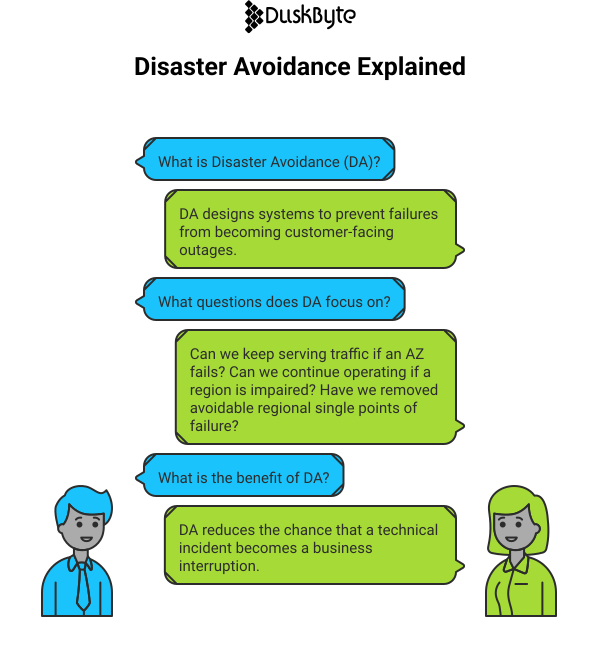
Disaster Recovery (DR) is how quickly you restore systems after a serious failure.
It focuses on questions such as:
- How fast can we recover?
- How much data can we afford to lose?
- What is our failover and failback path?
DR reduces downtime after impact has already happened.
What Is Disaster Avoidance
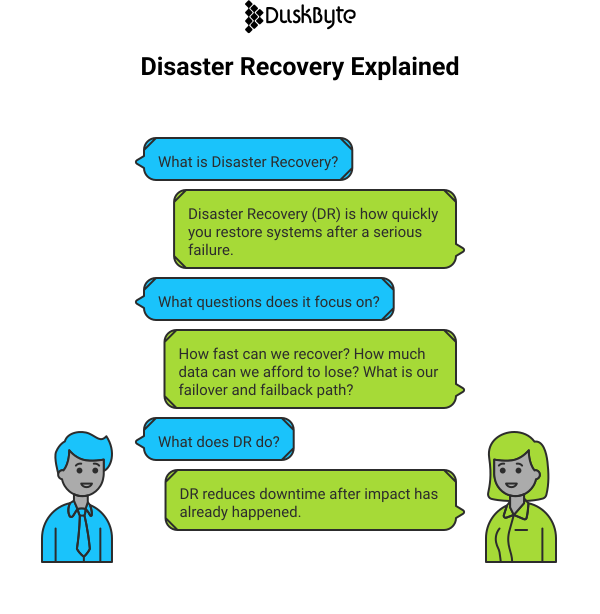
Disaster Avoidance (DA) is how you design systems so that a failure does not become a customer-facing outage in the first place.
It focuses on questions such as:
- Can we keep serving traffic if an AZ fails?
- Can we continue operating if a region is impaired?
- Have we removed avoidable regional single points of failure?
DA reduces the chance that a technical incident becomes a business interruption.
Why You Need Both
A resilient architecture needs both:
- Disaster Avoidance to reduce blast radius
- Disaster Recovery to restore confidence when impact still occurs
In practical terms
- DR helps you recover.
- DA helps you avoid impact.
Why Multi-AZ Is Not Enough for Critical Systems
Multi-AZ architecture is important, but it should not be mistaken for full resilience.
For critical workloads, a single region may still be too narrow a safety boundary. If the business depends on continuous availability, the design needs to account for the possibility that an entire region becomes constrained, degraded, or unavailable.
That does not mean every workload must be active-active across multiple regions. It does mean that critical systems should have a deliberate strategy for:
off-region data protection,
off-region recovery capacity,
and a tested path for traffic redirection.
What Disaster Avoidance Looks Like in Practice
Disaster Avoidance is not a theory. It is an architecture and operations discipline.
Replicate Critical Data Across Regions
If critical data exists only in one region, the business is still exposed. Cross-region replication, backup copies, and validated restore paths are the foundation of avoiding regional data risk.
Pre-Build Traffic Failover Paths
Failover should not start with an emergency design discussion. Health checks, routing logic, standby environments, and operational runbooks should already exist before they are needed.
### Reduce Regional Single Points of Failure
True resilience requires looking beyond the application tier. Regional dependencies often exist in:
- secrets management,
- CI/CD pipelines,
- observability tooling,
- shared storage,
- and operational access paths.
If those dependencies remain single-region, the overall system may still fail even when the
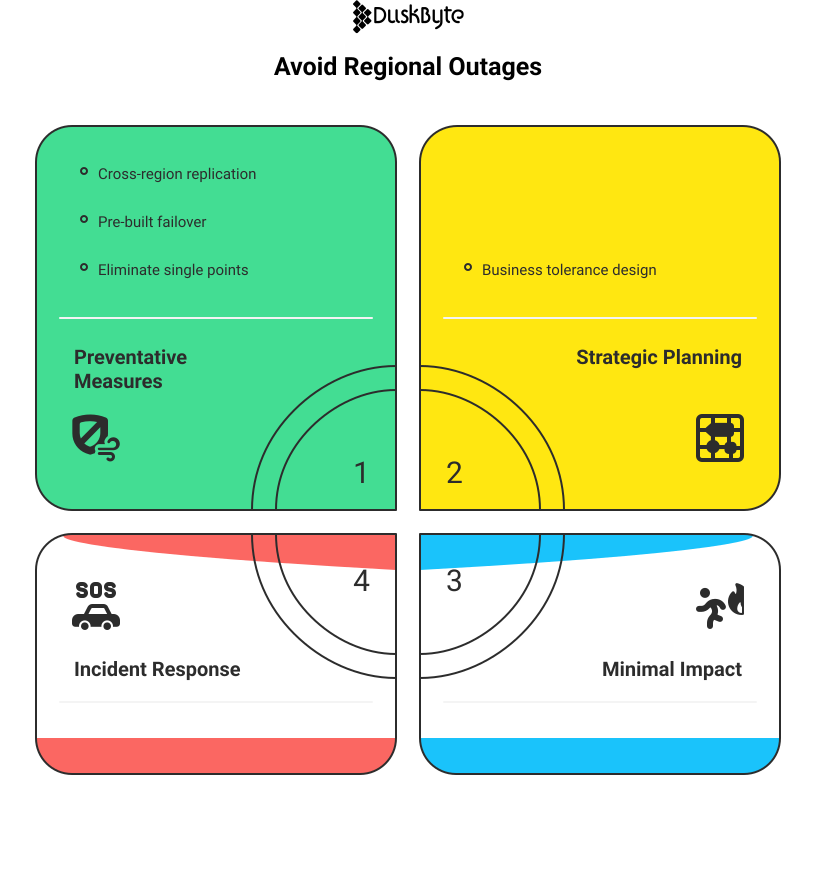
Design to Business Tolerance
Every important system should have explicit:
RTO (Recovery Time Objective)
RPO (Recovery Point Objective)
If the business cannot tolerate hours of downtime or meaningful data loss, the architecture must reflect that reality.
What Disaster Recovery Should Include
Even strong avoidance measures will not remove all risk. That is where DR matters.
A Defined Target Region
Recovery should not be abstract. There should be a known target region, preplanned infrastructure, and documented operational steps.
Recovery Tooling That Matches the Workload
AWS provides services such as AWS Elastic Disaster Recovery, and AWS documentation lists me-central-1 as a supported region. The specific tool matters less than choosing a recovery approach that aligns with the workload’s tolerance for downtime, data loss, and operational complexity.
Regular Recovery Testing
The most common failure in DR is not missing technology. It is untested assumptions.
A recovery plan that has never been exercised usually breaks under pressure because of:
stale dependencies,
incomplete automation,
or unclear ownership during the incident.
If failover has never been tested, the plan is still theoretical.
Key Questions to Ask After a Regional Cloud Incident
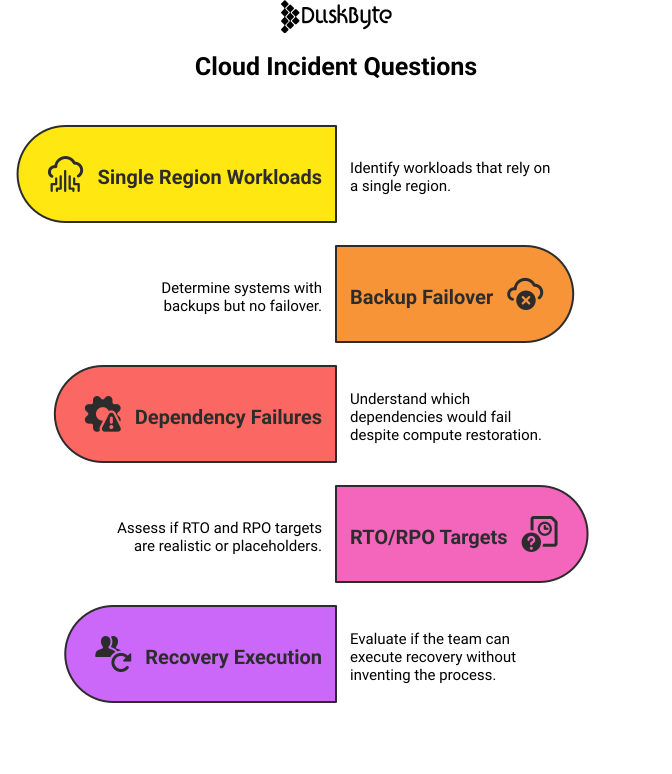
Incidents like the AWS UAE disruption are the right time to ask:
- Which workloads still depend on a single region?
- Which systems have off-region backups but no realistic failover path?
- Which dependencies would fail even if compute is restored elsewhere?
- Are our RTO and RPO targets real, or just placeholders?
Can our team execute recovery without inventing the process during the outage?
These questions are more valuable than focusing only on the headline.
The Real Takeaway for Engineering Leaders
The AWS UAE incident is not just an outage story. It is a resilience design story.
Cloud providers give you strong infrastructure primitives. But they do not decide:
- whether your critical systems rely on one region,
- whether your failover path is already built,
- whether your backups are usable,
- or whether your team can recover under pressure.
Those are architecture and operating model decisions.
And those decisions determine business continuity.
Final Takeaway
The most useful lesson from the AWS UAE region incident is not simply that outages happe
It is that single-region confidence can create a false sense of safety.
- Multi-AZ availability is important.
- Multi-region resilience is different.
- And for critical systems, the difference matters.
The strongest organizations do not only plan for recovery.
They design to avoid impact, and then make sure they can recover anyway.