
Safe systems are not the ones that never fail. They are the ones that fail in ways the business can survive. In live production environments, that means designing for containment, visibility, reversibility, and operational clarity from the start.
A lot of engineering discussions still treat failure as something to eliminate completely.
That sounds responsible. In practice, it often leads teams in the wrong direction.
Mature systems do not become safer because someone declares that incidents are unacceptable. They become safer when failure is expected, bounded, visible, and recoverable. The real question is not whether a platform can fail. It is whether it can fail in a way the business can survive.
That distinction matters even more in enterprise SaaS modernization, legacy SaaS modernization, and cloud migration work, where teams are changing live systems that already carry customers, data, revenue, and operational dependency.
The mistake most teams make
The common mistake is designing for steady-state success while treating failure as an operational afterthought.
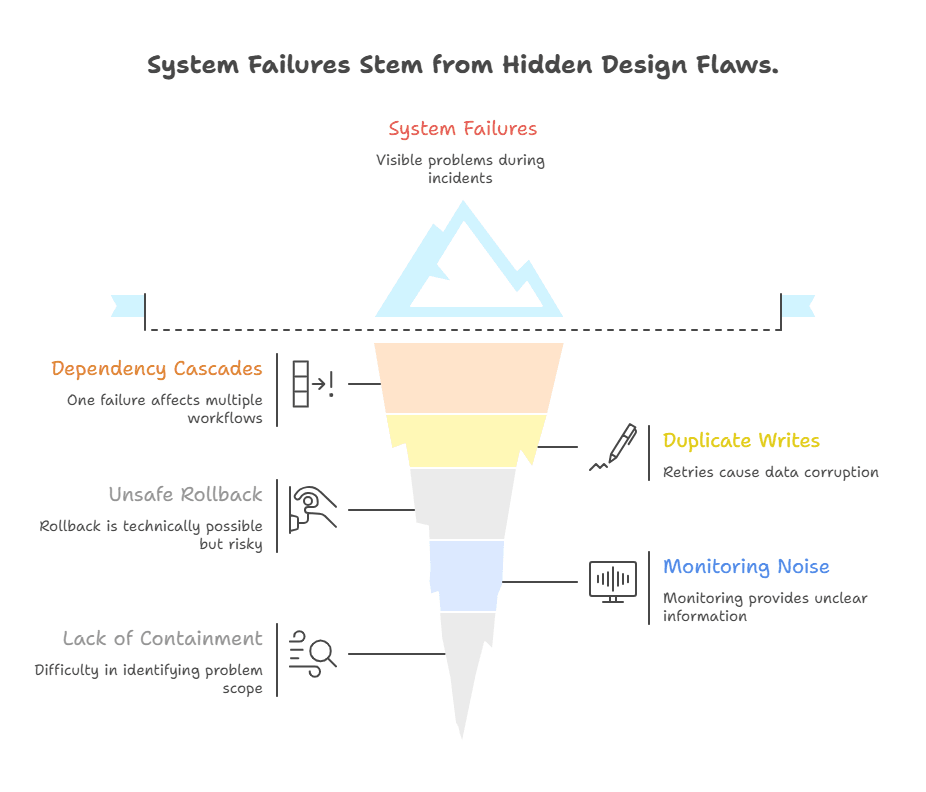
On paper, the architecture looks sound. The service boundaries seem reasonable. The release plan appears organized. But when something actually goes wrong, the system reveals a different shape:
- one dependency failure cascades across multiple workflows
- retries create duplicate writes
- rollback is technically possible but operationally unsafe
- monitoring shows noise instead of signal
- no one can quickly tell whether the problem is contained or spreading
This is where many platform incidents become more expensive than they needed to be. Not because the original defect was catastrophic, but because the system had no disciplined way to absorb it.
That is also why Duskbyte’s approach and engineering practices emphasize sequencing, rollback readiness, and operational clarity rather than speed theatre alone.
What “fail safely” actually means
A system that fails safely does not avoid all disruption.
It does something more realistic and more useful.
It makes failure easier to contain, easier to understand, and easier to reverse.
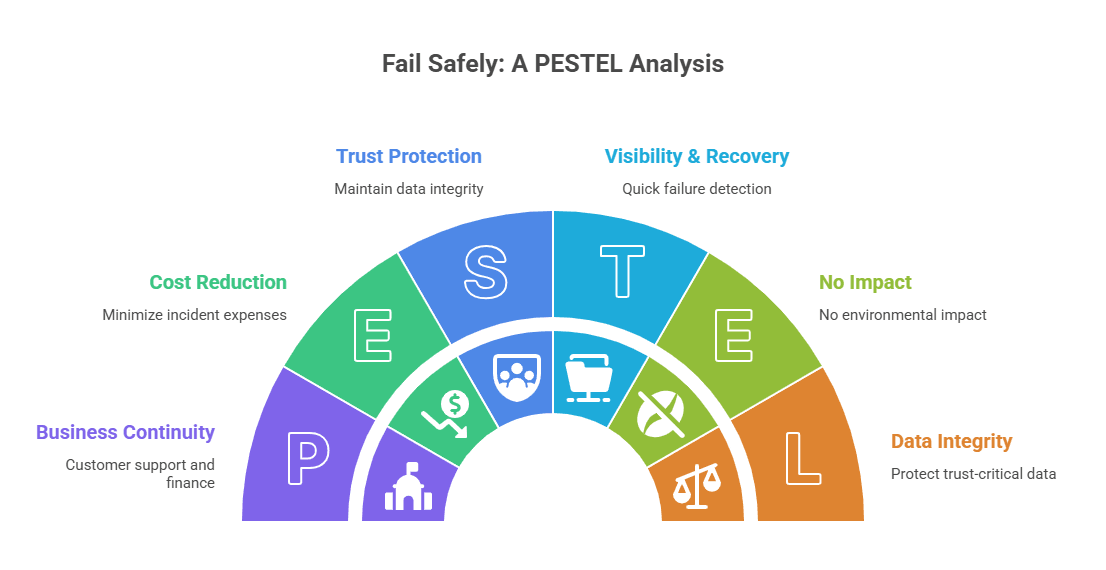
In practice, safe failure usually means five things:
1. Failure stays bounded
A fault in one component should not automatically become a platform-wide event.
That requires clear boundaries between critical and non-critical paths. It means separating what must remain available from what can degrade temporarily. It means resisting architectures where everything depends on everything else under load.
2. Failure becomes visible quickly
If a team cannot see failure clearly, they cannot respond intelligently.
This is not just a monitoring problem. It is a design problem. Systems should expose the difference between delay, degradation, corruption, retry, and outright unavailability. Otherwise, incident response becomes guesswork.
3. Failure does not corrupt trust-critical data
A slow service is painful. A corrupted write path is worse.
Systems that fail safely protect data integrity first. They make it difficult for partial success, duplicate execution, or out-of-order behavior to quietly poison downstream workflows.
4. Recovery paths are real, not theoretical
A rollback plan that exists only in a runbook is not enough.
Safe systems are designed so that recovery can actually happen under pressure, with realistic timing, realistic people, and realistic operational conditions.
5. The business can continue operating
This is the most overlooked test.
If a component fails, can customer support still work? Can finance still reconcile? Can operations still fulfill? Can leadership get a truthful picture of impact quickly enough to make decisions?
A system is not failing safely if the technical issue is small but the operational confusion is large.
Safe failure starts with boundaries, not tooling
Teams often reach for resilience tooling before they fix resilience structure.
They add retries, queues, circuit breakers, or feature flags into an architecture that still has unclear ownership, tightly coupled dependencies, and fragile release assumptions.
Those controls can help. But they do not compensate for poor failure boundaries.
Systems fail more safely when teams make a few harder architectural choices early:
- isolate critical workflows from convenience features
- reduce synchronous coupling where latency or availability matters
- keep control paths separate from bulk-processing paths
- make dependency direction obvious
- avoid hidden shared state across unrelated operations
This is especially important in automation and applied AI work, where teams are often tempted to introduce decision-making or orchestration layers before the underlying system has enough predictability to support them.
If the base platform cannot fail in a controlled way, adding more automation usually increases the blast radius rather than reducing the workload.
Deployment safety matters as much as application design
A surprising amount of unsafe failure is introduced during change, not during normal operation.
Many systems appear stable until deployment begins. Then hidden assumptions surface:
- schemas change before code is compatible
- background workers process mixed-version states
- queues replay events into logic that no longer behaves the same way
- rollback restores code but not data shape
- caches and search indexes drift out of sync
This is why safe-failure design has to include release design.
Teams should be asking:
- can this change be introduced backward-compatibly?
- can old and new versions coexist during rollout?
- does rollback return us to a known-good operational state?
- are data migrations reversible, staged, or at least safely paused?
- can impact be measured before full exposure?
If the answer is no, the system may still work on a quiet day. It is just not designed to fail safely when release pressure, user load, and dependency behavior all collide.
Data failure is usually the expensive failure
Application outages get attention because they are visible.
Data failures often carry the longer tail.
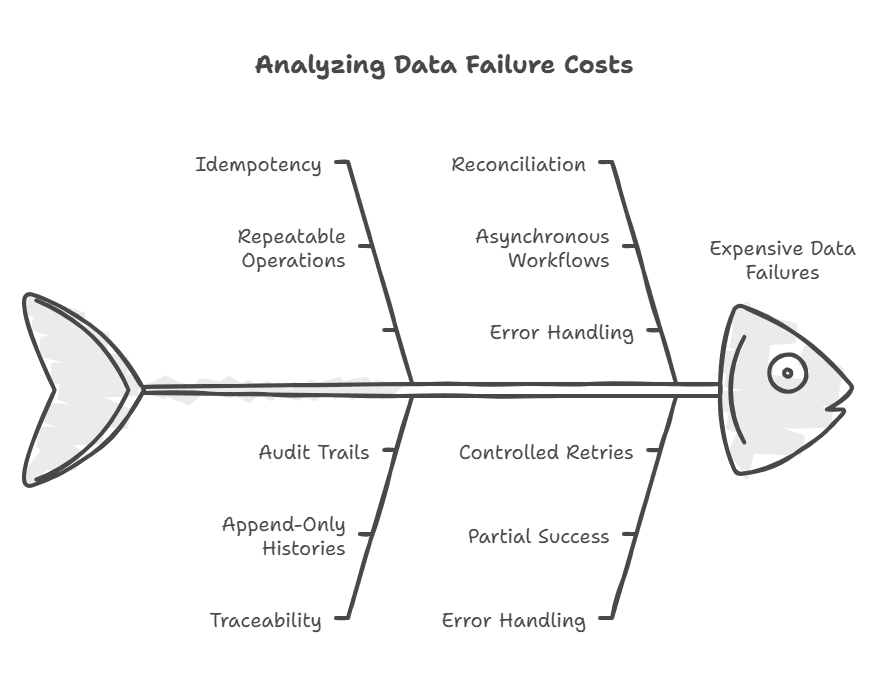
A system that fails safely should make it difficult for errors to silently become durable business facts. That usually means thinking carefully about:
- idempotency for repeatable operations
- append-only or auditable change histories where traceability matters
- reconciliation paths for asynchronous workflows
- explicit handling for partial success
- controlled retry behavior rather than blind repetition
- clear ownership of the source of truth
This matters even more in operationally sensitive environments, including pricing systems, customer communications, workflow-heavy portals, and regulated workflows, where the cost of incorrect behavior is often higher than the cost of temporary delay.
For example, in customer communications and messaging platforms, a “small” failure may not only delay messages. It may affect suppression logic, audit trails, authorization boundaries, or delivery reputation. In those environments, safe failure means preserving correctness and traceability before optimizing throughput.
Dependency failure should be treated as normal
External systems do not fail on your release calendar.
They time out, degrade, rate-limit, change behavior, and recover unevenly.
Internal systems do the same.
Designing for safe failure means treating dependency instability as a normal operating condition. Not as an edge case.
That usually leads to better decisions:
- set explicit timeout behavior instead of waiting indefinitely
- decide what should fail closed and what can fail soft
- use queues where they reduce coupling, not where they hide state
- provide degraded but truthful behavior where possible
- define what “unavailable” means in business terms, not only technical terms
The goal is not to mask every dependency problem. It is to stop one unstable edge from becoming a platform-wide confidence collapse.
Human operations are part of the system
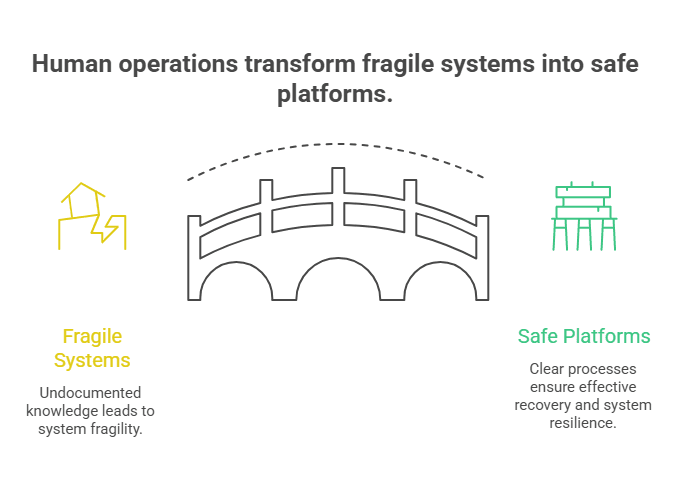
A platform does not fail safely just because the software has guardrails.
It fails safely when people can respond with clarity.
That includes:
- alerts that reflect business impact, not just infrastructure symptoms
- ownership boundaries that are obvious during an incident
- runbooks that match reality
- escalation paths that do not depend on tribal knowledge
- dashboards that help teams distinguish spread from containment
- recovery steps that can be executed under pressure
This is one reason “operational maturity” should not be treated as something separate from architecture. The human response layer is part of the design.
If recovery depends on one senior engineer remembering undocumented behavior at 2:00 a.m., the system is more fragile than it looks.
The real design question is not “How do we prevent failure?”
A better question is:
If this part of the system misbehaves tomorrow, what exactly happens next?
That question is usually more revealing than high-level resilience language.
It forces specificity.
What breaks immediately?
What degrades?
What remains trustworthy?
What becomes ambiguous?
What can be reversed?
What requires coordination across teams?
What becomes harder to recover after thirty minutes than after five?
Systems that fail dangerously usually hide those answers until production reveals them.
Systems that fail safely make those answers legible before the incident.
Questions worth asking in a modernization review
When evaluating an existing platform, these questions tend to surface the real problem faster than broad discussions about reliability:
Can one local defect create cross-system confusion?
If yes, the issue is not only correctness. It is containment.
Can we roll this back without making the data situation worse?
If no, the release model is carrying more risk than the team admits.
Do we know which workflows must stay correct even during degradation?
If not, the architecture may not reflect business criticality clearly enough.
Can we tell the difference between delay, loss, duplication, and corruption?
If not, observability is too shallow for safe operations.
Are there components nobody wants to touch because the failure path is unclear?
That usually signals hidden coupling or undocumented operational dependency.
Does a dependency outage create graceful degradation or organizational panic?
That difference is often a better measure of maturity than raw uptime.
Are we modernizing in a sequence that reduces risk, or just moving visible parts first?
This is where many programs become expensive without becoming safer.
##Safe failure is a design choice
Systems rarely become safer by accident.
They become safer when teams deliberately choose containment over convenience, reversibility over speed theatre, and operational clarity over architectural optimism.
That does not mean building for theoretical perfection.
It means respecting a simpler truth: in live systems, the biggest risk is often not failure itself. It is failure that spreads too far, stays hidden too long, or leaves the team with no clean way back.
Designing systems that can fail safely is not defensive engineering in the pejorative sense.
It is what responsible platform design looks like when uptime, data integrity, and business continuity actually matter.