
Enterprise pricing systems are rarely just calculation engines. They are operational control systems with downstream impact across revenue, margin, approvals, supplier relationships, and customer trust. This article explains why they become fragile over time and how to modernize them safely.
Many enterprise teams talk about pricing as if it were a rules engine problem.
In practice, pricing systems usually fail for a different reason.
They stop being only about price calculation and become a dense operational layer where contracts, approvals, exceptions, supplier changes, customer commitments, data dependencies, and internal workarounds all start living in the same place.
That is why pricing platforms often become fragile long before leadership fully recognizes the risk.
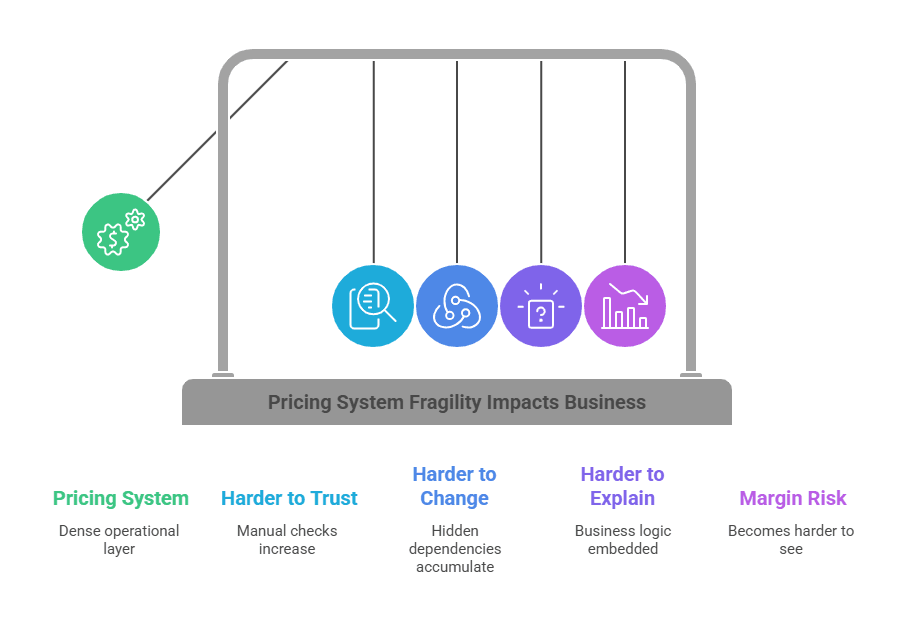
The failure usually does not begin with a dramatic outage. It begins when the system becomes harder to trust, harder to change, and harder to explain. Teams start compensating with manual checks. Approvals multiply. Edge cases get embedded into production behavior. Release confidence drops. Margin risk becomes harder to see clearly. What looked like “pricing logic” becomes a business-critical control surface with too many hidden dependencies.
The real question is not whether pricing should be modernized.
The real question is whether it can be modernized without breaking the operational controls the business depends on.
That distinction matters. In complex environments, pricing is rarely isolated. It sits close to catalog governance, supplier workflows, promotions, customer entitlements, rebate structures, approvals, ERP data, CRM expectations, and reporting assumptions. Changing it casually is one of the fastest ways to create downstream disruption that looks technical on the surface but is operational at its core.
This is also why many pricing modernization efforts go wrong. Teams treat the system like an old application that needs a better interface or a cleaner service layer. What they actually have is a mature control mechanism that has accumulated years of implicit business logic.
That kind of system cannot be improved safely through surface-level cleanup alone.
The Mistake Most Teams Make
The most common mistake is assuming that pricing fragility comes from old technology first.
Sometimes the stack is part of the problem. But in mature platforms, the deeper issue is usually structural.
Pricing systems break when the business keeps evolving but the control model underneath it does not. New commercial models appear. New supplier relationships are introduced. More customer-specific arrangements are layered in. Exception handling expands. Approval paths become more political. Integrations grow around legacy assumptions. Over time, the platform is asked to carry more nuance than it was ever designed to support.
So the visible symptoms start to appear.
Changes take too long.
Teams fear releases.
Data disputes increase.
Support escalations become harder to resolve.
Finance, operations, and engineering stop trusting the same system in the same way.
At that point, many teams make the problem worse by treating modernization as a technical rebuild. They try to replace the interface, replatform the codebase, or rebuild the rules layer without first understanding what the platform is actually doing as an operational system.
That approach usually creates one of two bad outcomes.
Either the project stalls because nobody can fully untangle the business behavior embedded in the old system.
Or it ships and quietly removes the controls the business depended on, creating pricing disputes, workflow confusion, approval gaps, or reporting drift.
A pricing system does not need to be old to be dangerous.
It only needs to be poorly governed.
Why Enterprise Pricing Systems Become Fragile
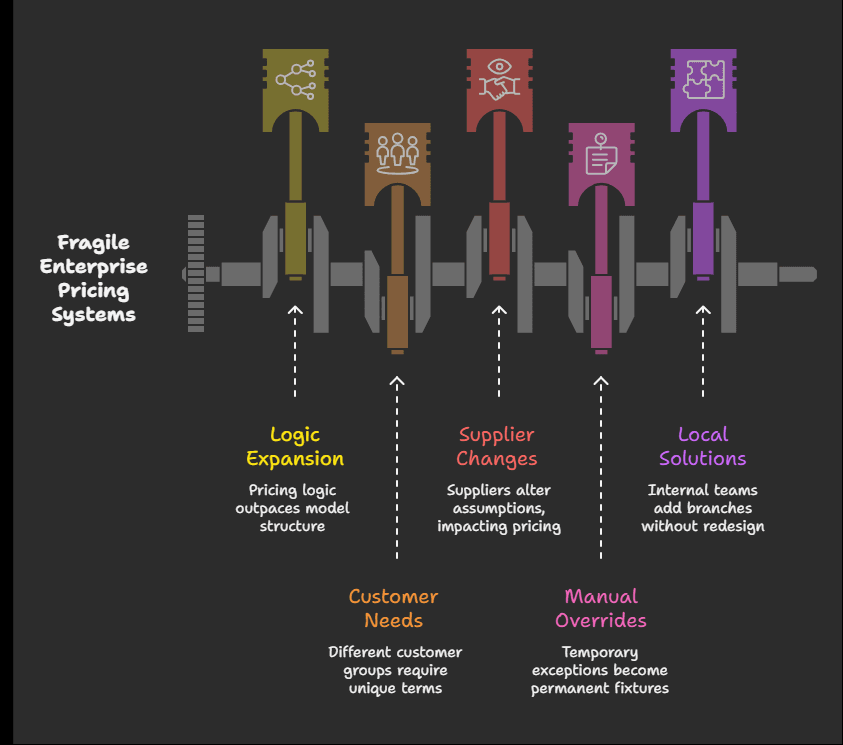
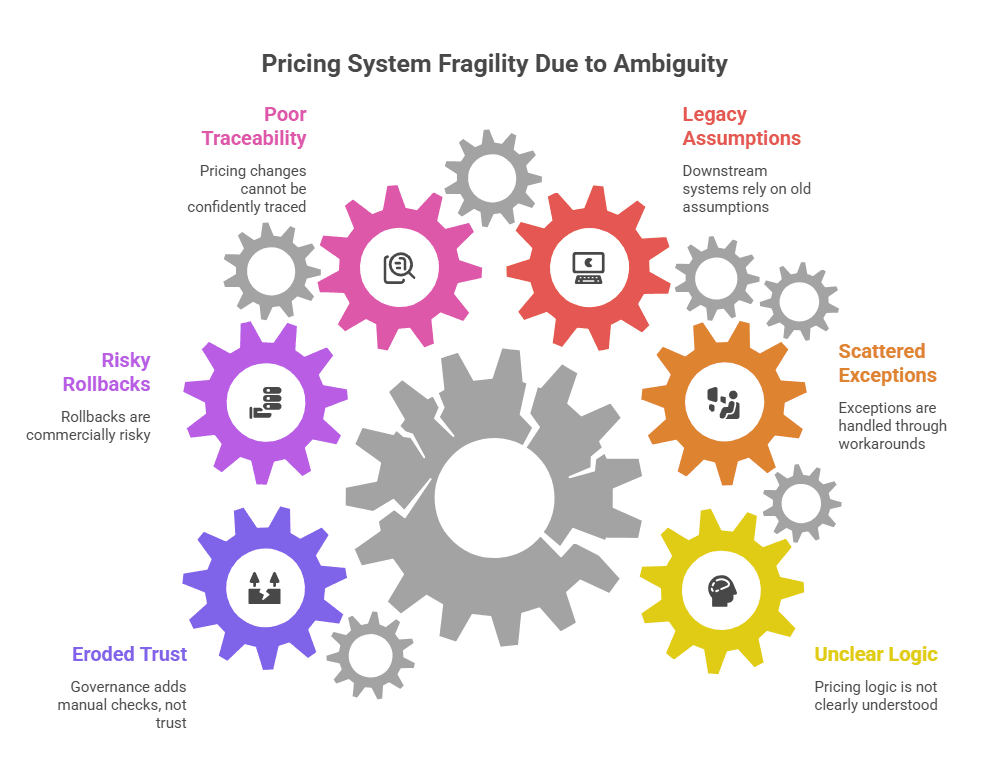
Pricing systems rarely collapse because of one flawed rule. They become unstable when multiple forms of drift accumulate together.
Pricing Logic Expands Faster Than the Model
Most pricing platforms start with a clean-enough structure. Base prices, discounts, tiers, maybe contract overrides.
Then reality arrives.
Different customer groups need different terms. Promotions need timing logic. Suppliers change assumptions. Temporary exceptions become semi-permanent. Manual overrides stay longer than expected. Internal teams add decision branches to solve local problems without redesigning the broader model.
Eventually, the system stops expressing a coherent pricing strategy and starts reflecting organizational history.
That is a dangerous transition because it means the platform is no longer easy to reason about. Even small changes can trigger unintended effects elsewhere.
A pricing system becomes fragile when the rules are technically stored, but conceptually unclear.
Enterprise systems do not usually fail because they lack the happy path.
They fail because the unhappy paths become too numerous, too implicit, and too operationally important.
A one-off supplier accommodation.
A customer-specific approval path.
A sales override process nobody wanted to harden properly.
A promotion workflow built around timing assumptions from years ago.
These exceptions often begin as practical solutions. Over time, they become the architecture people actually rely on.
That is when modernization gets risky. If those exception paths are poorly documented but operationally essential, rewriting the system without first isolating them can break business continuity even if the new platform looks cleaner.
Integrations Start Carrying Hidden Pricing Assumptions
Pricing rarely lives in one place.
It touches product catalogs, customer records, purchasing logic, invoicing, reporting, ERP data, discount feeds, and external partner processes. In some businesses, it also sits close to procurement, contract workflows, or member-facing portals.
That means pricing problems are often integration problems in disguise.
A field is interpreted differently across systems.
A timing mismatch causes stale values.
A downstream process assumes a rule that no longer exists.
An upstream source quietly changes shape and nobody notices until pricing behavior drifts.
When teams say pricing feels unreliable, they are often describing dependency opacity rather than calculation failure.
This is why enterprise integrations often have to be reviewed as part of pricing modernization, even when the original project request sounds like a rules or workflow problem.
Governance Becomes Process Theater
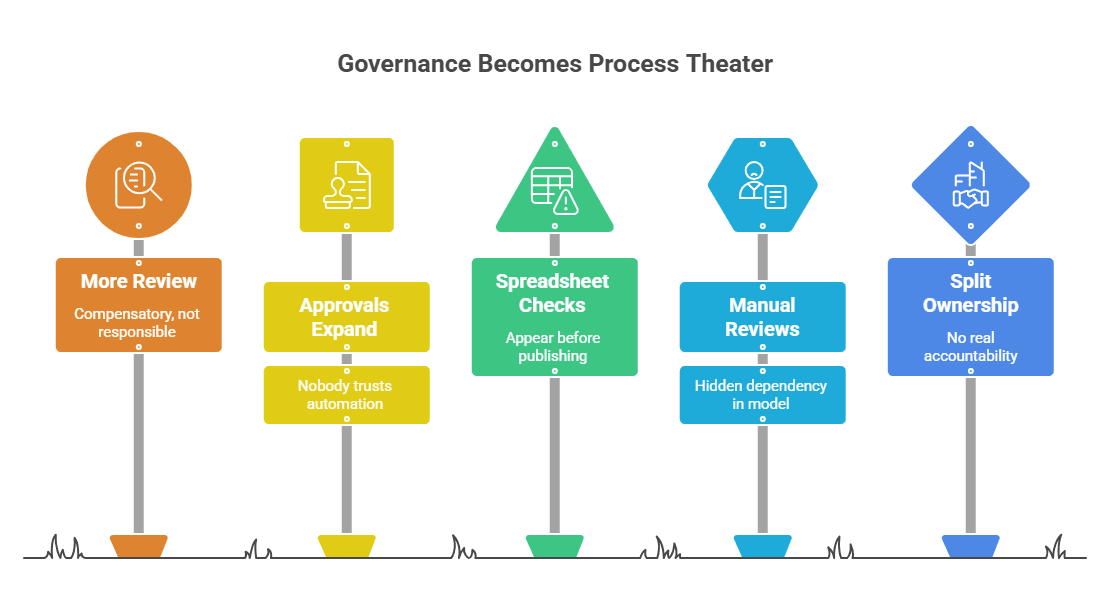
When confidence in the pricing platform starts to weaken, organizations usually respond by adding more review.
That sounds responsible. Often it is only compensatory.
Approvals expand because nobody trusts the automation.
Spreadsheet checks appear before publishing.
Manual reviews become a hidden dependency in the operating model.
Ownership gets split across departments without real accountability.
What results is not stronger governance. It is governance theater.
The system looks controlled from the outside, but the real control lives in human intervention, inbox routing, and institutional memory.
That is not resilient. It is merely familiar.
Not every enterprise system needs the same level of release caution.
Pricing systems usually do.
A flawed pricing release can affect revenue, supplier trust, margin accuracy, customer relationships, and internal support load almost immediately. Yet many teams still handle pricing changes with the same release assumptions they use elsewhere.
That mismatch is costly.
Pricing platforms need stronger validation, safer sequencing, clearer rollback logic, and better visibility into what changed and why. The more operationally sensitive the platform becomes, the less acceptable casual release practice becomes.
That is why release discipline in production systems matters so much here. In pricing environments, release discipline is not bureaucracy. It is commercial risk control.
What Safe Pricing Modernization Actually Looks Like
Safe modernization starts with a change in framing.
Do not begin by asking how to rebuild the system.
Begin by asking what the system is currently controlling.
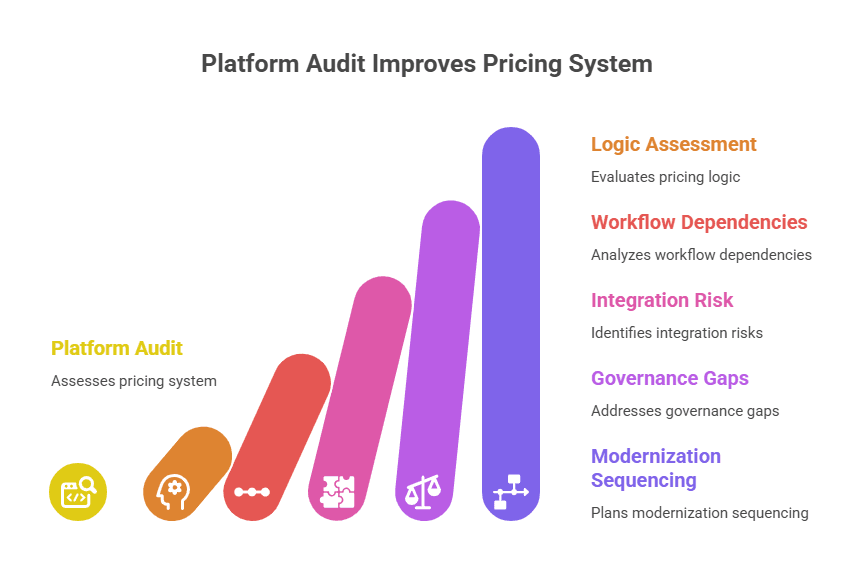
That usually includes more than teams first expect: commercial logic, approval paths, catalog governance, exception handling, external data dependencies, reporting assumptions, and informal human workarounds that have become part of day-to-day operations.
Until those are visible, modernization is guesswork.
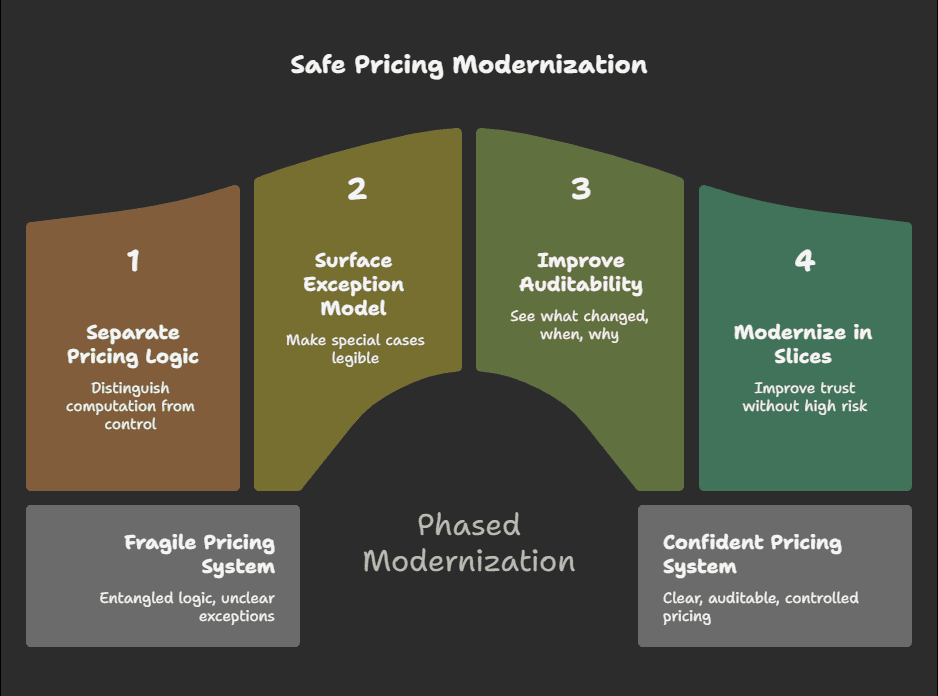
First, Separate Pricing Calculation from Pricing Control
Many mature pricing systems entangle core calculation logic with approval workflow, publishing decisions, data corrections, exception handling, and operational reconciliation.
That is a major source of fragility.
The safer path is to distinguish between:
- how a price is computed
- who can change it
- how exceptions are introduced
- how approvals are recorded
- how downstream systems consume it
- how disputes are investigated later
This separation does not require an immediate rewrite. Often it begins with dependency mapping, clearer ownership, and controlled boundaries around what the pricing engine should and should not do.
That is one reason legacy modernization works best when it is phased. Mature systems usually need structural clarification before large technical movement.
Then, Surface the Exception Model Explicitly
If the platform contains years of special-case behavior, the answer is not to pretend those exceptions should disappear overnight.
The answer is to make them legible.
Which exceptions are temporary?
Which are recurring?
Which are tied to commercial policy versus operational workaround?
Which create the most downstream risk?
Which no longer serve a valid business purpose?
This matters because not all complexity is equal.
Some complexity reflects real business needs. Some reflects unresolved design debt. Safe modernization depends on telling those apart before re-implementing anything.
Rebuild Trust Through Auditability, Not More Approval Layers
When pricing confidence is weak, many organizations add friction instead of clarity.
A better approach is to improve auditability.
Teams need to see what changed, when it changed, why it changed, who approved it, what data it depended on, and which downstream entities were affected. Without that, every pricing issue becomes a slow forensic exercise.
Strong auditability reduces operational anxiety because it makes the system easier to defend, troubleshoot, and improve.
This is especially important in governance-heavy environments such as distribution, buying groups, contract pricing, or other operational platforms where pricing changes can carry real downstream consequences. The lesson is similar to what we discussed in How Foodservice Buying Groups Can Modernize Price Governance Without Losing Control: modernization succeeds when control becomes clearer, not when the interface simply becomes newer.
Modernize in Slices That Preserve Operational Confidence
Large pricing rewrites are tempting because the existing system feels messy enough to justify a reset.
That instinct is understandable. It is also where many programs go off course.
A safer path usually modernizes in slices such as:
- pricing visibility and audit trails
- exception handling flows
- approval and publishing controls
- integration boundaries
- data quality checks
- rule-domain cleanup by product, customer group, or commercial model
This lets teams improve trust and reduce fragility without forcing the business to absorb one high-risk cutover.
It also creates room for evidence. Each phase can show whether clarity, control, and release confidence are actually improving.
That is far more valuable than a modernization plan that looks ambitious but cannot be defended once operational risk becomes visible.
Where This Breaks Most Often
Some environments are more vulnerable than others.
Pricing fragility tends to surface fastest where the business combines high operational dependence with a high rate of commercial change.
That includes:
- buying groups and distribution environments
- B2B commerce with customer-specific arrangements
- platforms with supplier-driven catalog changes
- contract-heavy pricing models
- systems with layered approvals and regional exceptions
- environments where pricing affects downstream service, fulfillment, or partner workflows
In those contexts, pricing is not just a commercial configuration problem.
It is a platform integrity problem.
That is why teams often benefit from stepping back and asking the same broader question we raise in What Should You Modernize First in a Live Production System?: what part of this system is generating the most operational risk right now, and what is the safest sequence for reducing it?
Sometimes that is not the calculation layer first.
- Sometimes it is approvals.
- Sometimes auditability.
- Sometimes data contracts.
- Sometimes publishing controls.
- Sometimes release process.
The right answer depends on where the business is currently compensating for lost trust.
A Practical Test for Engineering and Platform Leaders
If you are trying to assess whether your pricing system is becoming a modernization risk, these are the questions worth asking:
- Can we explain our pricing logic clearly, or only operate it through experience?
- Do exceptions live in a deliberate model, or in scattered process workarounds?
- Do downstream systems consume pricing through well-defined contracts, or through legacy assumptions?
- Can we trace pricing changes confidently, including approvals, data sources, and affected entities?
- Can we release pricing changes with rollback confidence, or does every change feel commercially risky?
- Has governance improved system trust, or simply added manual checking around a platform people no longer trust fully?
Those questions usually reveal more than a code review alone.
Because pricing risk is rarely just technical debt.
It is accumulated ambiguity inside a business-critical control system.
The Safer Way Forward
Enterprise pricing systems do not become fragile because the teams running them are careless.
They become fragile because the business keeps moving, and the platform absorbs that movement unevenly over time.
That is why safe remediation starts with understanding before replacement.
Before a team replatforms pricing, rewrites rules, or consolidates workflows, it needs clarity on what the system is actually doing, which controls matter most, where operational trust has already weakened, and what sequence of change the business can tolerate.
That work is slower than pretending the answer is a fresh build.
It is also far more likely to survive contact with reality.
The strongest pricing modernization programs are not the ones that promise the cleanest future-state architecture on paper.
They are the ones that reduce fragility while preserving operational confidence along the way.