
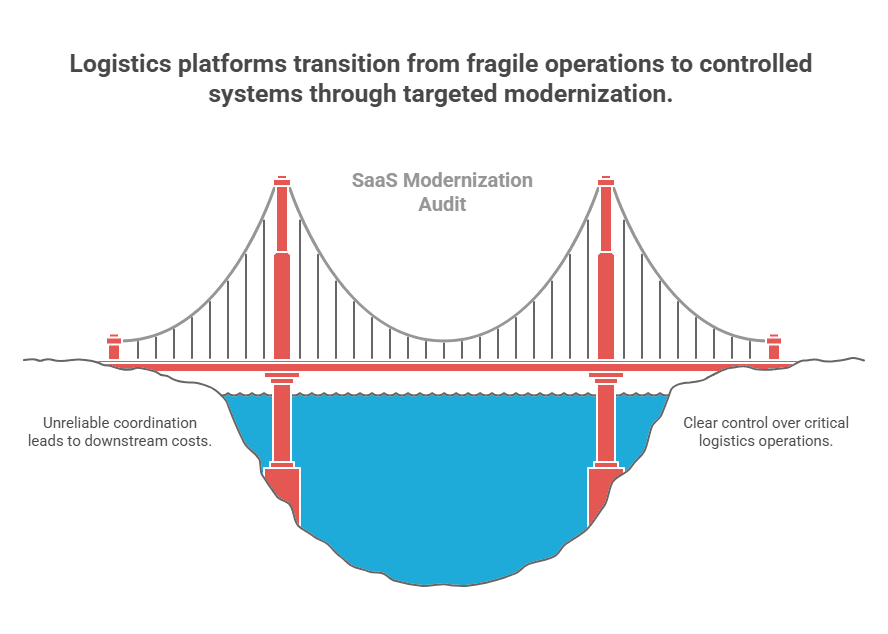
In logistics, modernization usually fails when teams focus on surface-level upgrades before fixing the operational layer underneath. The real leverage sits in workflow control, integration reliability, exception handling, auditability, and release discipline.
Logistics platforms rarely become difficult because the interface looks dated.
They become difficult because the operational layer underneath has grown fragile.
Orders move across multiple systems. Inventory states change in different places. Carrier events arrive late or out of sequence. Exceptions get handled in email, spreadsheets, chat, and admin screens that were never designed to carry that much responsibility. Over time, the platform starts to look like a software problem, when it is really an operational coordination problem.
That distinction matters.
For logistics businesses running live production systems, modernization should not begin with a broad rewrite program or a cosmetic overhaul. It should begin with a more practical question: where does operational risk actually sit today, and which parts of the platform are carrying the most downstream cost?
That is the same logic behind a disciplined SaaS modernization & cloud readiness audit and the broader work of enterprise SaaS modernization. The goal is not movement for its own sake. The goal is clearer control over a system that already matters.
The Mistake Most Teams Make
A common mistake in logistics modernization is to treat the platform as if the main issue is age.
It usually is not.
The real issue is often that the platform has become the meeting point for too many operational dependencies without enough structural clarity. Warehouse workflows depend on legacy database assumptions. Shipment visibility depends on brittle third-party event feeds. Customer service relies on status fields that mean different things in different systems. Dispatch teams work around missing logic with manual overrides. Finance depends on exports because the operational platform cannot express the right business state cleanly.
In that environment, replacing screens does not remove complexity. It often hides it for a while.
This is why logistics modernization needs to be approached more like legacy system modernization than a greenfield rebuild. The question is not how to replace everything quickly. The question is how to reduce fragility without interrupting live operations.
In logistics, the most expensive platform failures are usually not visible at the UI layer first. They appear as timing errors, coordination gaps, exception drift, and operational workarounds.
Where Modernization Usually Matters First
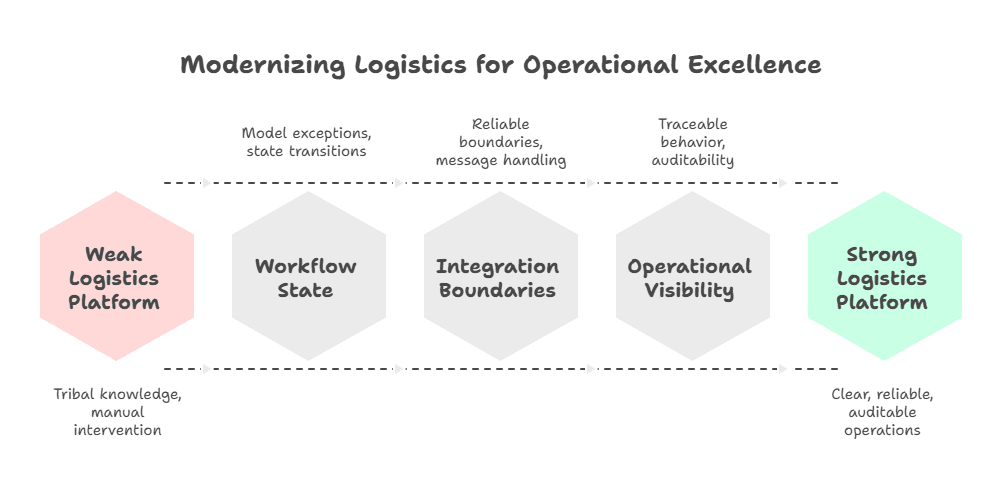
1. Workflow state and exception handling
In logistics platforms, the most important logic is often not the happy path. It is the exception path.
A system may process standard orders reasonably well and still be operationally weak because it breaks down when inventory changes mid-flow, a carrier scan is missed, a shipment is partially fulfilled, a warehouse handoff fails, or a customer change arrives after downstream steps have already started.
That is where modernization often creates the most value.
If the current platform cannot model operational state clearly, teams compensate with tribal knowledge and manual intervention. That creates latency, inconsistency, and avoidable escalation pressure. A more modern stack does not fix that by itself. What helps is reworking the workflow model so that state transitions, exception paths, ownership boundaries, and rollback behavior become clearer.
This is also where how Duskbyte works matters more than technology branding. In live systems, operational clarity is worth more than architectural theatre.
2. Integration boundaries and data contracts
Most logistics platforms are integration-heavy by default.
They sit between ERPs, WMS platforms, TMS tools, carrier APIs, customer portals, EDI flows, reporting layers, procurement systems, and finance systems. Over time, those connections tend to accumulate inconsistent assumptions. Status names drift. Field mappings become fragile. Retry behavior is undocumented. Failures get swallowed. Support teams become the real integration layer.
This is one of the clearest places where modernization actually matters.
If the platform cannot expose reliable boundaries between systems, every change becomes risky. Delivery slows down. Testing becomes political. Production incidents become harder to diagnose because nobody is fully sure which system owns which truth.
That is why logistics modernization often needs to focus first on integration reliability, message handling, reconciliation flows, and event observability before larger platform changes. In many environments, that work sits closer to automation, integrations, and applied AI in production systems than to a classic “replatforming” story.
3. Operational visibility and auditability
A surprising number of logistics platforms remain weak at the point where leadership needs answers.
What happened?
Why did it happen?
Who changed it?
Which system originated the event?
Was this an exception, a retry, a manual override, or a true platform failure?
When those questions cannot be answered quickly, the problem is not only technical. It becomes managerial. Operations loses confidence. Support teams work from fragments. Engineering spends too much time reconstructing platform behavior after the fact.
This is why auditability is not a compliance-only concern. It is an operating requirement.
The same pattern shows up in distribution environments where pricing, supplier workflows, and multi-party coordination must remain traceable under real operational pressure. The point is not the specific vertical. The point is that once a platform sits inside live commercial operations, structured visibility becomes part of stability.
That is one reason engineering practices matter so much in modernization work. Mature systems do not become safer just because the code is newer. They become safer when behavior is easier to observe, explain, and control.
A Better Way to Start
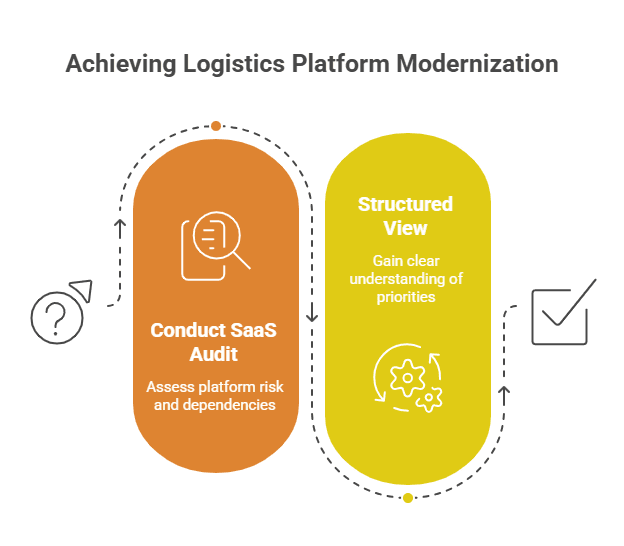
If your logistics platform is carrying operational complexity, the first modernization decision should not be “What should we rebuild?”
It should be:
Which workflows create the most operational drag, where are the most dangerous dependencies, and what can be improved without increasing blast radius?
That is usually the beginning of a more credible roadmap.
A focused assessment can separate:
- workflow bottlenecks from architectural bottlenecks
- integration fragility from core platform limitations
- true modernization priorities from expensive distractions
- what should happen now from what should wait
That is the kind of sequencing a phased, risk-first approach is designed to support.
What Usually Matters Less Than Teams Think
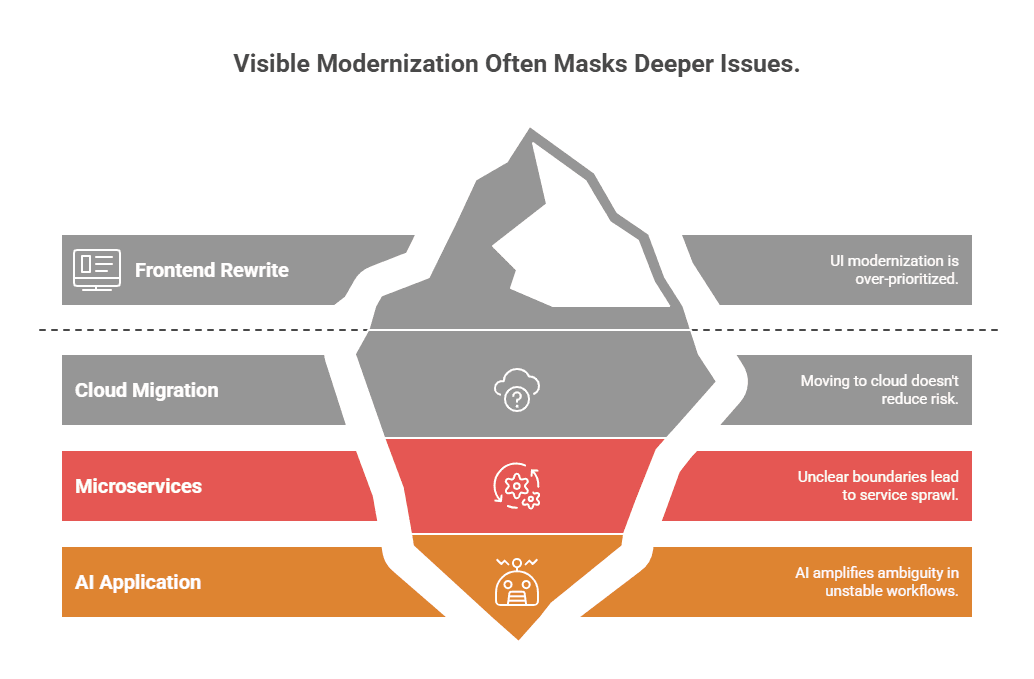
A frontend rewrite
In some cases, the frontend genuinely does need work. But in logistics environments, UI modernization often gets over-prioritized because it is visible.
Visibility is not the same as leverage.
If the operational model underneath is unclear, a better interface can make the system easier to use while leaving the costly parts untouched. That can still be worthwhile, but it should not be confused with structural modernization.
Cloud migration by itself
Moving a fragile logistics platform to the cloud does not automatically reduce operational risk.
If the system still has tight coupling, weak release controls, unclear dependencies, and limited observability, migration can preserve the same problems in a different environment. Sometimes it makes them more expensive and harder to reason about.
That is why AWS SaaS cloud migration should be treated as a sequencing decision, not an automatic first move.
Microservices as a default answer
A logistics platform with unclear boundaries does not become healthier just because the architecture diagram becomes more distributed.
In the wrong environment, service sprawl simply moves ambiguity from one codebase into several. If ownership, contracts, and operational responsibility are already weak, fragmentation can worsen the problem.
The right unit of modernization is not “how do we break this into more services?” It is “which responsibilities need cleaner boundaries so that the platform becomes safer to change?”
AI on top of unstable workflows
AI can be useful in logistics environments, especially around classification, support workflows, anomaly triage, document handling, and decision support.
But it should not be asked to compensate for missing process discipline.
If base workflows are inconsistent, operational data is noisy, and exception handling is poorly defined, AI usually amplifies ambiguity instead of reducing it. Applied well, it extends a controlled system. Applied too early, it adds another layer of risk.
What Strong Logistics Modernization Usually Looks Like
The strongest logistics modernization programs are rarely dramatic.
They usually look like:
- clearer workflow states
- better exception handling
- stronger ownership boundaries between systems
- more reliable integrations
- improved audit trails
- safer release practices
- targeted modernization around the parts of the platform that carry real operational weight
That is also why Duskbyte’s industries we serve and work across e-commerce and distribution platforms are useful context here. The recurring pattern is not “logistics needs more software.” It is that operational platforms break where process complexity, data movement, and system coordination have been allowed to drift too far without structural control.
You can see a version of that pattern in the Pricing-Hub case study, where operational flow, integration handling, pricing control, and auditability mattered more than surface-level feature work.
Questions Worth Asking Before You Modernize
Before committing to a logistics modernization program, leadership should be able to answer a few basic questions:
- Which workflows create the most manual exception handling today?
- Where do status definitions change meaning across systems?
- Which integrations are operationally critical but poorly observed?
- Where does the business rely on exports, spreadsheets, or manual reconciliation to keep work moving?
- Which changes would reduce day-to-day operational risk without requiring a full platform reset?
Those questions usually lead to better decisions than broad transformation language ever will.
The Real Goal
Operational platforms in logistics do not need modernization because they are old.
They need modernization because they are carrying coordination responsibilities that have outgrown the structure beneath them.
That is where the real work is.
Not in making the platform look newer.
Not in migrating for appearances.
Not in introducing more components than the team can safely operate.
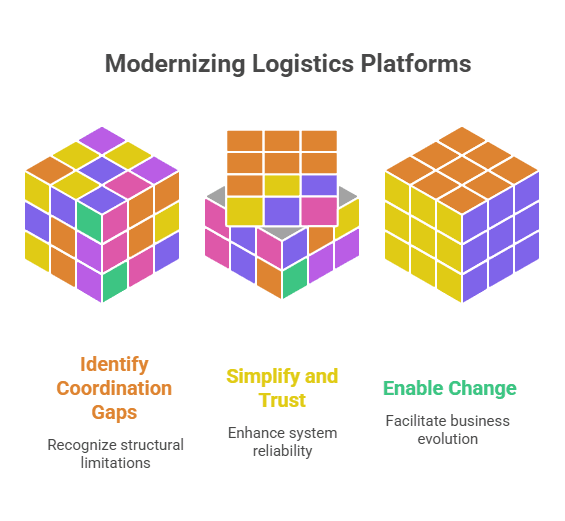
The real goal is to make the system easier to trust, easier to change, and less likely to create operational cost every time the business needs it to evolve.