
Real estate and appraisal workflows are not simple SaaS use cases. They involve messy property data, valuation logic, document-heavy processes, operational exceptions, and trust-sensitive decisions. SaaS platforms in this space need to be designed and modernized around data integrity, workflow clarity, auditability, and controlled change.
Real estate and appraisal platforms are often described as portals, workflow tools, valuation systems, document platforms, or customer-facing SaaS products.
That description is accurate, but incomplete.
In practice, a mature real estate or appraisal platform becomes a coordination layer between records, people, evidence, decisions, deadlines, documents, and operational judgment.
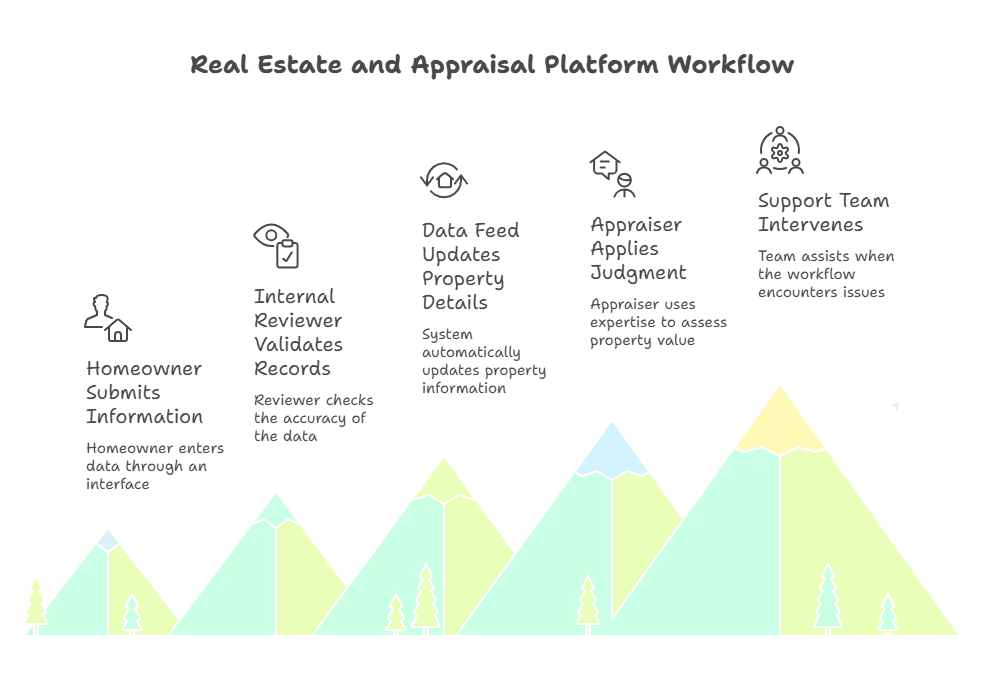
A homeowner may submit information through one interface.
An internal reviewer may validate records through another.
A data feed may update property details overnight.
An appraiser or analyst may apply judgment based on comparable properties.
A support or operations team may need to intervene when the workflow does not follow the happy path.
That is why building or modernizing SaaS platforms for this category requires more than clean screens and basic CRUD logic.
It requires a serious platform view.
For teams operating in real estate, appraisal, valuation, protest, review, or PropTech workflows, the most important question is not only, “Can the system process the workflow?”
The better question is:
Can the platform preserve trust when the workflow becomes messy?
That distinction matters. It is also why real estate and appraisal platforms fit naturally into Duskbyte’s work around Real Estate / Appraisal / PropTech Platforms, where the challenge is usually not just product delivery, but controlled platform evolution under real operational constraints.
The Mistake Most Teams Make
The common mistake is treating real estate and appraisal SaaS as a feature-delivery problem.
The team starts with a list of product requirements:
- intake forms
- user accounts
- property search
- document upload
- status tracking
- admin dashboards
- notifications
- valuation fields
- reporting
- payment or submission flows
- integrations with external data sources
Those features matter. But they are not the whole system.
The deeper risk is that each feature depends on assumptions about data quality, workflow ownership, record history, exception handling, and operational accountability.
A document upload feature is simple until multiple versions exist.
A valuation field is simple until the underlying comparable data changes.
A property record is simple until duplicate identifiers appear across sources.
A workflow status is simple until an admin override changes the expected path.
A portal is simple until customers, reviewers, support teams, and external systems all need different views of the same case.
This is why real estate and appraisal SaaS platforms should be treated as operational platforms, not just application interfaces.
A mature platform must make it clear what happened, who changed what, which data was trusted, which decision was made, and whether the workflow can be defended later.
That is the difference between software that looks complete and software that can support real appraisal operations.
Why These Workflows Are Platform-Sensitive
Real estate and appraisal workflows carry a specific kind of complexity.
They are data-heavy, document-heavy, exception-heavy, and often deadline-sensitive. They also depend on trust. Users need to believe that property records, valuation inputs, supporting documents, and workflow outcomes are accurate enough to act on.
That makes these platforms sensitive in several areas.
1. Property Data Integrity Comes First
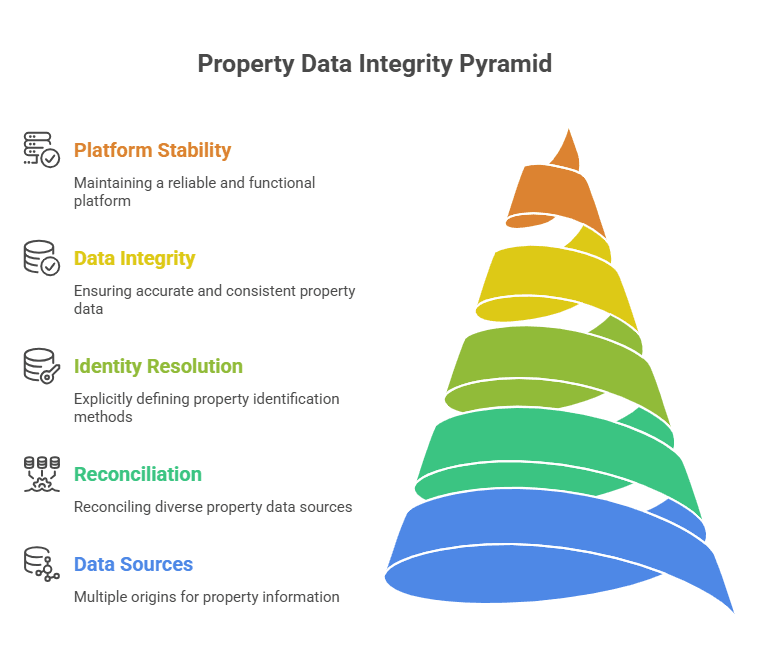
Real estate platforms often depend on multiple sources of truth.
A single property may be represented through:
- parcel records
- MLS identifiers
- assessor data
- address strings
- owner records
- tax records
- valuation history
- internal platform IDs
- third-party data feeds
- manually corrected records
The technical issue is not simply storing this data. The issue is reconciling it.
When property identity is handled poorly, the platform can create duplicate records, merge unrelated properties, break historical lineage, or show inconsistent information to different users.
That kind of damage is difficult to detect and expensive to unwind.
This is one reason modernizing real estate and PropTech platforms without disrupting data integrity deserves its own modernization discipline. In these systems, the database is not just storage. It is part of the operational record.
A strong SaaS platform should make identity resolution explicit:
- What identifies a property?
- Which identifiers are authoritative?
- Which fields can be overwritten?
- Which changes must be preserved historically?
- Which external source wins when data conflicts?
- How are duplicates detected and resolved?
- Can the team trace why a property record changed?
Without those answers, even a modern interface can sit on top of fragile data.
2. Workflow State Must Be More Than a Status Field
Appraisal and real estate workflows rarely move in a straight line.
A case may be submitted, reviewed, paused, reopened, assigned, escalated, rejected, corrected, approved, or appealed. Documents may be missing. Data may be incomplete. A reviewer may need to override a normal step. A user may submit information late. An external feed may update a relevant field after the workflow has already started.
If the platform treats workflow state as a simple status dropdown, the system eventually becomes unclear.
The operational team may not know who owns the next action.
The user may not understand why a case is delayed.
Reports may show misleading progress.
Automation may trigger too early or too late.
Support teams may rely on informal knowledge rather than system clarity.
A better platform treats workflow state as a controlled model.
That means designing around:
- ownership
- next required action
- blocked reasons
- decision history
- required evidence
- manual overrides
- role permissions
- review checkpoints
- escalation paths
- timestamps and accountability
This is where enterprise SaaS modernization becomes highly practical. The goal is not to make the workflow more complex. The goal is to make real operational complexity visible, traceable, and safer to manage.
3. Document Handling Needs Audit-Level Discipline
Real estate and appraisal workflows often depend on documents.
That may include property evidence, photos, forms, review packets, legal records, correspondence, valuation support, approval material, or internally generated summaries.
Document handling becomes risky when the platform cannot clearly answer:
- Which document is the latest version?
- Who uploaded it?
- Was it replaced, rejected, or corrected?
- Which workflow decision depended on it?
- Can the original version still be retrieved?
- Is access controlled by user role and case ownership?
- Are sensitive documents protected appropriately?
- Can the document trail be explained later?
Many platforms start with basic upload functionality and later discover that uploads are part of the evidence model.
That changes the design standard.
A mature platform needs versioning, metadata, access control, retention logic, and clear links between documents and workflow decisions. Without that, document handling becomes operationally fragile even if the upload feature technically works.
For appraisal workflows in particular, document integrity often affects user trust, internal review quality, and the ability to explain decisions after the fact.
4. Admin Operations Are Not Secondary
Many real estate SaaS products focus heavily on the customer-facing experience.
That is understandable. The user portal is visible. It affects conversion, completion, and user satisfaction.
But in appraisal and property workflows, the admin side often determines whether the platform can operate at scale.
The internal team needs to manage queues, assign work, review exceptions, batch similar cases, surface bottlenecks, correct records, monitor deadlines, and identify workflows at risk.
If the admin experience is weak, the platform quietly becomes dependent on spreadsheets, manual tracking, Slack messages, email threads, and undocumented workarounds.
That creates operational risk.
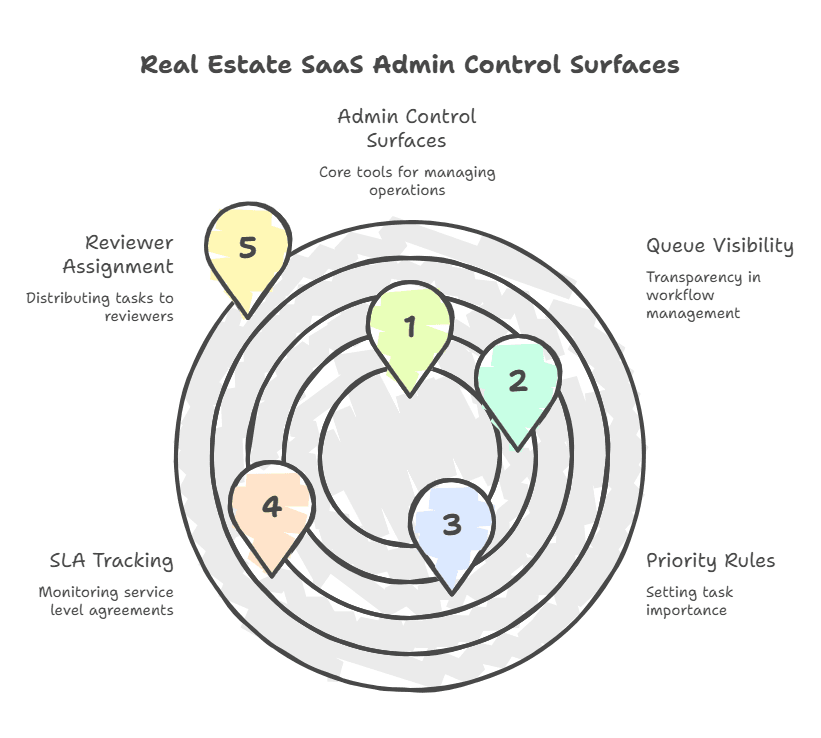
A serious appraisal platform should provide administrative control surfaces, not just admin screens.
Those control surfaces may include:
- queue visibility
- priority rules
- SLA tracking
- reviewer assignment
- exception categories
- bulk actions with guardrails
- bottleneck reporting
- document review states
- case history
- audit logs
- operational analytics
This is where Duskbyte’s broader enterprise software development for live systems framing matters. These systems are not brochure applications. They support daily work, real users, sensitive records, and operational accountability.
5. Integrations Can Become the Highest-Risk Layer
Real estate platforms frequently depend on external systems.
These may include MLS, IDX, RESO, assessor data, mapping services, payment providers, CRM systems, document services, notification providers, analytics tools, or internal operational systems.
The integration layer often starts simple. A feed is added. An API is connected. A sync job runs on a schedule.
Over time, those integrations become part of the platform’s operational truth.
That is when risk increases.
External systems change formats.
Feeds arrive late.
Records conflict.
APIs throttle requests.
Mapping logic fails on edge cases.
Retries create duplicates.
Partial failures go unnoticed.
Downstream reports rely on stale data.
This is why integrations break more systems than core code in many mature platforms. The failure does not always come from the main application. It often comes from weak boundaries, unclear contracts, poor retry behavior, and limited observability around data movement.
A strong SaaS platform should design integrations with operational control:
- clear data contracts
- validation rules
- idempotent sync behavior
- retry visibility
- failure queues
- reconciliation reports
- source-level timestamps
- monitoring and alerting
- manual recovery paths
- ownership for each dependency
In real estate and appraisal workflows, integration quality directly affects record trust.
6. Peak-Season Behavior Must Be Designed In
Many appraisal and real estate workflows are not evenly distributed throughout the year.
There may be seasonal filing periods, appeal deadlines, valuation cycles, market activity spikes, campaign windows, customer communication bursts, or internal review backlogs.
A platform that performs acceptably in normal conditions may fail under peak load.
Common problems include:
- slow property search
- delayed document processing
- queue backlogs
- failed notifications
- timeout-heavy admin screens
- blocked batch operations
- degraded third-party integrations
- support volume spikes
- unclear operational prioritization
Peak-season reliability is not only an infrastructure problem. It is also a workflow and architecture problem.
The platform needs to support the way work behaves under pressure.
That may require:
- asynchronous processing
- queue-based workloads
- caching strategies
- search optimization
- background job observability
- rate-limit handling
- batch review tooling
- graceful degradation
- operational dashboards
- rollback-safe releases
This is also where SaaS cloud migration should be approached carefully. Moving infrastructure to the cloud can help, but cloud migration alone does not fix weak workflows, poor data models, or fragile integration behavior.
Cloud is useful when the platform is ready to benefit from it.
It is risky when it simply relocates existing instability.
7. Appraisal Logic Needs Explainability
Appraisal and valuation workflows often involve judgment.
Even when the platform uses formulas, rules, comparable properties, scoring, or automation, the business still needs to understand how the output was produced.
That makes explainability important.
A SaaS platform should avoid turning valuation logic into an opaque calculation buried inside application code.
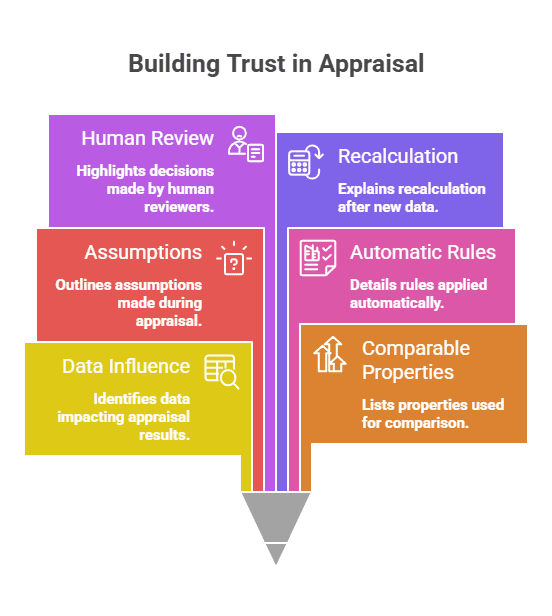
Instead, teams should be able to answer:
- What data influenced the result?
- Which comparable properties were used?
- Which assumptions were applied?
- Which rules were automatic?
- Which decisions involved human review?
- Was the output recalculated after new data arrived?
- Can the platform explain the result to an internal reviewer?
- Can the platform preserve prior calculations for historical comparison?
This matters even more when automation or AI is introduced.
Automation can improve throughput, but it can also amplify weak data, inconsistent rules, or unclear ownership. Duskbyte’s approach to Automation, Integrations & Applied AI is especially relevant here because AI and automation should be introduced only where reliability, data quality, monitoring, and fallback paths are strong enough to support them.
For appraisal workflows, automation should support judgment, not hide it.
8. Security and Role Boundaries Must Match the Workflow
Real estate and appraisal platforms often involve multiple user types.
There may be homeowners, agents, appraisers, reviewers, admins, support teams, managers, external partners, and internal operators.
Each role needs access to different information and actions.
Weak role design creates two kinds of risk.
The first is security risk: users may see records, documents, or actions they should not access.
The second is workflow risk: users may be able to move a case, alter a document, change a valuation input, or override a decision without proper authority.
A mature SaaS platform should design access around operational reality:
- role-based permissions
- case-level access control
- document-level access rules
- administrative override controls
- approval permissions
- audit logs for sensitive actions
- separation of duties where needed
- secure authentication and session management
Security should not be treated as a final layer added after feature delivery. In appraisal and real estate workflows, permissions are part of the workflow model.
9. Legacy Systems Should Be Modernized Incrementally
Many real estate and appraisal platforms were built under earlier constraints.
The initial version may have been designed for a narrower workflow, smaller user base, simpler data model, or lower operational volume. Over time, new features, integrations, reports, admin tools, and exception logic were added.
Eventually, the platform works, but it becomes harder to change safely.
That is usually when leadership starts considering modernization.
The risk is assuming the answer is a rewrite.
Full rewrites are especially dangerous in appraisal workflows because much of the platform’s value lives in accumulated operational behavior: data corrections, edge cases, status rules, document conventions, admin workarounds, reporting expectations, and integration assumptions.
A safer path is usually incremental modernization.
That may include:
- stabilizing the existing platform first
- mapping workflows and dependencies
- isolating risky modules
- improving test coverage around critical paths
- introducing clearer service boundaries
- modernizing the data model in phases
- improving deployment and rollback practices
- replacing fragile components gradually
- keeping old and new paths compatible during transition
This aligns with Duskbyte’s approach to Legacy SaaS Modernization: reduce risk, preserve continuity, and improve the platform without forcing a big-bang replacement.
10. Reporting Should Reflect Operational Reality
Real estate and appraisal teams need reporting, but reporting becomes misleading when the underlying workflow model is weak.
A dashboard may show case counts, completion rates, user submissions, review timelines, document status, or valuation outcomes. But if workflow states are unclear, documents are not versioned properly, or data reconciliation is inconsistent, reporting becomes a polished view of unreliable behavior.
Useful reporting depends on trustworthy events.
That means the platform should capture:
- status changes
- user actions
- admin actions
- document events
- assignment changes
- valuation updates
- integration sync results
- review decisions
- exception reasons
- timing between workflow stages
This makes reporting more than analytics. It becomes operational intelligence.
It helps leadership understand where work is stuck, where data quality is weak, where automation may help, and where the platform needs modernization.
What Better Platform Design Looks Like
A stronger real estate or appraisal SaaS platform is not necessarily more complex.
It is more explicit.
It defines what the system believes to be true.
It preserves how that truth changed over time.
It shows who acted, when, and why.
It treats documents as evidence, not attachments.
It makes workflow ownership visible.
It contains integration failure instead of letting it spread.
It supports automation only where the surrounding system is ready.
It modernizes in phases rather than betting the business on a rewrite.
This is the difference between a platform that merely supports real estate workflows and a platform that can be trusted under operational pressure.
Duskbyte’s How We Work model is built around this kind of sequencing: assessment first, stabilization before acceleration, and phased change where the system’s constraints are understood before major implementation begins.
Practical Evaluation Questions for CTOs and Platform Leaders
Before expanding, modernizing, or migrating a real estate or appraisal platform, leadership should ask a few disciplined questions.
Data Integrity
- Which property identifiers are authoritative?
- Where do duplicates or false matches currently appear?
- Can the platform trace record changes over time?
- Which external sources can overwrite internal data?
- Can users and admins trust the same version of a record?
Workflow Control
- Are workflow states explicit and meaningful?
- Can the team see who owns the next action?
- Are blocked cases visible?
- Are manual overrides controlled and logged?
- Are escalation paths designed or informal?
Document Management
- Is document versioning clear?
- Are documents linked to decisions and workflow stages?
- Can access be controlled at the right level?
- Can the platform explain which document supported which decision?
Integrations
- Which external systems are critical to operations?
- What happens when a feed fails or arrives late?
- Are retries safe?
- Can failed syncs be reconciled?
- Is integration ownership clear?
Modernization Readiness
- Which parts of the platform are too risky to change casually?
- What should be stabilized before new features are added?
- Which workflows could be isolated first?
- Where would cloud migration help, and where would it simply move existing fragility?
- What needs to be true before automation or AI can be trusted?
These questions are more useful than starting with a preferred technology stack.
They help teams understand the platform as it actually operates.
Closing Thought
Real estate and appraisal SaaS platforms are trust systems.
They manage records, documents, decisions, deadlines, and operational evidence. They serve users who need clarity and internal teams who need control. They often depend on imperfect external data and workflows that do not always follow a clean path.
That is why modernization in this space should not begin with a rewrite mindset.
It should begin with platform understanding.
The strongest platforms in this category are not the ones with the most features. They are the ones that can preserve data integrity, support operational judgment, handle exceptions, and evolve without making the business less confident in its own records.
For mature real estate and appraisal workflows, that is the real platform consideration.
Not just what the software can do.
What the business can safely trust it to do.