
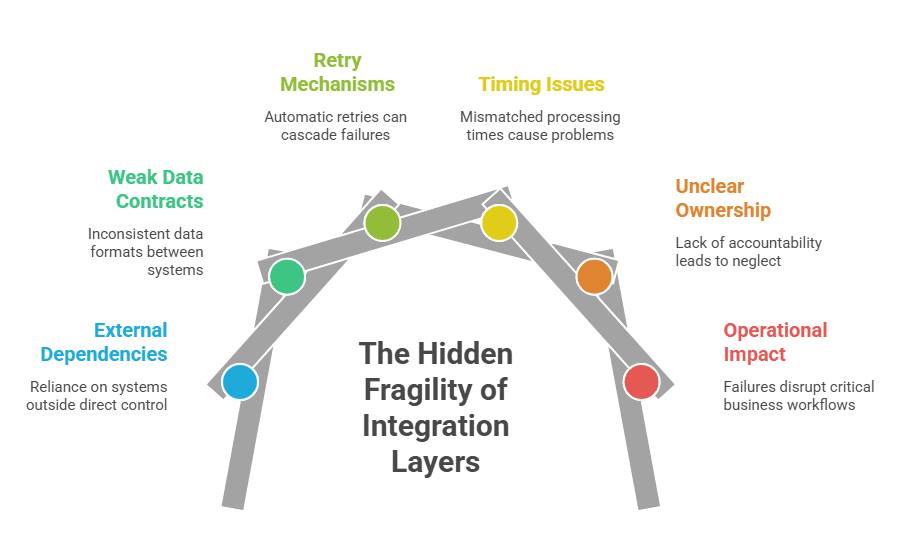
Many platform failures are blamed on core code, but the real fragility often lives in the integration layer. External dependencies, weak data contracts, retries, timing issues, and unclear ownership can turn small changes into broad operational failures. This article explains why integrations create outsized risk in mature systems and what safer modernization looks like.
When enterprise platforms begin to fail under pressure, teams usually look first at the application itself.
The monolith feels too old.
The services feel too coupled.
The framework feels outdated.
The codebase feels difficult to reason about.
Sometimes that diagnosis is correct.
But in many mature systems, the more dangerous fragility sits elsewhere.
It sits in the integration layer.
That is where internal assumptions meet external dependencies. It is where architecture decisions meet operational reality. And it is often where one team’s “small change” becomes another team’s production incident.
This is one reason enterprise SaaS modernization has to be treated as a dependency and risk problem, not simply a code-quality problem. In live systems, core code is only part of the failure surface. The integration layer is often where instability spreads fastest.
The Mistake Most Teams Make
Many teams still treat integrations as secondary work.
Core product logic feels strategic.
Integrations feel peripheral.
One gets architectural attention.
The other gets implemented as something that “works for now.”
That is usually backwards.
In mature platforms, integrations are rarely just technical plumbing. They often carry operationally critical workflows such as customer data movement, billing events, supplier synchronization, reporting pipelines, partner APIs, communication triggers, and administrative handoffs.
Once a business begins to rely on those flows, the integration layer is no longer a supporting detail. It becomes part of the platform’s operating model.
That is why Duskbyte’s modernization approach puts such strong emphasis on sequencing, dependency clarity, and controlled change. If the real fragility lives in the integration layer, improving core code alone will not restore control. In some cases, it can make the boundary conditions harder to manage.
Why Integrations Create More Operational Risk
Core code usually lives inside a boundary your team can inspect, test, and change deliberately.
Integrations do not.
They sit across system boundaries, ownership boundaries, timing boundaries, and often commercial boundaries. That alone changes the risk profile.
Below are the patterns that explain why integrations break more systems than core code.
1. They Depend on Behavior You Do Not Control
Your internal application may be stable. External systems rarely behave with the same consistency.
A vendor changes an API response format.
A webhook starts arriving out of order.
A third-party service introduces undocumented rate limits.
A partner retries more aggressively than expected.
A downstream system changes validation rules without understanding upstream assumptions.
None of these failures require a dramatic bug in your core application. They only require one side of the boundary to behave differently than the other side expects.
That makes integrations inherently more fragile than code you control directly.
2. Integration Failures Rarely Stay Isolated
A defect in core logic may affect one part of the application.
A defect in an integration often affects an entire business process.
An order sync issue becomes a fulfillment delay.
A pricing import problem becomes margin exposure.
A billing mismatch becomes finance reconciliation work.
A customer communications failure becomes a trust issue.
A supplier data inconsistency becomes operational confusion across teams.
This is where integration risk becomes broader than software behavior. It begins to shape business operations.
That is also why how Duskbyte works is built around assessment, structured recommendations, and controlled execution rather than fast implementation for its own sake. In integration-heavy systems, the important question is not only whether the code runs. It is whether the operating workflow remains trustworthy when the boundary becomes unstable.
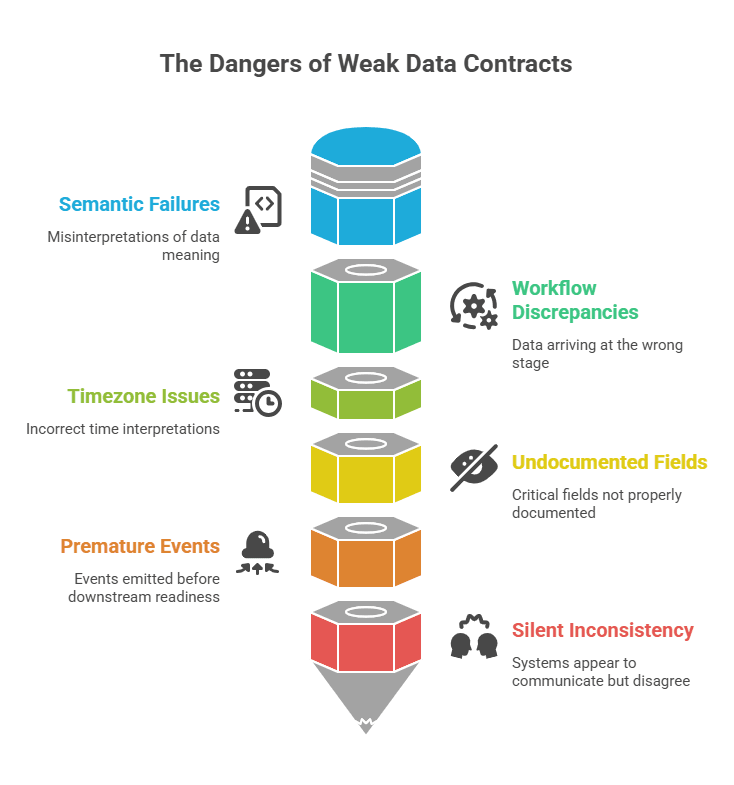
3. Data Contracts Are Often Weaker Than They Appear
Most integration failures are not obvious protocol failures.
They are semantic failures.
A field still exists, but it no longer means the same thing.
A status value is technically valid, but now arrives at a different point in the workflow.
A timestamp is present, but its timezone assumption changed.
A nullable field becomes business-critical without being documented that way.
A “completed” event gets emitted before the downstream system is actually ready.
These failures are particularly dangerous because the systems still appear to be communicating. Traffic flows. Payloads arrive. Logs show activity.
But the systems are no longer agreeing.
That kind of drift is common in mature platforms because integrations accumulate over time without a strong contract discipline. The result is not always a visible outage. Often it is silent inconsistency.
4. Timing, Retries, and Queues Introduce Hidden Failure Modes
Core code is often reviewed function by function.
Integration behavior is temporal.
What happens when the partner system is slow?
What happens when the same event arrives twice?
What happens when messages are delayed or replayed?
What happens when one side succeeds and the other times out?
What happens when a process must be resumed manually halfway through?
These are not edge cases in enterprise environments. They are normal operating conditions.
And this is one reason the integration layer causes so much downstream instability. It does not only fail. It fails in ways that leave duplication, stale data, partial completion, manual intervention, and recovery complexity behind it.
Integrations do not simply break. They create operational residue.
5. Manual Workarounds Hide the Real Level of Fragility
One of the most misleading aspects of integration-heavy systems is that they often appear healthier than they are.
Operations compensates.
Support intervenes.
Finance reconciles by hand.
Admins re-upload files.
Engineers rerun jobs quietly.
Someone on the team knows which workaround keeps the process moving.
From the outside, the system looks strained but functional.
From the inside, it is often being held together by institutional memory and repetitive manual correction.
This is why assessment-first modernization matters. The visible defect is rarely the full problem. The real question is which manual behaviors are masking unstable system boundaries.
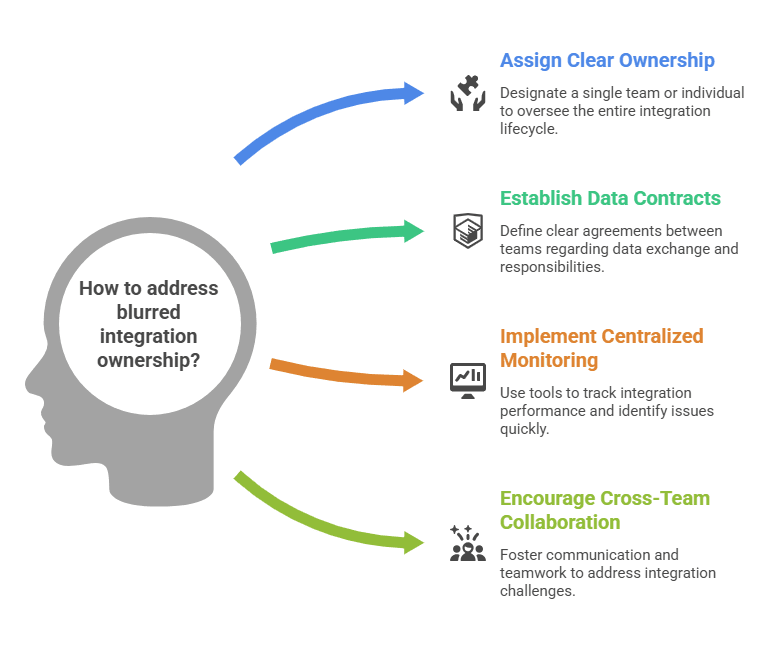
6. Integration Ownership Is Often Blurred
Core code usually has a clear home.
Integrations often do not.
One team owns the application side.
Another team owns the data layer.
A vendor owns the external system.
Operations owns the failure handling.
Support owns the customer impact.
No one owns the full lifecycle.
That makes integration issues slower to detect, slower to resolve, and harder to improve in a durable way.
The problem is not just technical complexity. It is fragmented responsibility.
And once responsibility is fragmented, modernization gets harder too. Teams start proposing local fixes to what is actually a cross-system design problem.
Signs the Integration Layer Is the Real Problem
A few patterns show up repeatedly when integrations have become the primary source of platform risk:
- Releases look successful in engineering, but downstream workflows become unpredictable.
- Incidents repeatedly trace back to synchronization issues, timing drift, stale data, or third-party dependency behavior.
- Manual reconciliation continues to grow even as product quality appears to improve.
- Teams disagree about where failures begin because workflows cross too many boundaries.
- Change feels risky not because the application cannot evolve, but because no one fully understands what the change might trigger elsewhere.
These are not just delivery annoyances.
They are signs that integration architecture has become part of the platform’s core risk surface.
What Safer Integration Modernization Looks Like
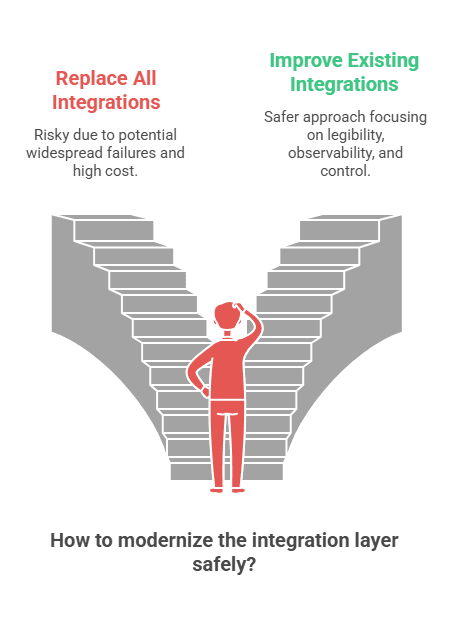
The answer is usually not to replace every integration at once.
The safer path is to make the integration layer more legible, more observable, and more controlled.
That often starts with practical dependency mapping:
Which integrations are business-critical?
Which ones are timing-sensitive?
Which ones are failure-prone?
Which ones are poorly owned?
Which ones create the most operational drag?
Which ones quietly limit future change?
From there, safer improvement usually includes:
- clearer contract boundaries
- better payload and event versioning
- idempotency where duplicate processing is possible
- replay-safe workflows
- stronger visibility into retries, queues, and dead-letter conditions
- better operator tooling for recovery and exception handling
- explicit ownership for each integration boundary
- rollback-aware delivery planning
This is where engineering practices and automation, integrations, and applied AI for production systems become practical modernization disciplines rather than technical add-ons. Mature systems need integration architecture that can tolerate variance, not just happy-path connectivity.
A Better Way to Think About Integration Work
Integration work should be treated less like glue code and more like control-surface design.
Because that is what it becomes in live systems.
It determines how reliably systems coordinate.
It shapes how safely data moves.
It affects how failures are detected.
It influences whether recovery is controlled or chaotic.
And it often determines whether modernization is survivable.
That is why integration-heavy environments are such an important proof category for Duskbyte. In complex systems, the real value is rarely just shipping features. It is improving clarity, control, resilience, and operational confidence.
A strong example of this can be seen in Duskbyte’s work on an enterprise pricing platform for foodservice distribution, where the challenge was not simply application delivery. It involved fragmented supplier data, multiple input formats, synchronized workflows, pricing controls, and the need to improve governance without creating new operational fragility.
he Real Decision
When a platform feels unstable, the natural instinct is to focus on the most visible layer of the system: the application itself.
But the more useful question is often this:
Where does system behavior stop being fully under our control?
In many enterprise environments, the answer is not the core codebase.
It is the integration boundary.
That is where operational assumptions accumulate.
That is where hidden coupling becomes expensive.
That is where modernization efforts often meet their first real resistance.
And that is why integrations break more systems than core code.
Not because core code does not matter.
Because integrations are where software becomes operational reality.