
Modernization rarely fails because teams change too little. It usually fails because they change the wrong layer first. When the visible layer gets attention before the constraining layer gets understood, cost rises, risk spreads, and platform confidence drops.
Modernization is often framed as a question of speed, tooling, or ambition.
In practice, it is usually a question of sequencing.
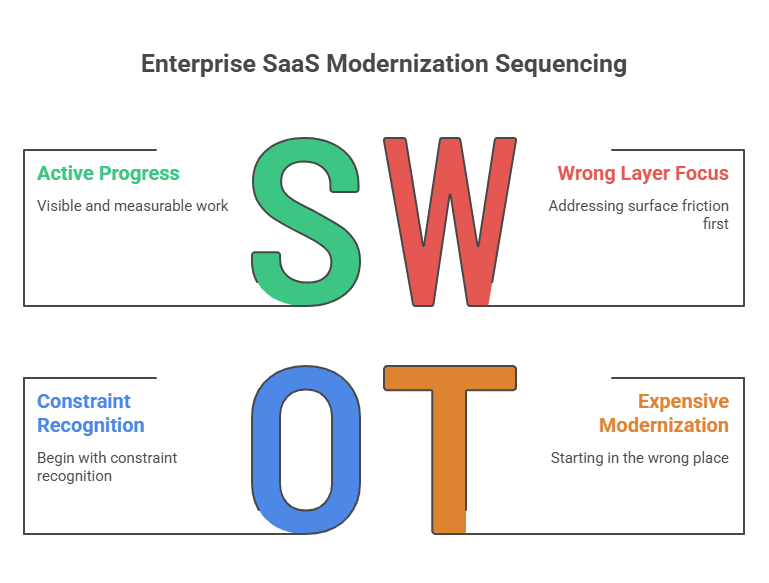
The most expensive modernization programs are not always the most technically difficult ones. They are often the ones that start in the wrong place. A team sees visible friction and moves quickly to address the layer closest to the surface: the UI, the hosting environment, the framework version, the reporting layer, the automation layer, or the AI layer. The work looks active. Progress looks measurable. But the structural constraint underneath remains untouched.
That is when modernization starts getting expensive in the wrong way.
The issue is not that the team changed something. The issue is that they changed a layer that depended on other unresolved problems below it. The result is rework, architectural drag, rising operational risk, and a growing sense that the platform is getting more modern without becoming easier to evolve.
That is why enterprise SaaS modernization has to begin with constraint recognition, not just implementation momentum.
The mistake most teams make
Most teams do not deliberately choose the wrong layer.
They choose the most legible layer.
That may be the frontend because customer complaints are visible there. It may be cloud migration because infrastructure costs are being questioned. It may be workflow automation because manual effort is obvious. It may be AI because the business wants a visible step forward. It may even be a rewrite because the existing codebase feels frustrating enough that starting over appears cleaner.
But the most visible problem is not always the controlling problem.
A platform may look like it needs a new interface when the real bottleneck is fragmented domain logic across services. It may look like it needs cloud replatforming when the real issue is brittle release control and unclear dependency boundaries. It may look like it needs new automation when the actual problem is inconsistent data contracts and exception-heavy operational workflows.
This is one reason why most SaaS rewrites fail. They often respond to pain at the visible layer while underestimating the logic, coupling, and operational realities underneath it.
What “the wrong layer” usually means
Modern platforms tend to have several overlapping layers of change:
- presentation and user experience
- business logic and workflow orchestration
- data model and data quality
- integration boundaries and external dependencies
- infrastructure and cloud architecture
- release process and operational controls
- automation and decision-support layers
The wrong layer is not a universal category. It is contextual.
The wrong layer is simply the one that is not currently limiting safe progress.
If your team cannot release with confidence, moving to a new cloud architecture may only increase complexity. If your data contracts are unstable, adding automation, integrations, and applied AI may amplify inconsistency rather than reduce effort. If your system boundaries are unclear, a UI rebuild may create a cleaner shell around the same operational confusion.
Modernization gets expensive when improvement at one layer depends on maturity that does not yet exist in another.
Why this gets missed
There are a few reasons teams modernize the wrong layer first.
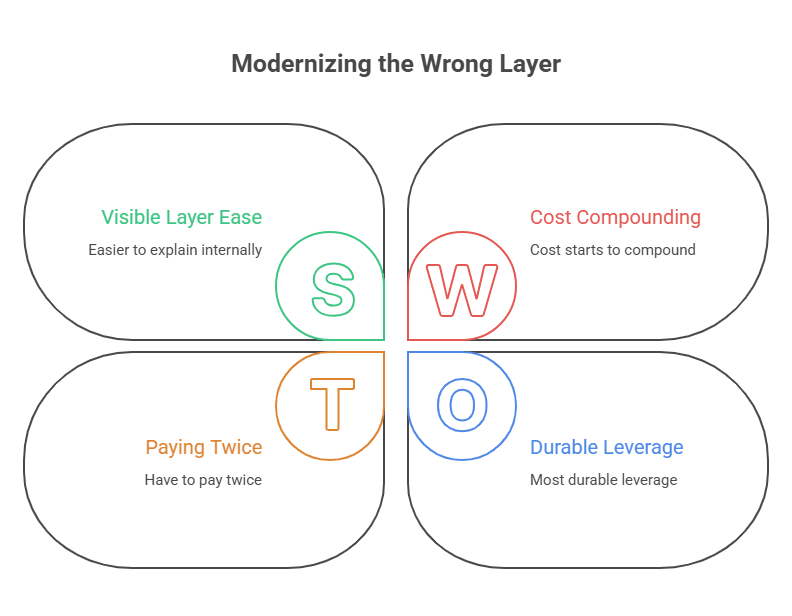
First, visible layers are easier to explain internally. A new frontend, a cloud migration, a new automation program, or a platform rewrite are all easier to package than dependency reduction or release discipline.
Second, surface-layer work often looks more strategic than structural work. It feels easier to rally stakeholders around visible change than around refactoring integration seams or stabilizing deployment behavior.
Third, teams under pressure tend to choose the layer that offers the fastest narrative, not the most durable leverage.
That is understandable. But it is also where cost starts to compound.
Because once the wrong layer is modernized, it still has to sit on top of the old constraint.
And eventually the team has to pay twice.
What that cost actually looks like
The cost is not just budget overrun.
It is architectural duplication. New layers must compensate for old assumptions. Adapters multiply. Exceptions spread. Temporary compatibility patterns become semi-permanent.
It is delivery slowdown. The team now supports both the old and new versions of behavior while trying to untangle underlying issues that were never addressed first.
It is operational fragility. Surface improvements create expectations of reliability that the underlying system still cannot support consistently.
It is trust erosion. Leadership sees investment happening but does not feel equivalent increases in stability, speed, or clarity.
It is strategic distortion. The organization starts concluding that modernization itself is the problem, when the real issue was modernization sequencing.
This is why engineering practices matter so much. Many platform failures are not caused by a lack of effort or talent. They come from changing the wrong thing before the system is ready to absorb that change.
Where this shows up most often
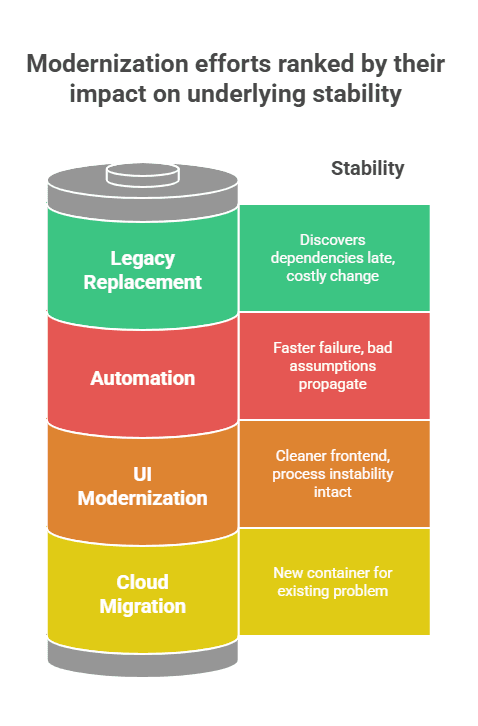
1. Cloud before release control
A team moves toward AWS SaaS cloud migration because the current environment feels limiting.
But deployments are still brittle.
Rollback paths are still weak.
Service ownership is still unclear.
Integration failure modes are still poorly understood.
In that situation, the cloud is not the first problem. It is the new container for the existing problem.
Cloud migration may still be necessary. It just may not be the next move.
2. UI modernization before workflow stabilization
The customer-facing experience gets redesigned because it feels outdated or inconsistent.
But the actual friction lives in the approval logic, data validation rules, edge-case handling, and internal operational workflows behind it.
Now the frontend is cleaner, but the user journey still breaks in the same places. The work improves presentation while leaving process instability intact.
3. Automation before data discipline
Manual work becomes painful, so automation is introduced quickly.
But the inputs are inconsistent, the ownership model is unclear, and upstream changes are common.
Now the organization has faster failure, not less failure.
Automation works best when the underlying process is sufficiently stable to automate safely. Otherwise it simply increases the rate at which bad assumptions propagate.
4. Legacy replacement before dependency mapping
The existing system feels old enough that legacy system modernization gets interpreted as broad replacement.
But the team still has not mapped hidden dependencies, backward-compatibility needs, or operational edge cases.
The replacement effort then discovers those realities late, when the cost of change is higher and the rollback path is politically harder.
A useful test: what is actually constraining safe progress?
Before choosing a modernization layer, the better question is not:
“What feels outdated?”
It is:
“What is currently preventing safe improvement elsewhere?”
That shift matters.
If unstable integrations are blocking releases, integration architecture may matter more than interface modernization.
If fear of regression is slowing change, release discipline may matter more than cloud transformation.
If reporting is inconsistent because the source-of-truth model is fragmented, analytics modernization is not the first layer to address.
If new automation depends on unreliable inputs, data quality and process ownership come first.
This is where how we work and our approach become important. The point is not to delay change. The point is to identify the layer where change creates downstream freedom instead of downstream compensation.
The Layer That Feels Strategic Is Not Always the Layer With Leverage
This is one of the hardest parts of platform decision-making.
The layers that attract the most executive attention are usually the ones with the clearest external narrative:
- cloud
- AI
- customer experience
- platform rewrite
- new architecture
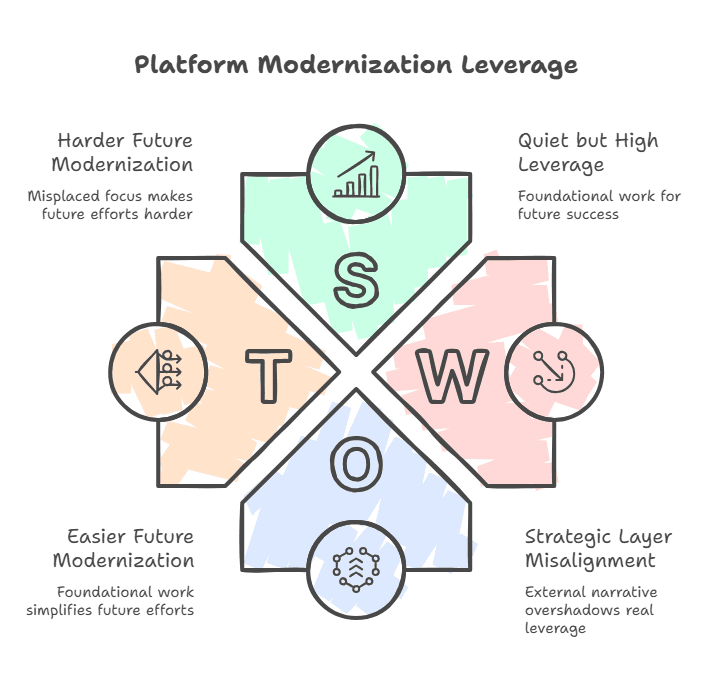
But the layer with the greatest leverage is often much quieter:
- release safety
- dependency isolation
- data integrity
- workflow stability
- ownership clarity
- bounded integration change
That work may not look dramatic at first.
It may not create a launch moment.
It may not immediately change what customers see.
It may not even feel like visible modernization in the early stages.
But it often determines whether every future modernization effort becomes easier or harder, safer or riskier, faster or more fragile.
That is where real leverage sits.
Signs You Are Modernizing the Wrong Layer
A few patterns usually show up early.
They do not always mean the work itself is flawed.
But they often suggest the platform is being changed in the wrong dependency order.
Common signs include:
- visible improvements are happening, but releases still feel tense
- a new platform component exists, but core workflows still depend on legacy behavior nobody wants to touch
- cloud costs are rising, but operational predictability is not improving
- automation is expanding, but exception handling and manual overrides keep growing
- the frontend is getting cleaner, but service teams still cannot agree where business logic belongs
- the modernization program is active, but internal confidence is declining rather than improving
These signals matter because they often point to the same underlying issue:
The work may be real.
The effort may be serious.
But the sequence may still be wrong.
In many cases, the problem is not that change is happening.
It is that change is happening above the layer that is actually constraining progress.
What Better Sequencing Looks Like
Better sequencing usually starts with a more disciplined set of questions.
Instead of asking what looks oldest or what sounds most strategic, ask:
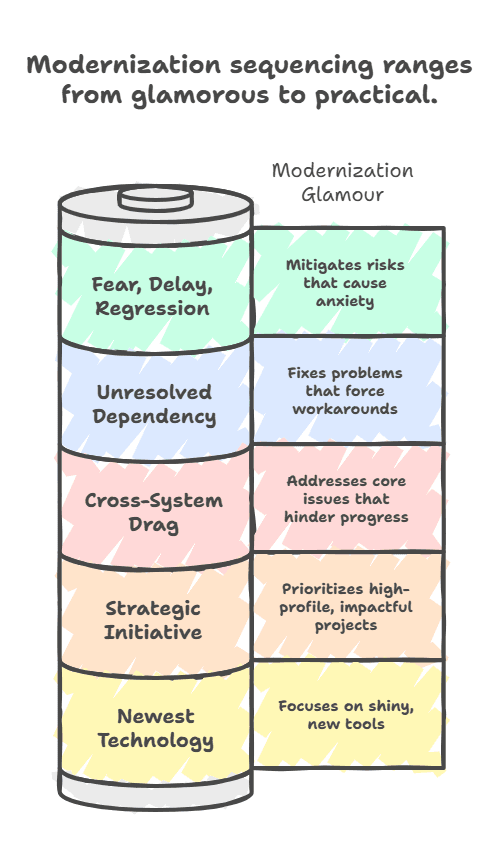
- What layer currently creates the most cross-system drag?
- What unresolved dependency forces multiple teams to work around the same problem?
- Where does change routinely create fear, delay, or regression risk?
- Which layer, if improved first, would make the next two layers safer to evolve?
- What needs to become more predictable before more complexity is added?
These questions are often far more useful than asking which stack feels outdated or which initiative sounds the most transformational.
In mature platforms, the best sequencing is rarely the most dramatic.
It is usually the sequence that:
- reduces coupling
- improves delivery confidence
- strengthens operational predictability
- increases the number of safe moves available afterward
That is what good sequencing actually does.
It creates room for the next decision to be made with more control.
The Real Goal Is Not Visible Modernization
The real goal is not to make the platform look more modern.
The goal is to make the platform easier to change without increasing operational risk.
That may involve cloud work.
It may involve architecture changes.
It may involve data restructuring, integration cleanup, release controls, or legacy reduction.
But the decision should be grounded in structural leverage, not presentation value.
Modernization should reduce constraint.
If it starts increasing compensation layers, duplicate logic, dependency confusion, or release anxiety, then the team may be modernizing the wrong thing first.
That is often the cost leadership feels later.
Not because they refused to invest.
Because they invested one layer too high.