
Enterprise platforms rarely break because teams are too slow. They break because change moves faster than the platform can safely absorb. The problem is not speed itself. The problem is unmanaged speed inside systems with real dependencies, real users, and real operational consequences.
“Move fast” sounds efficient.
It sounds decisive. It sounds commercially useful. It sounds like the opposite of bureaucracy.
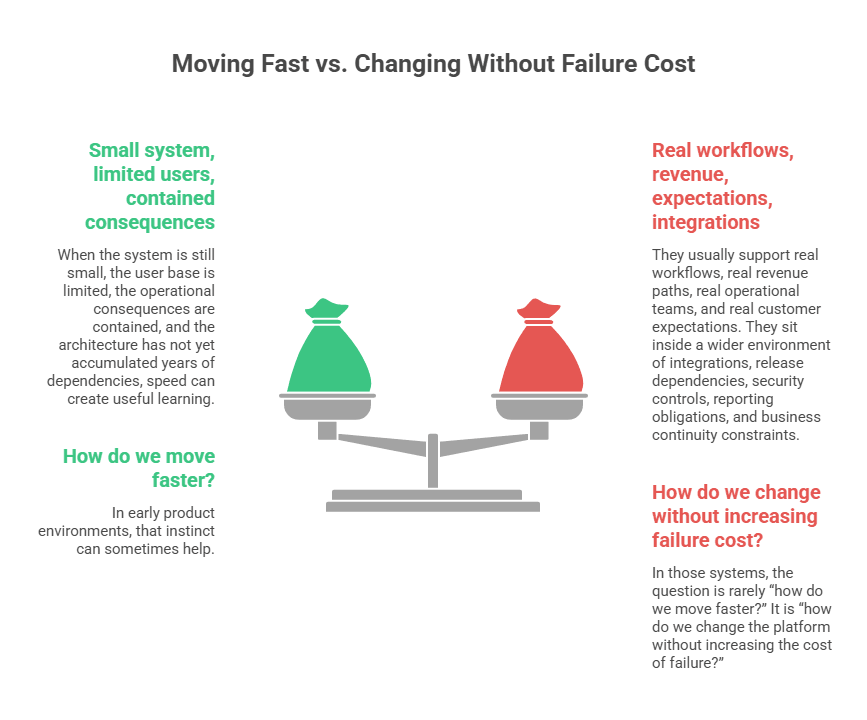
In early product environments, that instinct can sometimes help. When the system is still small, the user base is limited, the operational consequences are contained, and the architecture has not yet accumulated years of dependencies, speed can create useful learning.
Enterprise platforms are different.
They usually support real workflows, real revenue paths, real operational teams, and real customer expectations. They sit inside a wider environment of integrations, release dependencies, security controls, reporting obligations, and business continuity constraints. In those systems, the question is rarely “how do we move faster?” It is “how do we change the platform without increasing the cost of failure?”
That is a very different decision.
The Mistake Most Teams Make
Most teams do not explicitly say, “let’s be reckless.”
What they usually say is something more reasonable:
- we need momentum
- we cannot afford to overthink this
- we need visible progress
- we will clean it up later
- we just need to get the first version out
The problem is not the intent.
The problem is that in mature enterprise systems, speed without control usually shifts risk rather than removing it.
The team may ship more quickly for a short period. But underneath that visible movement, release confidence weakens, system coupling deepens, rollback becomes harder, and business teams inherit more uncertainty than they expected.
That is why many enterprise platforms do not fail during planning.
They fail during execution, when the platform starts absorbing more change than its current structure can safely tolerate.
What “Move Fast” Usually Means in Practice
Inside enterprise delivery environments, “move fast” often translates into one or more of the following patterns:
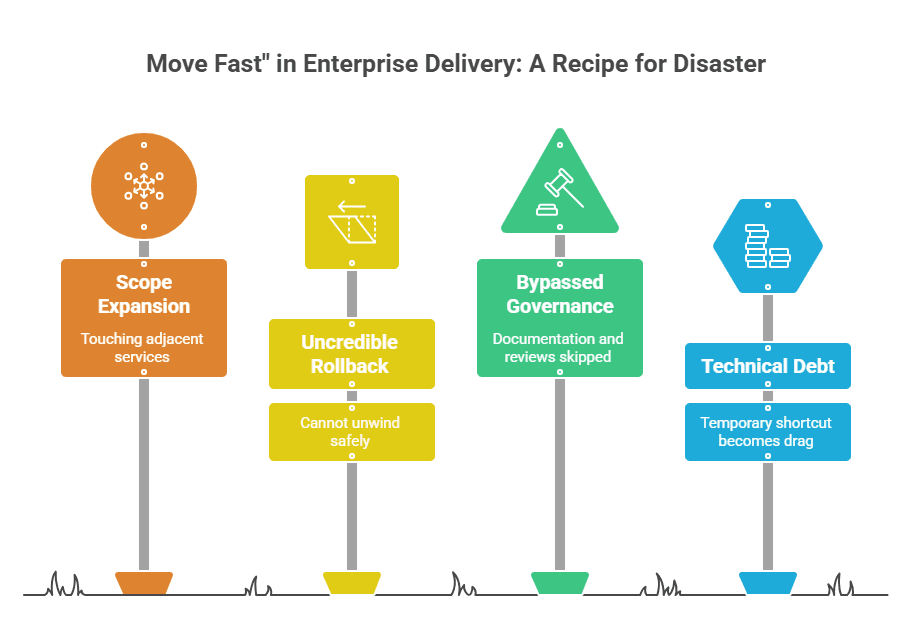
1. Scope expands before dependencies are understood
A change that looked local turns out to touch adjacent services, reporting logic, permissions, data contracts, support workflows, or external integrations.
The original estimate assumed a clean boundary.
The real platform does not have one.
2. Releases happen before rollback is credible
The team can deploy, but cannot unwind safely.
That is not release confidence. That is operational hope.
A platform becomes fragile when change is easier to introduce than to reverse.
3. Teams bypass governance because governance feels slow
Documentation gets skipped. Change reviews become informal. Operational sign-off disappears. Edge cases are deferred.
This creates the illusion of acceleration, but it usually reduces clarity precisely when the platform is becoming harder to reason about.
4. Technical debt becomes delivery debt
The phrase “we will fix it later” sounds harmless until “later” arrives inside a live production system with customer commitments and parallel priorities.
At that point, what looked like a temporary shortcut becomes a structural drag on every release that follows.
Why It Breaks Enterprise Platforms
Enterprise platforms do not only carry code complexity.
They carry consequence.
A release problem in a mature platform can affect internal operations, customer workflows, reporting accuracy, pricing logic, support load, compliance posture, or upstream and downstream systems. That is why speed has to be evaluated against blast radius, not just delivery cadence.
Here is where the “move fast” mindset starts to break down.
Fast Change Amplifies Existing Fragility
If a platform already has unclear service boundaries, brittle integrations, manual release steps, weak observability, or unresolved data assumptions, moving faster does not solve those issues.
It compounds them.
The team starts making more changes inside a system that is already difficult to understand. Each release increases the amount of hidden risk being carried forward. The pace may look healthy from the outside, but the platform becomes progressively harder to stabilize.
This is one reason modernization sequencing matters so much. The goal is not to move slowly. The goal is to avoid accelerating into the wrong layer of the problem.
Fast Delivery Often Hides Slow Recovery
Speed gets measured at the front of the change.
Rarely at the back.
A team may be able to ship quickly, but if a failure takes days of investigation, emergency coordination, manual correction, customer communication, and follow-up rework, the real delivery system is not fast.
It is unstable.
For enterprise platforms, recovery capability matters as much as release capability. That is why release discipline should be treated as an operating control, not a delivery tax. It is also why release discipline in production systems matters more than release theatre.
Fast Teams Can Still Create Slow Organizations
A product or engineering team may optimize for local velocity while increasing organizational drag everywhere else.
Support gets more tickets. Operations gets more exceptions. Finance gets more reconciliation work. Customer-facing teams lose confidence in release timing. Leadership gets less clarity about what is actually stable.
That is not speed.
That is cost redistribution.
The engineering team may look fast on paper while the wider business absorbs the consequences more slowly and more painfully.
Fast Execution Without Structural Change Creates False Progress
This is one of the most expensive patterns in enterprise modernization.
A team ships multiple visible changes. Leadership sees movement. The roadmap looks active.
But the underlying platform remains just as difficult to operate, test, release, and evolve as before.
So the organization mistakes activity for modernization.
In reality, the same architectural bottlenecks, release risks, and operational constraints are still there. They are now simply wrapped in more recent delivery output.
Where Speed Does Belong
The answer is not bureaucratic slowness.
The answer is controlled speed.
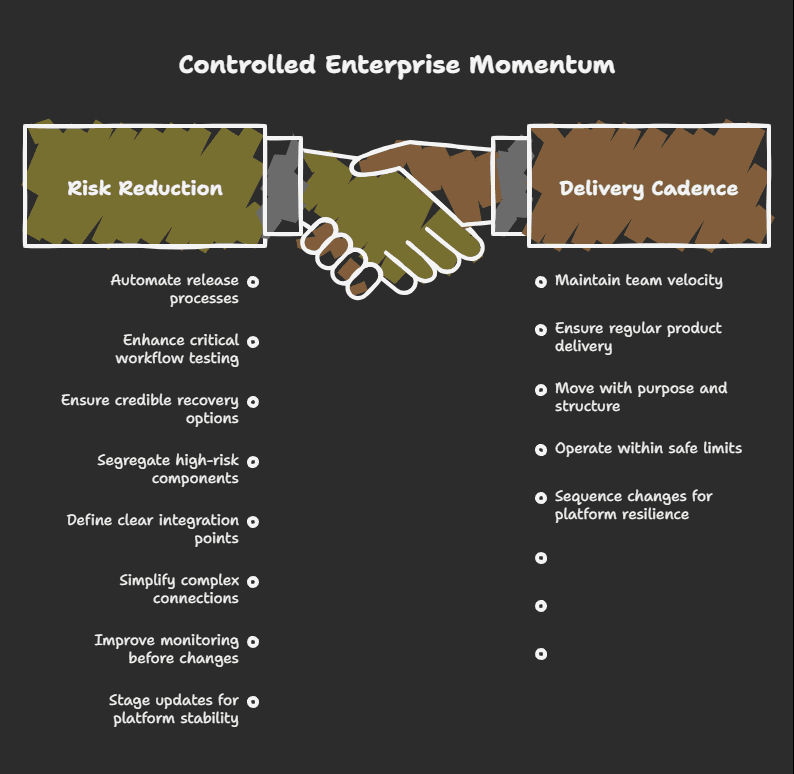
Enterprise teams still need momentum. They still need delivery cadence. They still need to ship.
But the speed has to exist inside a structure that reduces risk instead of amplifying it.
That usually means moving fast in areas such as:
- reducing manual release steps
- improving test confidence around critical workflows
- making rollback paths credible
- isolating high-risk dependencies
- tightening service boundaries
- simplifying noisy integration points
- improving observability before major change
- sequencing modernization so the platform can absorb it safely
That is a very different posture from “just move.”
It is closer to: move with control, move with containment, and move in an order the platform can survive.
What Disciplined Speed Looks Like Instead
Disciplined speed is not slow.
It is selective.
It accepts that enterprise platforms can move quickly, but only when the conditions for safe change are deliberately built.
In practice, that usually looks like this.
Change is scoped to survivable units
Large, ambiguous change sets create ambiguity in testing, deployment, ownership, and rollback.
Smaller, better-bounded changes do the opposite. They make release behavior easier to predict and production behavior easier to trace.
Release paths are designed before pressure arrives
A rollback plan invented during an incident is not a rollback strategy.
Disciplined teams decide in advance how they will release, observe, pause, revert, and recover.
Dependencies are made visible
Many delivery problems are not coding problems.
They are hidden dependency problems.
Teams move too quickly because they assume a change is local when it actually crosses service, data, workflow, or business-process boundaries. Mapping those boundaries early is often what prevents false speed later.
Stability becomes a delivery metric
If the only success metric is “did it ship,” the team will keep pushing risk downstream.
Mature platforms need broader success criteria: release confidence, incident frequency, rollback reliability, support impact, operational load, and the platform’s ability to accept the next change cleanly.
The Difference Between Reckless Speed and Engineered Speed
A useful distinction is this:
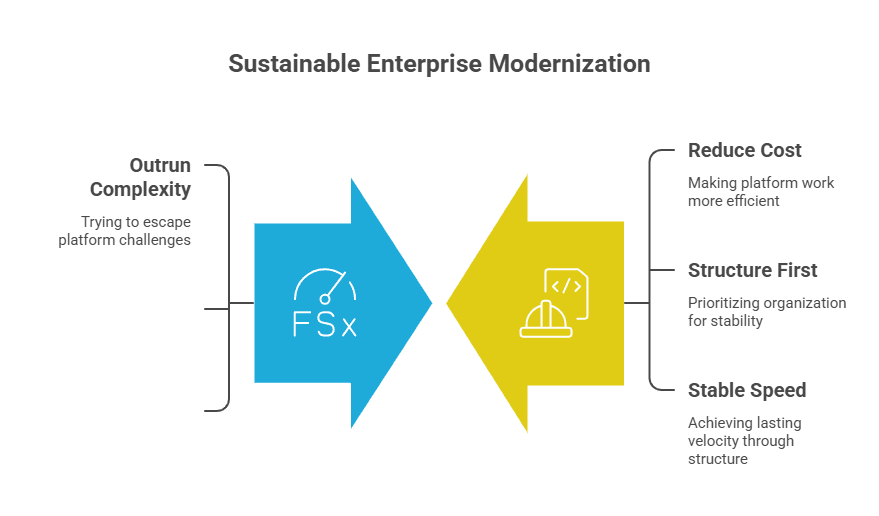
Reckless speed tries to outrun platform complexity.
Engineered speed reduces the cost of working inside it.
That is where enterprise modernization becomes commercially meaningful. The outcome is not simply that the team ships more. It is that the platform becomes easier to change without creating fresh instability.
You can see that difference clearly in workflow-heavy systems. In Duskbyte’s PriceFlow case study, the gains did not come from “moving fast” in the abstract. They came from structuring workflows, tightening governance, improving auditability, and reducing operational ambiguity. That led to price change processing moving from 7–12 days to 24–48 hours, supplier onboarding from 21 days to 2–3 days, product data entry errors dropping by 73%, pricing support inquiries dropping by 63%, and promotional conflicts reducing by 90%.
That is the pattern worth paying attention to.
Not speed first.
Structure first, then speed that holds.
A Better Question for Enterprise Leaders
Instead of asking, “how do we move faster?”
Ask:
- where does change currently become unsafe?
- which dependencies make releases harder than they should be?
- what is creating recovery pain after deployment?
- where are teams compensating manually for platform weakness?
- what needs to be stabilized before acceleration is responsible?
- which modernization steps would improve future delivery confidence, not just current output?
Those questions are less theatrical.
They are also more useful.
Because enterprise platforms do not usually fail from a lack of urgency.
They fail when urgency outruns architecture, release discipline, and operational reality.
Closing Thought
“Move fast” is not wrong in every context.
It is just incomplete.
In enterprise platforms, speed is only valuable when the platform can absorb it without creating downstream instability. That is why the strongest modernization work rarely feels dramatic from the inside. It feels structured. Sequenced. Controlled. Sometimes even boring.
That is usually a good sign.
Because in serious systems, boring releases are often the clearest evidence that the platform is getting healthier.