
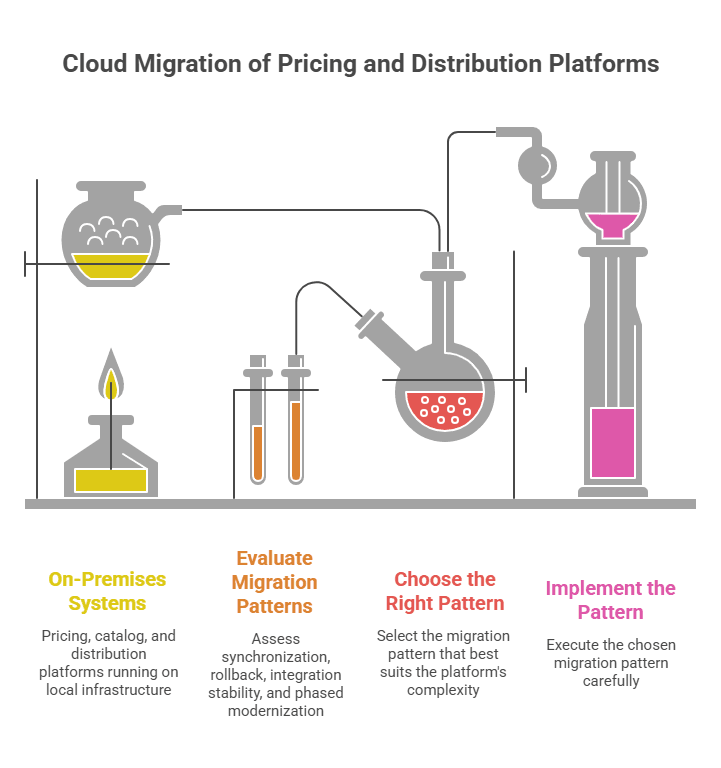
Pricing, catalog, and distribution platforms are difficult to migrate because they sit close to operational control. This article explains the cloud migration patterns platform leaders should evaluate before moving these systems, including synchronization, rollback, integration stability, and phased modernization.
Cloud migration looks simple when the system being moved is isolated.
Distribution and pricing platforms are rarely isolated.
They often sit between ERP systems, warehouse operations, supplier feeds, customer portals, sales teams, finance workflows, catalog governance, and downstream reporting. They may manage product data, pricing rules, contract terms, customer-specific conditions, margin controls, rebate logic, approval workflows, and integrations with operational systems that people depend on every day.
That makes cloud migration a platform decision, not just an infrastructure decision.
For distribution, foodservice, buying groups, wholesale, and pricing-heavy B2B platforms, the question is not only:
Can this system run in the cloud?
The better question is:
Can this system move toward the cloud without breaking synchronization, control, operational trust, or business continuity?
This article outlines the migration patterns platform leaders should evaluate before moving pricing, catalog, and distribution systems to the cloud.
Why Distribution and Pricing Platforms Are Hard to Move
Pricing and distribution systems are different from many customer-facing applications.
They are not just user interfaces. They are control systems.
They often influence:
- What products customers can see
- Which prices apply to which accounts
- Which supplier terms are active
- Which contracts override standard pricing
- Which catalog changes are approved
- Which orders are valid
- Which margins are protected
- Which downstream systems receive updates
A small synchronization issue can create real commercial risk.
A catalog mismatch can cause ordering errors. A delayed price update can affect margin. A failed integration can disrupt warehouse, finance, or customer service workflows. A rollback without data consistency can create confusion across systems.
That is why cloud migration for these platforms should not start with hosting diagrams alone.
It should start with control, data flow, ownership, and recovery.
The Core Migration Question
Before choosing a cloud migration pattern, platform leaders need to understand what kind of system they are migrating.
Some platforms are primarily workflow systems. Some are pricing engines. Some are catalog governance platforms. Some act as integration hubs between older systems. Others have become a mixture of all of these over time.
The right migration pattern depends on questions such as:
- Where is the source of truth for pricing?
- Where is the source of truth for product and catalog data?
- Which systems must remain synchronized?
- Which data changes require approval?
- Which integrations are real-time, near-real-time, or batch-based?
- Which users need uninterrupted access?
- What happens when the cloud system is unavailable?
- What happens when the legacy system and cloud system disagree?
- How will rollback work after data has changed?
These questions are not secondary details. They define the migration strategy.
Pattern 1: Assessment-First Migration
The safest cloud migration pattern for pricing and distribution platforms is often not a technical migration pattern at all.
It is an assessment-first pattern.
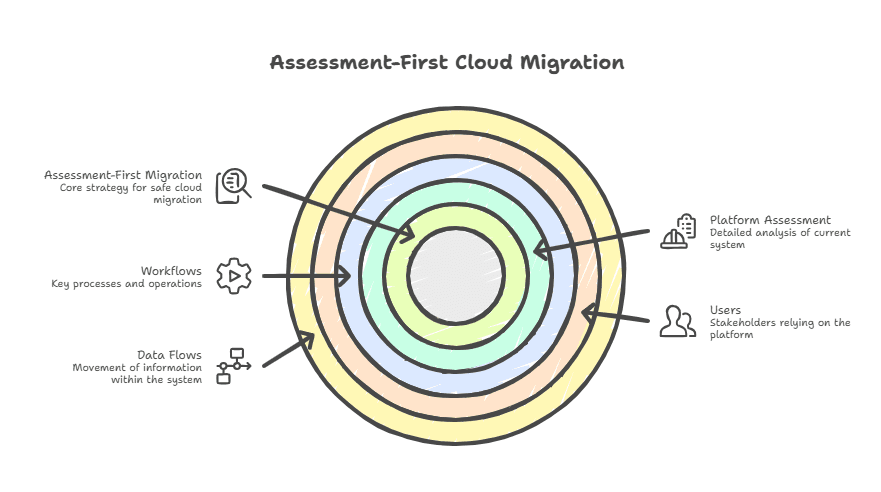
Before moving workloads, the team maps how the current platform actually behaves:
- Key workflows
- Critical users
- Pricing rules
- Catalog ownership
- Supplier and customer data flows
- Integration dependencies
- Batch jobs and scheduled processes
- Manual operational workarounds
- Security and access controls
- Reporting dependencies
- Failure and recovery scenarios
This assessment helps separate what the system was designed to do from what the business now depends on it to do.
That distinction matters.
Many mature distribution platforms contain hidden business rules that are not fully documented. Some live inside stored procedures, scheduled jobs, spreadsheets, admin screens, legacy services, or integration scripts.
Moving the system without understanding these rules can move technical debt into the cloud without reducing operational risk.
When this pattern fits
Use assessment-first migration when:
- The platform is business-critical
- Documentation is incomplete
- Integrations are fragile or poorly understood
- Pricing logic has grown over several years
- Multiple teams depend on the system
- There is low confidence in rollback behavior
What it prevents
This pattern prevents teams from treating cloud migration as a hosting exercise when the real risk sits in data behavior, operational dependencies, and business rules.
Pattern 2: Stabilize Before Moving
Some platforms should not be migrated immediately.
That does not mean cloud migration is wrong. It means the system may need stabilization before migration begins.
For distribution and pricing platforms, stabilization might include:
- Cleaning up environment separation
- Improving deployment discipline
- Documenting pricing and catalog data flows
- Reducing manual release steps
- Strengthening database backup and restore processes
- Adding monitoring around critical jobs and integrations
- Improving error handling for supplier, ERP, WMS, or customer portal integrations
- Removing known operational bottlenecks before migration
This pattern is especially useful when the current system is already difficult to operate.
Moving an unstable platform to cloud infrastructure may improve some infrastructure concerns, but it will not automatically fix unclear ownership, fragile releases, poor observability, inconsistent data, or undocumented business rules.
When this pattern fits
Use stabilize-before-moving when:
- Releases are risky
- Rollback is unclear
- Environments are inconsistent
- Production issues are hard to diagnose
- Integration failures are discovered late
- Cloud migration is being pushed as a shortcut around existing operational problems
What it prevents
This pattern prevents cloud migration from becoming a relocation of existing instability.
Pattern 3: Strangler Migration Around Platform Boundaries
A full rewrite is usually too risky for pricing and distribution platforms.
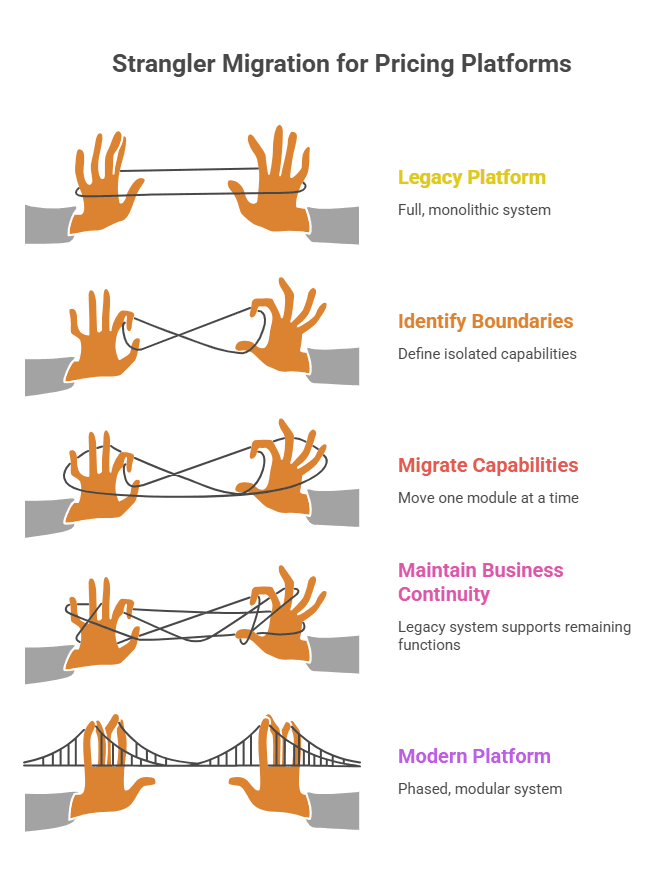
A safer pattern is to identify platform boundaries and migrate capabilities in phases.
This is commonly known as a strangler-style migration, but for pricing and distribution systems, the important part is not the name. The important part is boundary selection.
Possible boundaries might include:
- Product catalog search and browsing
- Customer-specific price lookup
- Supplier data ingestion
- Pricing approval workflow
- Contract pricing rules
- Reporting and analytics
- Admin configuration
- API access for downstream systems
- Customer portal experience
The goal is to move one capability at a time while the legacy system continues to support the rest of the business.
However, this only works when boundaries are carefully chosen.
A poorly selected boundary can create duplicate logic, conflicting sources of truth, or synchronization problems between old and new systems.
When this pattern fits
Use boundary-based migration when:
- The existing platform is too large to move all at once
- Specific modules are more painful than others
- Some capabilities can be isolated safely
- The organization needs business continuity during modernization
- Internal teams need time to adapt to the new architecture
What it prevents
This pattern prevents big-bang replacement while allowing modernization to progress in controlled increments.
Pattern 4: Read-Only Cloud First
For pricing, catalog, and distribution systems, a read-only cloud layer can be a useful first step.
Instead of immediately moving write operations, the platform exposes selected data through cloud-based APIs, search services, portals, or reporting tools.
This can allow teams to modernize customer-facing or internal experiences while keeping the legacy system as the system of record during the early phase.
Examples include:
- Cloud-based catalog browsing backed by synchronized legacy data
- Customer price visibility without changing pricing ownership
- Sales or customer service portals that read approved pricing data
- Reporting dashboards based on replicated operational data
- API layers that expose controlled views of product or account data
This pattern reduces migration risk because write authority remains unchanged at first.
But it still requires strong synchronization design.
If the cloud layer displays stale or incomplete pricing data, users will lose trust quickly.
When this pattern fits
Use read-only cloud first when:
- The business wants improved access or visibility
- The legacy system must remain the source of truth temporarily
- Write workflows are too risky to move immediately
- Customer-facing modernization is needed before deeper platform refactoring
- Reporting or API access is a priority
What it prevents
This pattern prevents teams from moving business-critical write operations before they understand synchronization, latency, and trust requirements.
Pattern 5: Controlled Write Migration
Eventually, some write operations may need to move to the cloud.
This is where migration risk increases.
Write operations in pricing and distribution systems may include:
- Price changes
- Catalog updates
- Supplier data approvals
- Customer-specific overrides
- Contract pricing rules
- Product availability controls
- Margin guardrails
- Workflow approvals
- Admin configuration changes
Before moving these workflows, leaders need clear answers to several questions:
- Which system owns the write?
- Is the write synchronous or asynchronous?
- What happens if downstream systems reject the change?
- How are conflicts detected?
- How are approvals preserved?
- How is audit history maintained?
- Can changes be rolled back safely?
- Are users prevented from making conflicting updates in two systems?
Controlled write migration usually requires strong governance, not just APIs.
The team may need approval states, event logs, reconciliation jobs, conflict handling, user permissions, and operational dashboards that show whether the platform is healthy.
When this pattern fits
Use controlled write migration when:
- Read-only migration has proven stable
- Synchronization behavior is understood
- Clear ownership exists for each data domain
- Rollback and reconciliation paths are defined
- Auditability matters
- Business users need cloud-based control over selected workflows
What it prevents
This pattern prevents uncontrolled dual-write behavior, which is one of the most dangerous failure modes in platform migration.
Pattern 6: Integration Layer Before Application Migration
In many mature distribution environments, the hardest part of migration is not the application itself.
It is the integration landscape.
Pricing and distribution platforms often connect to:
- ERP systems
- Warehouse management systems
- Supplier feeds
- EDI workflows
- Customer portals
- Finance systems
- BI and reporting platforms
- CRM systems
- Third-party logistics platforms
- Inventory or availability services
When integrations are point-to-point, undocumented, or tightly coupled to legacy database structures, moving the application first can create unnecessary risk.
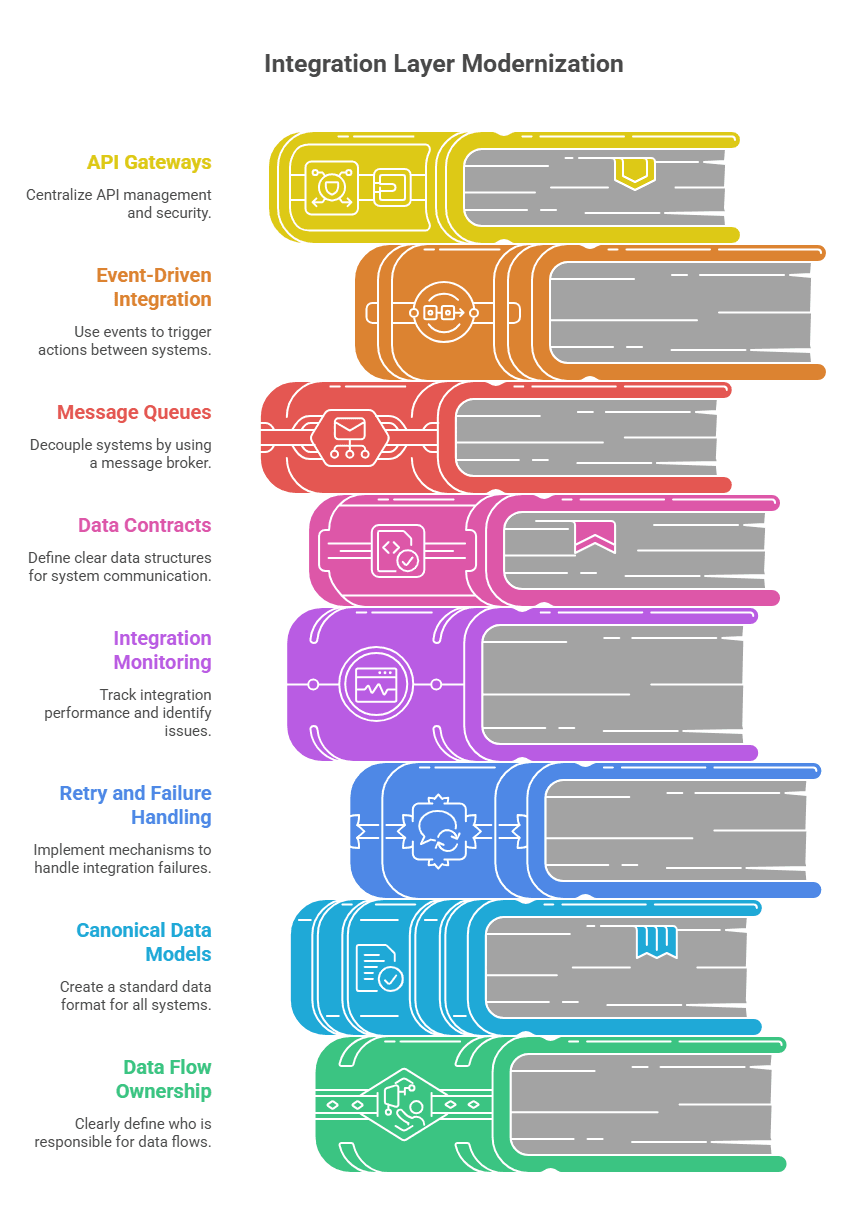
In these cases, a better pattern may be to modernize the integration layer first.
This could include:
- API gateways
- Event-driven integration patterns
- Message queues
- Data contracts
- Integration monitoring
- Retry and failure handling
- Canonical data models
- Clear ownership of inbound and outbound data flows
This does not mean over-engineering the architecture.
It means creating enough structure so that the platform can change without breaking every connected system.
When this pattern fits
Use integration-layer-first migration when:
- The platform is heavily connected to operational systems
- External partners depend on data feeds
- Integrations are brittle or undocumented
- Migration would otherwise require many systems to change at once
- There is a need to reduce coupling before deeper modernization
What it prevents
This pattern prevents cloud migration from being blocked by fragile legacy integrations.
Pattern 7: Data Replication and Reconciliation
For pricing and catalog systems, replication is not enough.
Reconciliation matters.
Many teams can copy data from one system to another. The harder question is whether the copied data is trusted, complete, current, and explainable.
Cloud migration plans should define:
- Which data is replicated
- How frequently data is updated
- Which fields are authoritative
- How failed sync jobs are detected
- How discrepancies are reported
- Who owns resolution
- Whether users can see sync status
- How historical pricing and catalog changes are preserved
This is especially important for systems where pricing disputes, customer-specific terms, or supplier agreements may need to be explained later.
A cloud system that is fast but not trusted will not be adopted.
When this pattern fits
Use replication-and-reconciliation when:
- Multiple systems need access to the same data
- Legacy systems remain active during migration
- Pricing and catalog accuracy are commercially sensitive
- The business requires auditability
- Operational teams need confidence in cloud-visible data
What it prevents
This pattern prevents silent data drift between legacy and cloud systems.
Pattern 8: Cloud-Native Where It Reduces Risk
Not every part of a distribution or pricing platform needs to become cloud-native immediately.
Cloud-native services can be useful when they reduce operational risk, improve scalability, strengthen resilience, or simplify delivery.
Good candidates may include:
- Search and catalog indexing
- Reporting and analytics workloads
- File ingestion and processing
- API management
- Asynchronous job processing
- Observability and alerting
- Backup and disaster recovery improvements
- Isolated services for high-volume read access
Poor candidates are usually areas where the team does not yet understand ownership, data consistency, or rollback behavior.
Cloud-native architecture should be introduced where it improves control.
It should not be introduced simply to make the architecture look modern.
When this pattern fits
Use selective cloud-native migration when:
- A capability has clear boundaries
- Cloud services reduce operational burden
- Scaling or resilience needs are well understood
- The team has enough operational maturity to manage the new model
- The business value is clear
What it prevents
This pattern prevents unnecessary complexity from being introduced in the name of modernization.
What Platform Leaders Should Evaluate Before Migrating
Before committing to a migration roadmap, platform leaders should evaluate the system through six lenses.
1. Source of Truth
Clarify which systems own pricing, catalog, customer, supplier, contract, and order-related data.
Do not begin migration with vague ownership.
If two systems can update the same data without clear rules, the migration will create operational conflict.
2. Synchronization
Define how data moves between systems.
This includes timing, failure handling, retry logic, monitoring, and reconciliation. Synchronization should be observable, not assumed.
3. Control
Understand who is allowed to change what.
Pricing and catalog systems often involve approvals, overrides, permissions, and audit trails. These controls must survive migration.
4. Rollback
Rollback is more complex when data changes are involved.
A deployment rollback may be simple. A pricing rollback after customers, sales teams, or downstream systems have seen the new data may not be simple.
5. Integration Impact
Map every system that depends on the platform.
This includes formal integrations, scheduled exports, database-level dependencies, spreadsheets, reports, and operational workarounds.
6. Operational Trust
The cloud system must be trusted by the people who depend on it.
If users cannot explain where data came from, whether it is current, or what happens when a sync fails, adoption will suffer.
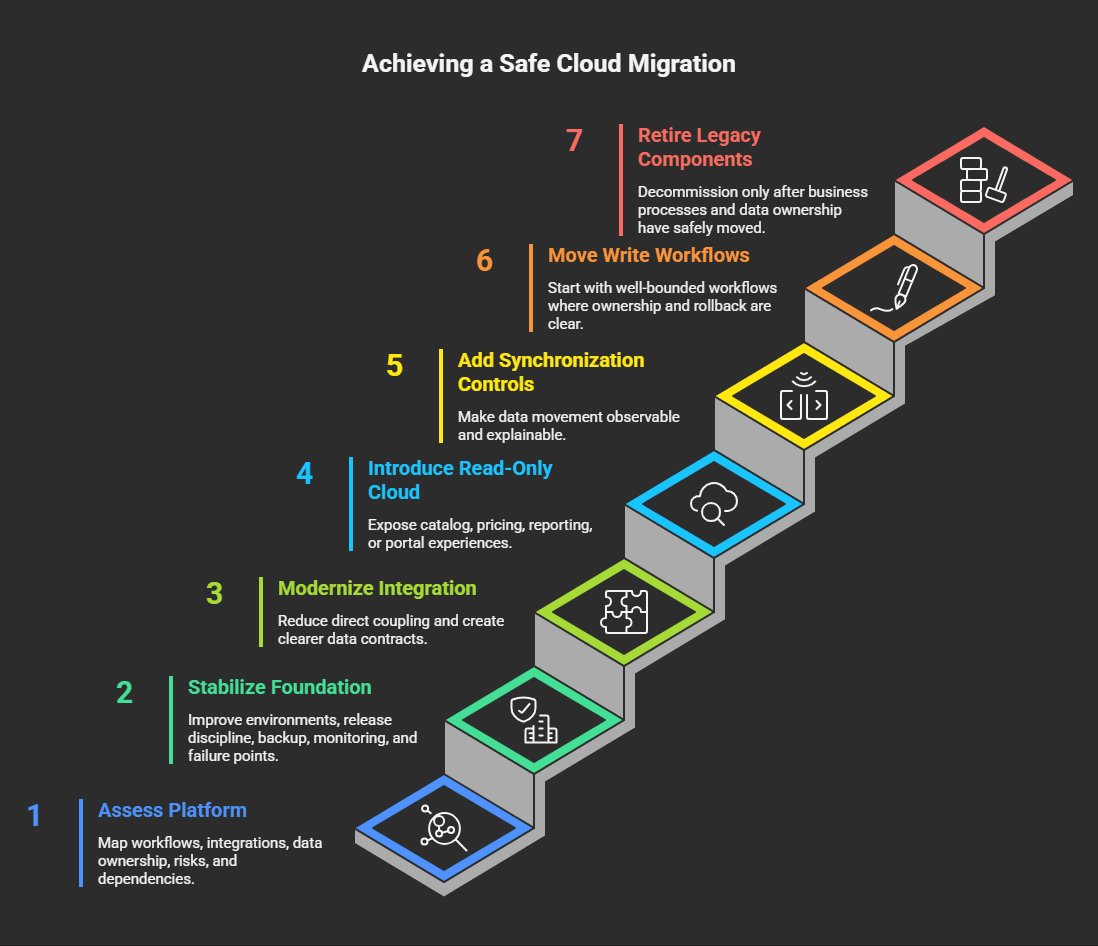
A Practical Migration Sequence
For many distribution and pricing platforms, a safe migration sequence looks like this:
- Assess the current platform
- Map workflows, integrations, data ownership, risks, and operational dependencies.
- Stabilize the foundation
- Improve environments, release discipline, backup, monitoring, and known failure points.
- Modernize the integration layer
- Reduce direct coupling and create clearer data contracts where needed.
- Introduce read-only cloud capabilities
- Expose catalog, pricing, reporting, or portal experiences without moving write authority too soon.
- Add synchronization and reconciliation controls
- Make data movement observable and explainable.
- Move selected write workflows
- Start with well-bounded workflows where ownership, audit, and rollback are clear.
- Retire legacy components gradually
- Decommission only after business processes, integrations, and data ownership have safely moved.
This sequence may feel slower than a pure lift-and-shift migration.
In practice, it often reduces rework, disruption, and business risk.
Common Mistakes to Avoid
Treating cloud migration as infrastructure-only
Hosting is only one part of the problem. The real complexity often sits in data ownership, integrations, workflows, and operational trust.
Moving writes too early
Read access is usually easier to migrate than write authority. Moving write operations before control and reconciliation are clear can create serious data consistency problems.
Ignoring hidden dependencies
Legacy systems often support reports, exports, spreadsheets, and informal operational workflows that are not visible in architecture diagrams.
Assuming real-time synchronization is always required
Some workflows need real-time behavior. Others can tolerate batch or delayed updates. The key is to define the requirement clearly instead of overengineering every flow.
Rebuilding without preserving business rules
Pricing and distribution platforms often contain years of business-specific rules. Losing those rules during modernization can create more harm than keeping older technology temporarily.
Underestimating rollback
Rollback must account for data changes, user actions, downstream integrations, and operational communication — not just application deployment.
Where Cloud Migration Can Create Real Value
When done carefully, cloud migration can improve distribution and pricing platforms in meaningful ways.
It can help teams:
- Improve resilience and recovery
- Reduce infrastructure constraints
- Support better API access
- Improve catalog search and performance
- Strengthen monitoring and operational visibility
- Separate high-volume read workloads from legacy systems
- Improve release discipline
- Support phased modernization
- Enable better reporting and analytics
- Reduce dependency on fragile legacy environments
But these benefits usually come from disciplined sequencing, not from moving everything at once.
Cloud migration creates value when it improves the platform’s ability to operate safely, change predictably, and support the business with less fragility.
The Leadership View
For platform leaders, the goal is not to make the architecture look modern.
The goal is to improve confidence.
Confidence that pricing data is correct.
Confidence that catalog changes are controlled.
Confidence that integrations are monitored.
Confidence that releases can be rolled back.
Confidence that users trust the system.
Confidence that modernization is reducing risk rather than moving it somewhere else.
That is why cloud migration for distribution and pricing platforms should be treated as a modernization program, not a hosting project.
The safest path is usually phased, observable, and grounded in how the business actually operates.
Final Thought
Distribution and pricing platforms carry operational weight.
They influence what customers see, what sales teams quote, what suppliers provide, what warehouses fulfill, and what finance teams reconcile.
Moving these systems to the cloud can be valuable, but only when the migration respects synchronization, control, rollback, and trust.
A strong migration does not begin with the question, “Which cloud service should we use?”
It begins with a more practical question:
What must remain stable while the platform changes?
That question leads to better architecture decisions, safer sequencing, and a modernization roadmap the business can trust.