
The most expensive modernization mistakes rarely come from bad intent. They come from pressure. When deadlines tighten, incidents escalate, or leadership demands movement, teams often choose visible action over sound sequencing. The result is not faster progress. It is avoidable risk.
Modernization decisions are often presented as strategic choices.
In practice, many of them are made under pressure.
A major customer is complaining.
A cloud cost review is turning political.
A security issue has surfaced.
A board conversation has created urgency.
An outage has exposed fragility the team already knew was there.
At that point, the question usually stops being, “What is the right modernization path?”
It becomes, “What can we do quickly that looks like progress?”
That shift is where expensive mistakes begin.
For teams responsible for live platforms, pressure does not remove the need for judgment. It increases it. That is why enterprise SaaS modernization has to be treated as a sequencing problem before it becomes an implementation program.
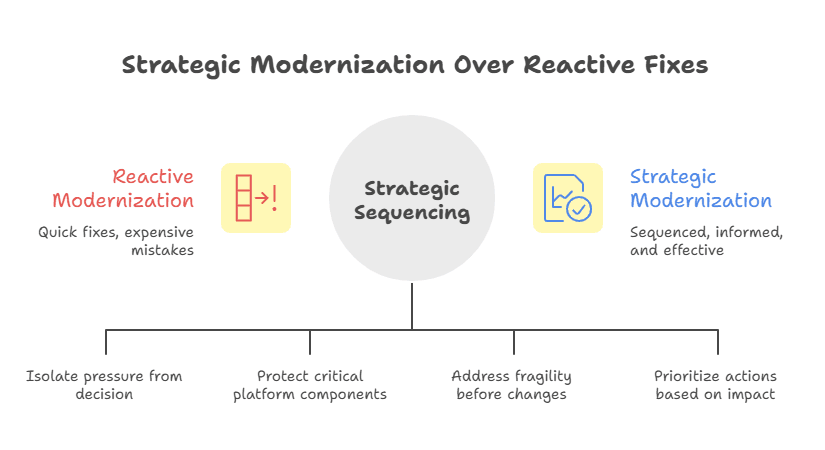
The Mistake Most Teams Make
Under pressure, teams often choose the decision that feels most legible rather than the one that is most defensible.
That usually shows up in familiar ways:
- announcing a rewrite because the current system feels frustrating
- starting a cloud migration because infrastructure has become the visible villain
- adding new tools, automation, or AI layers before stabilizing the platform underneath
- reorganizing architecture boundaries before dependencies are actually understood
- promising delivery dates before rollback paths, validation logic, and operational constraints are clear
None of those decisions are inherently wrong.
They become dangerous when they are made as a reaction to pressure instead of a response to evidence.
This is one reason why most SaaS rewrites fail. The problem is rarely ambition on its own. The problem is that pressure collapses analysis into action before the team has mapped what the platform can actually tolerate.
Pressure Distorts Modernization in Predictable Ways
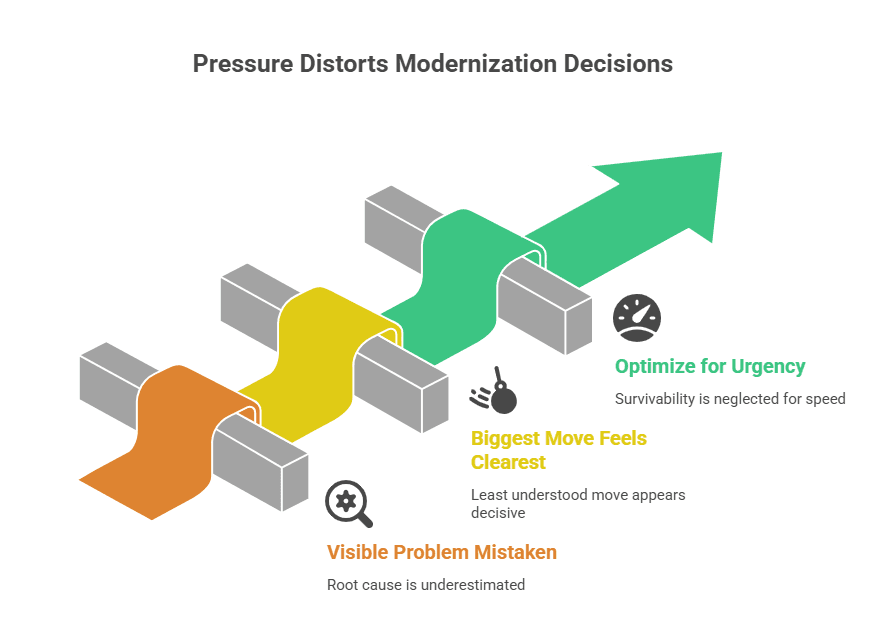
Pressure changes how organizations interpret risk.
Instead of asking, “What sequence reduces fragility?” teams start asking, “What decision signals momentum?”
Those are not the same question.
A pressure-shaped decision often has three characteristics.
1. The visible problem gets mistaken for the root problem
A slow release process gets blamed on the legacy stack.
But the deeper issue may be missing test confidence, unclear ownership boundaries, or brittle integrations.
A rising cloud bill gets blamed on infrastructure.
But the real problem may be poor workload assumptions, unnecessary coupling, or waste created by unstable architecture.
A security concern gets blamed on an old application.
But the actual exposure may sit in change discipline, permission design, auditability, or weak operational controls.
This is why legacy SaaS modernization should not start with code replacement by default. Mature systems usually carry architectural constraints, process debt, operational shortcuts, and business logic that are easy to underestimate when pressure is high.
2. The biggest possible move starts to feel like the clearest one
When leadership wants decisive action, incremental change can look too small.
That is misleading.
The largest move is often the least understood move.
A full migration, major replatform, or architectural reset may create the appearance of commitment, but that does not mean it reduces risk. In many production environments, it simply changes the location of the risk while making rollback harder.
Duskbyte’s approach and how we work both point in the opposite direction: assessment before execution, incremental change over rewrites, rollback-safe delivery, and stability before acceleration. That discipline matters most when the organization is tempted to move fastest.
3. Teams optimize for urgency instead of survivability**
Pressure makes speed feel expensive to slow down.
But the most expensive modernization work is usually the work that has to be redone, defended, rolled back, or politically unwound.
A decision is not strong because it moves quickly.
It is strong because it survives contact with reality.
For a live platform, that means asking:
- Can this be delivered in controlled phases?
- Can it be validated before the whole system depends on it?
- Can we isolate failure if the change behaves badly in production?
- Can the business tolerate the operational blast radius?
- Do we understand what should not be touched yet?
Those are not signs of hesitation.
They are signs of production maturity.
Where Pressure Creates the Most Expensive Mistakes
Not every modernization decision carries the same downside.
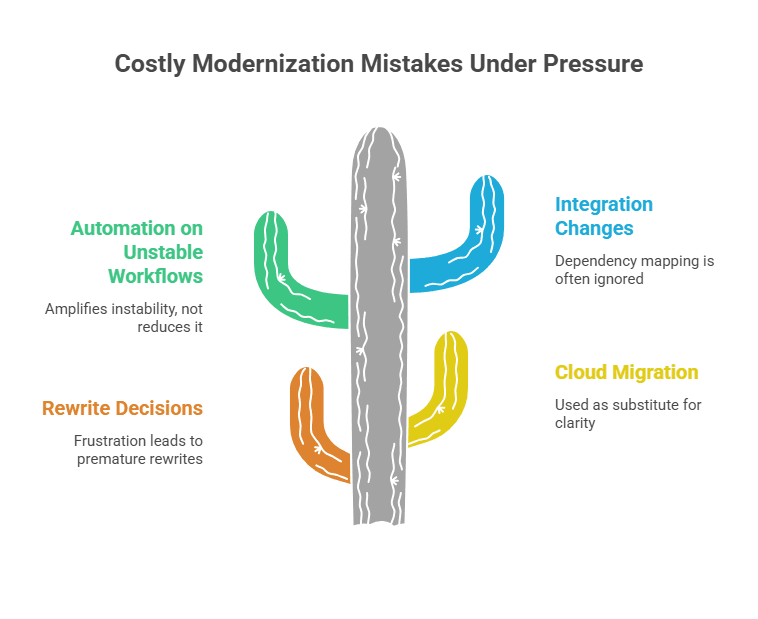
The most expensive errors tend to happen in four areas.
1. Rewrite decisions made from frustration
Frustration is understandable. It is not a reliable architecture input.
A hard-to-change system can make a rewrite feel rational long before it is necessary. But production systems contain more than visible code. They contain undocumented behavior, operational workarounds, exception paths, support assumptions, and years of encoded business decisions.
When a rewrite is chosen too early, the team usually creates two problems instead of one:
- the old platform still needs support
- the new platform now has to chase feature parity, edge cases, and operational reality at the same time
That is not simplification. It is a dual-maintenance burden.
2. Cloud migration used as a substitute for platform clarity
Cloud migration is often presented as a modernization answer.
It is not.
It can be part of a modernization strategy, but only when the platform is ready for the move and the move is properly sequenced.
A rushed migration often preserves the same release friction, the same coupling, the same weak observability, and the same support burden in a more expensive environment.
That is why SaaS cloud migration should be treated as an architectural and operational decision, not a badge of progress.
3. Automation and AI added on top of unstable workflows
When teams are under strain, automation, integrations, and applied AI can look like a quick way to create leverage.
Sometimes they are.
But when the workflow underneath is poorly governed, operationally brittle, or weakly instrumented, those additions amplify instability rather than reducing it.
Speed on top of ambiguity is not efficiency.
It is faster error propagation.
This is especially true in systems with approval logic, compliance exposure, customer communications, or high-volume operational workflows.
4. Integration changes made without dependency mapping
Integration-heavy systems are where pressure becomes operational very quickly.
A team may think it is changing one service boundary, one event flow, or one provider contract. In reality, it may be changing support processes, reconciliation logic, reporting assumptions, downstream automation, customer-facing behavior, and incident response paths all at once.
That is why integration work should be treated as a risk surface, not just a delivery task.
Speed Is Not the Enemy
There is a lazy version of this conversation that says, “Go slower.”
That is not the point.
Sometimes urgency is real.
Sometimes a team does need to move immediately.
But there is a difference between moving fast inside a controlled decision and moving fast because the decision itself is uncontrolled.
In production systems, good speed usually looks like this:
- narrow scope
- explicit rollback
- high observability
- limited blast radius
- reversible change
- clear success criteria
- known dependency boundaries
Bad speed usually looks like this:
- broad promises
- weak validation
- hidden dependencies
- overloaded teams
- architecture change without operational readiness
- no clear definition of what happens if the move fails
The issue is not motion.
It is whether the motion can survive production.
A Better Way to Decide Under Pressure
When modernization pressure is real, the goal is not to remove urgency from the room.
The goal is to stop urgency from making the architecture decision for you.
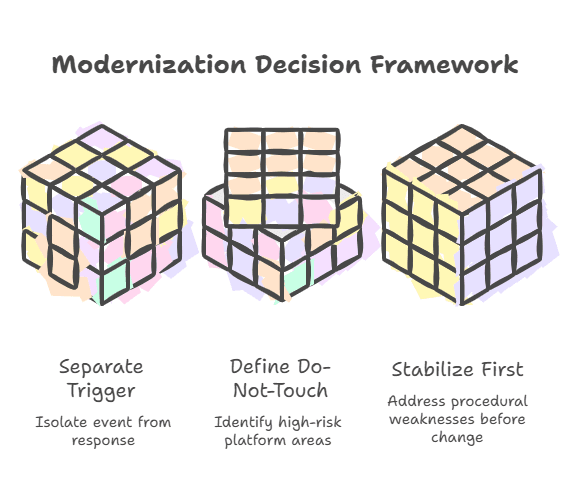
A safer pattern usually looks like this.
Step 1: Separate the trigger from the actual decision
The trigger might be an outage, cost concern, security issue, board request, or delivery slowdown.
But the modernization decision should not be whatever feels emotionally symmetrical to the trigger.
A cost spike does not automatically mean migration.
A brittle module does not automatically mean rewrite.
A delivery problem does not automatically mean a tooling change.
First separate the event from the response.
Step 2: Define the do-not-touch zones
Every mature platform has areas where change risk is disproportionately high.
These may include:
- revenue-critical workflows
- identity and access boundaries
- billing logic
- customer communications
- compliance-sensitive data handling
- high-volume integrations
- operational reporting dependencies
Under pressure, these areas are often exactly where teams overreach.
A strong modernization plan identifies these zones early and sequences around them deliberately.
Step 3: Decide what must be stabilized before it is modernized
Some systems do not need acceleration first. They need control first.
That may mean addressing:
- release confidence
- rollback procedures
- monitoring and alerting
- test reliability
- deployment discipline
- ownership boundaries
- operational documentation
This is why Duskbyte’s engineering practices matter in modernization work. Most expensive failures are procedural before they are technical. Poor sequencing and weak rollback plans create more damage than imperfect technology choices.
Step 4: Build a Now / Later / Not Yet view
Pressure creates all-or-nothing thinking.
Good modernization decisions resist that.
A stronger model is:
Now
What reduces risk immediately without increasing architectural chaos?
Later
What becomes safer once the platform is better understood or stabilized?
Not Yet
What is too expensive, too broad, or too poorly understood to defend right now?
That framing is especially useful for CTOs and platform leaders who need a decision structure they can explain internally without overcommitting the team.
The Real Cost of Getting This Wrong
An expensive modernization mistake does not just waste budget.
It creates secondary damage.
It reduces leadership confidence.
It increases delivery hesitation.
It makes future change harder to sponsor.
It burns engineering time on recovery rather than progress.
It turns a real platform problem into an organizational trust problem.
That is why the most valuable thing a team can do under pressure is not always to move first.
It is to decide in a way that preserves future options.
That usually means:
- understanding dependencies before changing them
- isolating risk before scaling the initiative
- stabilizing where needed before accelerating
- treating modernization as a phased operational decision, not a symbolic reset
In other words, pressure should narrow focus.
It should not narrow judgment.
Questions Worth Asking Before Committing
Before approving a major modernization move under pressure, leadership should be able to answer a few basic questions:
- What specific problem are we solving first?
- What evidence says this response is the right one?
- What are the key dependencies and hidden failure paths?
- What can be delivered in a reversible phase?
- What would make this decision harder to unwind six months from now?
- What should we explicitly defer until the platform is more stable?
- Are we reducing risk, or just relocating it?
If those questions cannot be answered clearly, the platform probably needs more assessment before it needs more implementation.