
In mature platforms, rollback is not a sign of failure. It is a sign of disciplined engineering. The teams that modernize safely design reversibility into the work before release pressure makes it necessary.
In mature production systems, rollback is often discussed as if it belongs at the very end of the delivery process.
A release goes wrong. A migration creates instability. A dependency behaves differently in production than expected. Then, and only then, someone asks whether the team can roll back.
That framing is already too late.
Rollback is not a rescue tactic for undisciplined change. It is one of the design conditions of safe change itself.
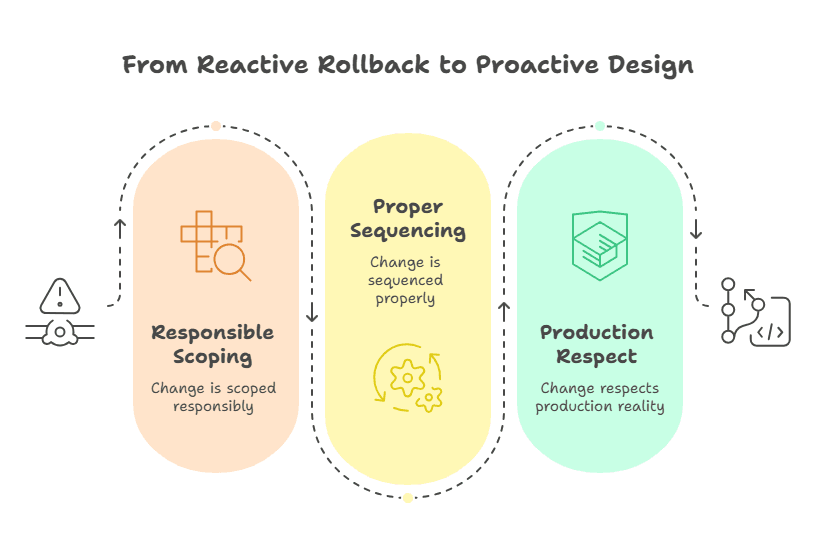
The teams that handle enterprise SaaS modernization, legacy system modernization, and AWS SaaS cloud migration well do not treat rollback as a panic button. They treat it as evidence that the change was scoped responsibly, sequenced properly, and introduced with respect for production reality.
That distinction matters because many modernization failures do not begin with bad intent or weak engineering. They begin with a planning model that assumes forward motion is the only direction that matters.
It rarely is.
The Mistake Most Teams Make
A lot of teams say they have rollback covered when what they really mean is this:
- they can redeploy the previous application version
- they can restore infrastructure from code
- they can revert a flag or configuration value
- they can probably recover if something goes wrong
That is not rollback strategy.
That is partial technical reversibility, often limited to one layer of the system.
Real rollback has to account for the full operational path of change: schema shifts, queue behavior, asynchronous jobs, third-party integrations, state mutations, customer-visible workflows, support implications, and the timing of recovery itself.
This is one reason how Duskbyte works and the broader modernization approach matter. In live systems, weak rollback planning usually points to a deeper issue: the change was designed as a technical event rather than an operational one.
A rollback path that only works in theory is not a rollback path. It is optimism with better vocabulary.
Why This Becomes More Dangerous in Mature Platforms
Rollback complexity grows with system maturity.
In early-stage systems, a failed deployment may be painful but contained. In enterprise platforms, the same failure can ripple across revenue workflows, customer access, data integrity, compliance obligations, or downstream integrations.
That is why rollback discipline matters more in systems with:
- active users and contractual uptime expectations
- tightly coupled services or legacy dependencies
- data models that have evolved through years of exceptions
- integration-heavy environments with partner or vendor dependencies
- regulated or audit-sensitive workflows
- change histories that already reduced team confidence
This is especially visible in sectors like customer communications and messaging platforms, where even a “small” change can affect routing, audit trails, suppression logic, or delivery behavior in ways that are hard to unwind cleanly.
The point is not that rollback is impossible in these environments.
The point is that rollback must be designed at the same level of seriousness as the release itself.
Rollback Works Best When It Shapes the Change Before the Change Happens
The best rollback plans do not sit in a forgotten section of a deployment document.
They influence architecture, rollout shape, and release scope before implementation is complete.
That usually means asking different questions earlier:
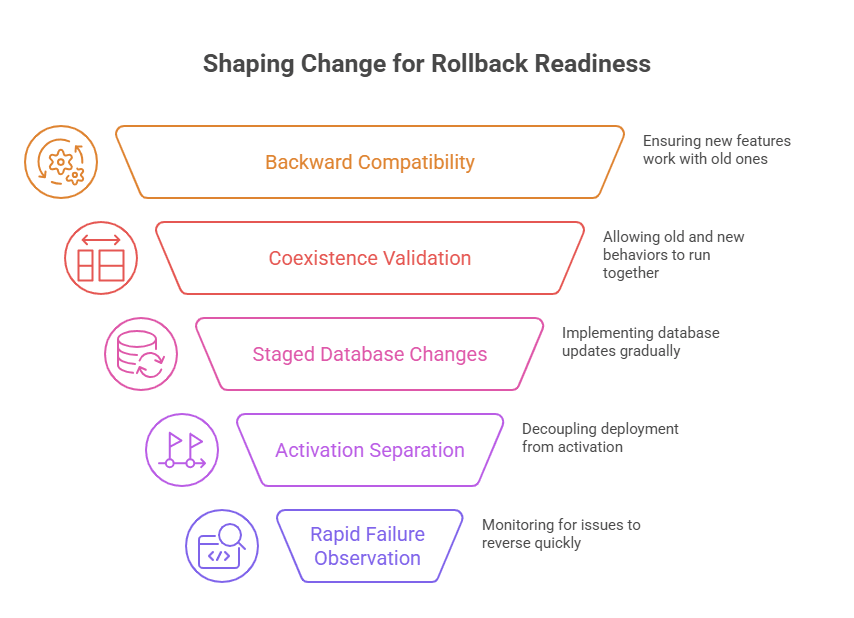
Can this change be introduced in a backward-compatible way?
Can old and new behavior coexist long enough to validate the transition?
Can database changes be staged instead of forced all at once?
Can activation be separated from deployment through flags, routing controls, or traffic segmentation?
Can the team observe failure quickly enough to reverse before the business impact widens?
Can rollback happen without creating a second incident?
These are not post-release questions. They are design questions.
That is also why safe modernization is usually incremental. As discussed in why most SaaS rewrites fail, large changes fail less often because the idea was wrong and more often because the team tried to cross too many risk boundaries at once.
Rollback becomes fragile when the change itself is too large to reverse cleanly.
Where Rollback Is a Real Strategy
Rollback is a real strategy when the team can reverse or contain change without introducing new ambiguity.
That usually looks like:
Backward-compatible application releases
The old version can still function against the current state long enough to restore stability.
Staged schema evolution
The database change is split into compatible phases rather than treated as a single irreversible event.
Traffic-controlled cutovers
A new path can be tested with limited exposure before becoming system-wide.
Queue and job isolation
Background processing can be paused, drained, or redirected without corrupting state.
Integration containment
Failures at external boundaries can be isolated instead of cascading through the platform.
Feature activation independent of deployment
The code can exist in production before the behavior is fully turned on.
In other words, rollback becomes credible when reversibility is built into the operating model, not stapled onto the end of delivery.
Where Teams Only Think They Have Rollback
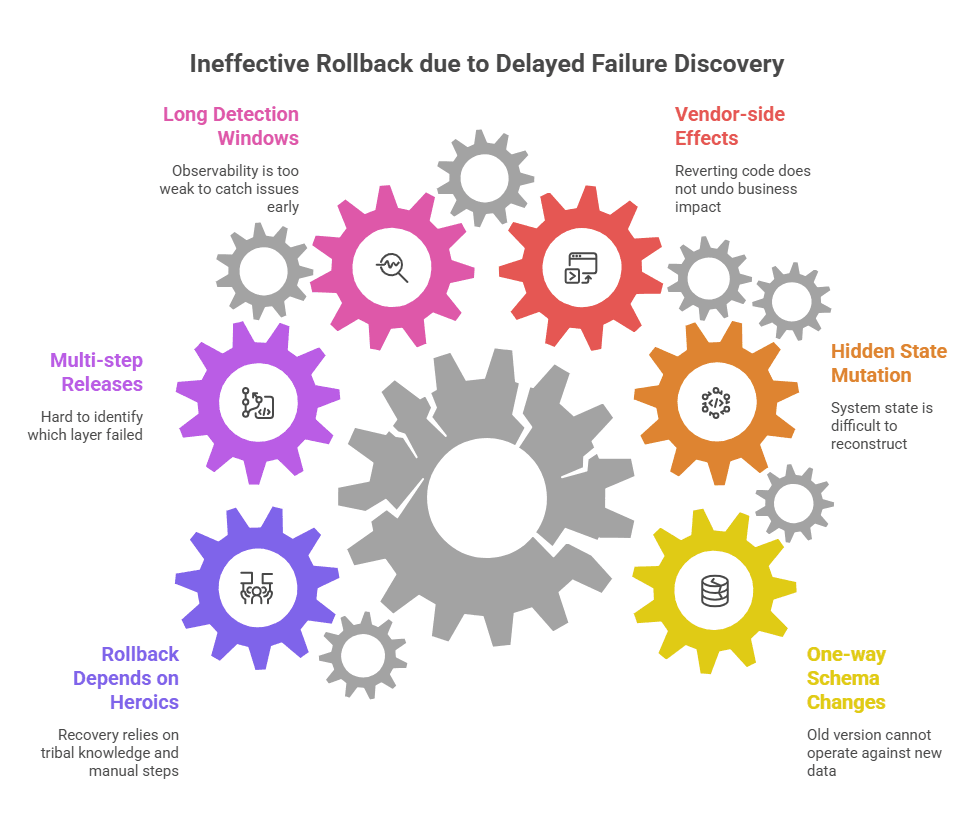
There are also many situations where teams talk about rollback, but what they really have is delayed failure discovery plus incomplete recovery options.
Common examples include:
One-way schema changes
The application can be redeployed, but the old version cannot safely operate against the new data model.
Hidden state mutation
A release changes system state in ways that are technically difficult to reconstruct.
Vendor-side effects
Messages were sent, webhooks fired, records synced, or external workflows triggered. Reverting code does not undo business impact.
Long detection windows
The team can reverse once they know something is wrong, but observability is too weak to catch the issue before customers do.
Multi-step releases without checkpoints
Several risky changes move together, making it hard to identify which layer actually failed.
Rollback that depends on heroics
Recovery exists, but only through tribal knowledge, manual steps, and a few people holding the system in their heads.
That is not safety.
That is survivability under stress, which is a very different thing.
The Real Role of Rollback in Modernization
Rollback is not there to make change feel safer than it is.
Its real purpose is to enforce discipline on the shape of change.
When a team knows it must preserve reversibility, the work changes.
Architectural boundaries become more explicit. Release scope becomes narrower. Validation checkpoints become more deliberate. Operational ownership becomes clearer. Risky coupling becomes harder to ignore.
This is why rollback belongs inside engineering practices, not only inside release notes.
It is also why it connects directly to automation, integrations, and applied AI. The more automation, orchestration, and system-to-system behavior you add to a live platform, the more important it becomes to understand what can be reversed, what can only be contained, and what must be introduced in stages.
Rollback does not make risk disappear.
It makes risk legible.
A Better Question Than “Can We Roll Back?”
By the time leadership is asking whether a change can be rolled back, they are often asking the wrong question.
A better question is:
What exactly are we prepared to reverse, how quickly can we do it, and what damage still remains even if we do?
That exposes the real maturity of the plan.
Because in many cases, the issue is not whether rollback is technically possible. The issue is whether the team has distinguished between:
- code reversal
- state recovery
- workflow containment
- customer impact mitigation
- downstream reconciliation
Those are not the same thing.
And when they get blurred together, executive confidence becomes artificially high right until the moment the platform proves otherwise.
Rollback Is Also a Leadership Signal
Strong rollback discipline does something beyond technical risk reduction.
It signals maturity.
It tells engineering, operations, and leadership that the goal is not performative momentum. The goal is controlled progress under real constraints.
That matters because many modernization programs become politically fragile before they become technically fragile. Trust erodes when teams push high-risk changes with no credible recovery path. Confidence drops when incidents reveal that rollback existed only as an assumption. Internal alignment weakens when “we can always revert” turns out to be false in practice.
The opposite is also true.
When a team can explain:
- what will change
- how exposure will be limited
- what will be measured
- when rollback would be triggered
- how recovery would actually work
the entire modernization effort becomes easier to support.
That is not just a delivery improvement. It is governance improvement.
How to Evaluate Rollback Readiness Honestly
For a live production platform, these questions are usually more useful than generic release confidence statements:
- Can old and new system behavior coexist safely during transition?
- Are database changes reversible, or only application deployments?
- What external side effects continue even if code is reverted?
- How quickly would the team detect failure under real traffic?
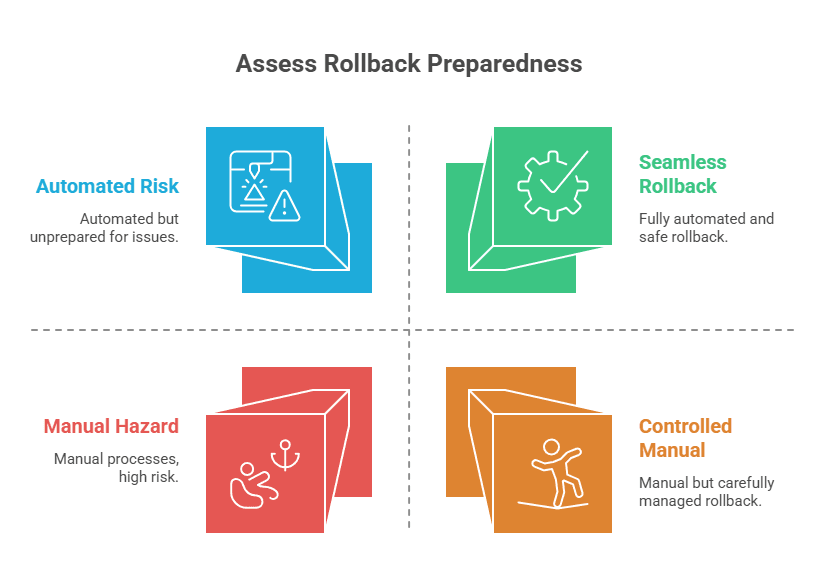
- Is rollback automated, rehearsed, or dependent on manual heroics?
- Can the team isolate the blast radius before full cutover?
- What customer, compliance, or operational effects remain after technical rollback?
- Which changes should be phased purely because they are hard to reverse cleanly?
If those questions create discomfort, that is useful.
It means the platform is telling you something about the real shape of the risk.
The Practical Takeaway
Rollback should not be treated as evidence that a team expects failure.
It should be treated as evidence that the team understands production systems well enough to respect uncertainty.
That is a healthier posture for any company modernizing an existing platform.
Especially in mature systems, rollback is not a backup thought. It is part of how responsible engineering decides what kind of change is acceptable in the first place.
The teams that modernize safely do not ask how to get away with larger leaps.
They ask how to make each step easier to validate, easier to contain, and easier to reverse.
That is what turns rollback from a comforting phrase into an actual strategy.