
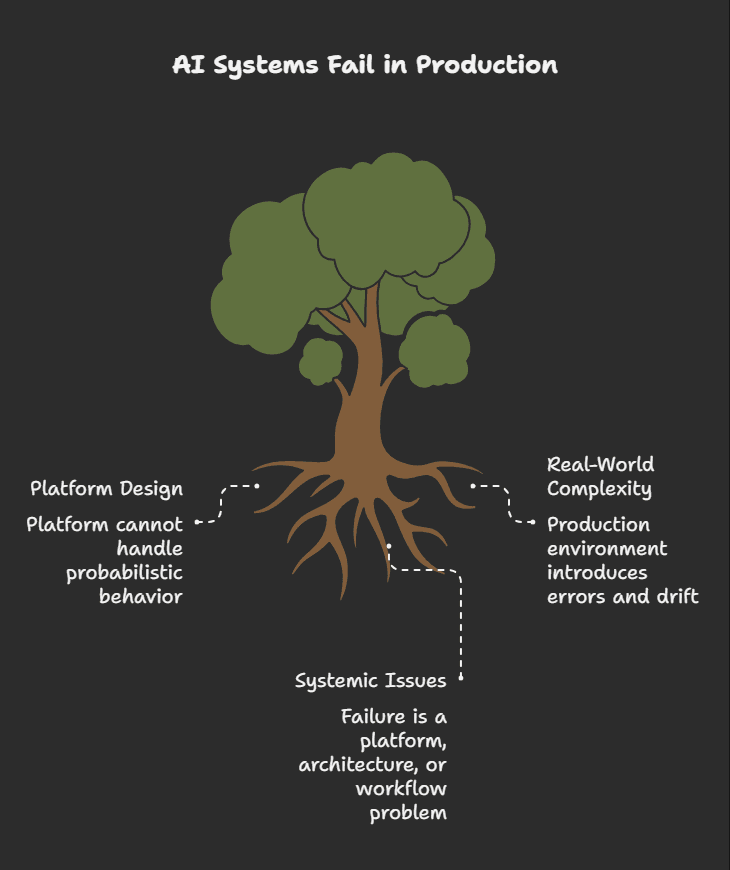
Most AI systems do not fail in production because the model is weak. They fail because the surrounding platform was never designed to absorb probabilistic behavior safely.
Most AI systems do not fail in production because the model is weak.
They fail because the surrounding platform was never designed to absorb probabilistic behavior safely.
That distinction matters. In a demo, an AI capability can look impressive very quickly. It can summarize documents, classify tickets, draft responses, extract entities, recommend actions, or answer operational questions with enough fluency to create internal momentum.
Production is where that confidence gets tested.
Once an AI system starts touching real workflows, real users, real data, and real operational dependencies, the question changes. It is no longer “Can the model do something useful?” It becomes “Can this system behave predictably enough inside a live environment where errors, drift, latency, ambiguity, and escalation all carry cost?”
That is rarely just an AI question. It is usually a platform question, an architecture question, and a workflow-control question. In many cases, it sits directly inside broader enterprise SaaS modernization work rather than outside it.
The mistake most teams make
The most common mistake is treating AI as a feature insertion problem.
A team identifies a use case, wires a model into an existing workflow, adds a prompt layer, and assumes the main challenge is model quality. But production behavior is not determined by the model alone. It is determined by how the full system handles uncertainty.
That includes:
- what data reaches the model
- what context is missing
- how outputs are validated
- where confidence breaks down
- what happens when the model is wrong
- how decisions are logged
- how downstream systems react
- how operators intervene
- how the release is monitored over time
A model can be impressive and still be unsafe inside a live workflow.
This is especially true in environments with brittle admin processes, legacy services, unclear ownership boundaries, or messy system dependencies. In those cases, AI does not remove operational complexity. It exposes it faster. What looks like an AI rollout often turns into a legacy system modernization or automation, integrations, and applied AI problem within weeks.
Production failure usually starts before the model runs
Most production issues begin upstream or downstream of inference.
The model is only one component in a longer chain: event triggers, data shaping, context retrieval, orchestration, business rules, access control, fallback logic, human review, logging, and downstream execution. Weakness in any of those layers can make a reasonable model look unreliable.
That is why AI systems often fail in production in six predictable ways.
1. The workflow boundary is unclear
A surprising number of AI implementations are inserted into workflows that have never been clearly defined.
The team knows they want “AI support” for ticket handling, claims review, document processing, pricing analysis, customer communication, or internal search. But they have not properly separated the workflow into deterministic steps, probabilistic steps, approval points, and non-negotiable controls.
That leads to a familiar pattern:
The AI is expected to do too much.
Exceptions are not designed for.
Ambiguous cases have nowhere to go.
The human role is poorly defined.
And the system begins to drift between assistant, recommender, and decision-maker without explicit control.
In production, that becomes dangerous.
AI works better when the workflow boundary is narrow and explicit. It struggles when the organization has not decided which decisions must remain controlled, which outputs are advisory, and which paths require structured escalation.
This is one reason AI adoption in mature systems often needs a stronger approach to modernization before feature delivery. The core issue is not whether the model is capable. It is whether the workflow can tolerate its behavior.
2. The data and integration layer is weaker than the demo suggested
Many AI pilots are built on curated inputs.
Production environments are not curated.
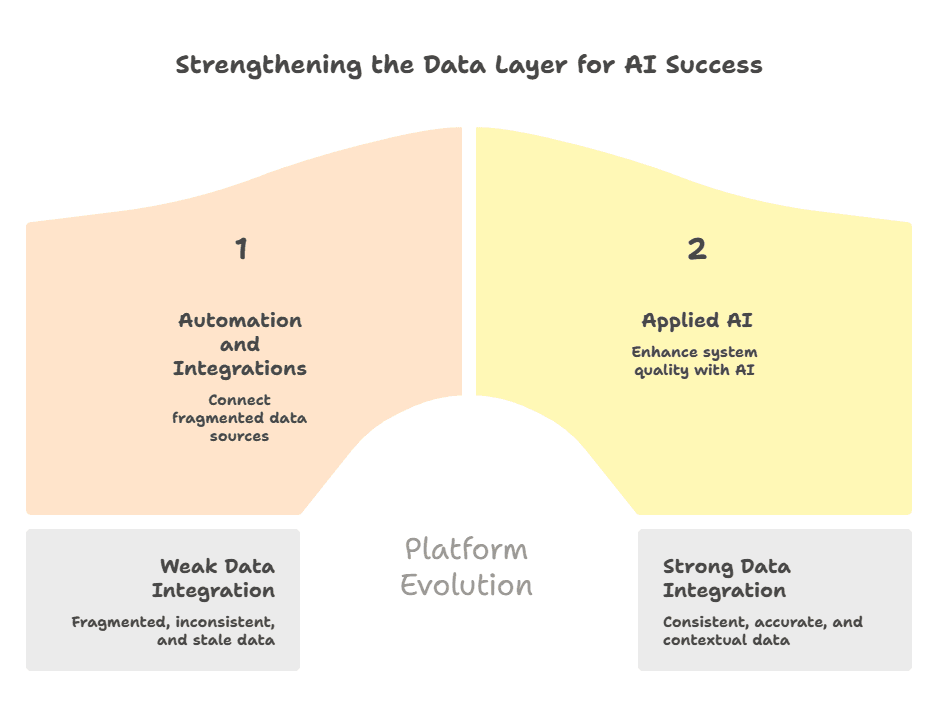
Real systems have fragmented data models, inconsistent naming, partial records, stale states, duplicate entities, broken assumptions, and context split across multiple services. They also have live dependencies that do not respond well to ambiguous output.
This is where AI systems run into trouble quickly.
A support assistant might draft strong responses in test mode, then fail once CRM records are incomplete, entitlement data is missing, or product state is inconsistent across systems. A document-processing flow may look accurate until exceptions, malformed uploads, policy variants, and customer-specific templates appear at scale. A recommendation engine may perform well until upstream pricing, inventory, or user intent signals become contradictory.
At that point, the real problem is no longer the model. It is the operational condition of the surrounding platform.
In many organizations, that work belongs inside automation, integrations, and applied AI and broader platform evolution, not inside another round of prompt tuning.
AI amplifies the quality of the system around it.
It does not quietly fix platform disorder.
3. Evaluation is too abstract to protect the business
A common enterprise mistake is evaluating AI systems with technical optimism rather than workflow realism.
Teams measure response quality, benchmark outputs, compare prompts, and track general accuracy. Those things matter, but they are not enough.
Production evaluation has to answer harder questions:
- What kinds of mistakes are acceptable here?
- Which errors are reversible, and which are expensive?
- Where does ambiguity create downstream rework?
- What confidence threshold is actually safe for this workflow?
- How often do humans override the output?
- What failure patterns emerge by segment, channel, or document type?
- What happens after the output enters a live operational path?
Without that level of evaluation, teams ship systems they cannot defend operationally.
This is why many AI programs appear successful in internal demos yet lose trust after rollout. The business is not evaluating the model in isolation. It is evaluating whether the system reduces friction without creating new uncertainty.
If the answer is unclear, adoption slows, operators work around the system, and AI becomes another layer of review overhead rather than a meaningful improvement.
A more useful question than “Where can we add AI?”
A better question is this:
Where can this system tolerate probabilistic behavior without creating hidden operational risk?
That framing changes the conversation immediately. It moves the discussion away from hype and toward control, observability, workflow design, and architectural readiness.
That is a much better decision lens for teams operating live systems.
4. There is no serious fallback design
This is one of the clearest differences between a demo and a production system.
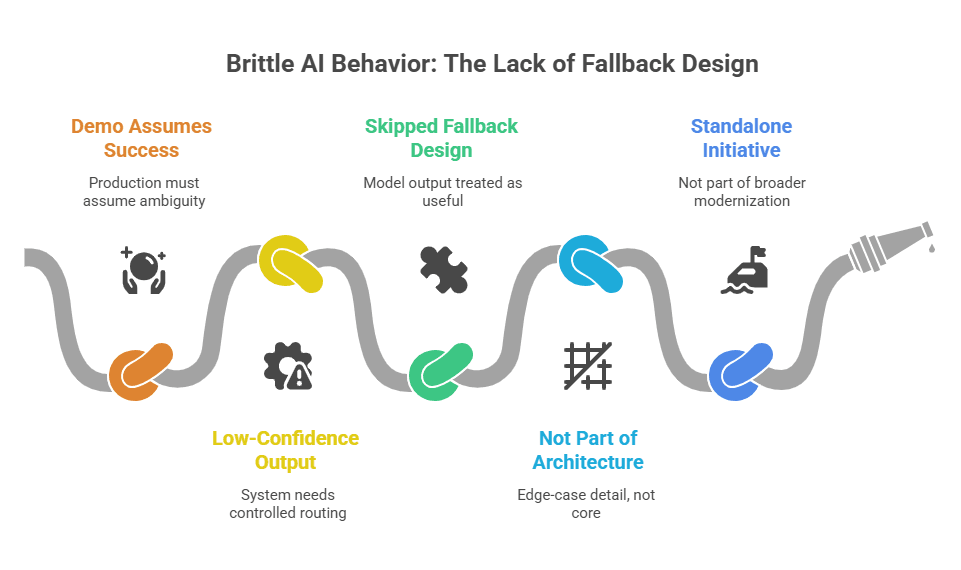
A demo assumes success.
A production system must assume ambiguity.
When the model output is low-confidence, contradictory, incomplete, delayed, or contextually unsafe, the system needs somewhere controlled to go. That might mean routing to a human queue, switching to a deterministic rule path, narrowing the action set, blocking execution, or triggering a review state with captured context.
Too many AI systems skip this.
Instead, the model output is treated as inherently useful, and the rest of the workflow is left to improvise around it. That is how organizations create brittle AI behavior without intending to.
Fallback design is not an edge-case detail. It is part of the product and platform architecture. In mature environments, it should be designed with the same seriousness as rollback planning, access control, and release safety.
That is also why AI rarely succeeds as a standalone initiative. In many live systems, safe adoption is part of broader enterprise SaaS modernization, not a separate track.
5. Release discipline is treated as optional
There is still a tendency to frame AI shipping as experimentation rather than production change control.
That mindset does not last once the system is tied to real operations.
AI systems need controlled releases because their behavior is not static. Prompt changes, context-window changes, retrieval logic changes, policy updates, model swaps, and orchestration changes can all materially alter outcomes. Even if the code footprint looks small, the operational impact may not be.
That means teams need:
- version control for prompts and policies
- clear environment separation
- rollback-safe deployment practices
- structured evaluation before release
- production observability
- exception tracking
- human feedback capture
- change logs that explain why behavior changed
Without that discipline, AI systems become difficult to trust. People stop knowing whether the problem is the model, the retrieval layer, the orchestration logic, the data source, or the release itself.
In some organizations, this also exposes underlying infrastructure and delivery weaknesses that were already present. That is where AI readiness starts intersecting with how Duskbyte works, broader delivery controls, and in some cases SaaS cloud migration decisions.
6. Governance arrives too late
AI governance is often introduced after the rollout starts feeling risky.
By then, the architecture has already formed around convenience.
That creates avoidable tension. Security wants traceability. Compliance wants defensible behavior. Operations wants control. Leadership wants value. Engineering wants to keep moving. But the system has already been wired together without a clear position on access boundaries, auditability, prompt ownership, policy enforcement, sensitive data handling, retention rules, or model-provider constraints.
In production, those questions cannot stay abstract.
Governance is not there to slow the system down. It is there to make the system survivable inside a real business context. That is particularly important in regulated, communication-heavy, document-heavy, or operationally sensitive environments, where a plausible answer is not the same thing as a safe outcome.
Where AI tends to work better
AI usually performs better in production when the surrounding conditions are disciplined.
That does not mean the system has to be perfect. It means the use case is bounded well enough that uncertainty can be contained.
In practice, stronger production use cases often share a few characteristics:
- the workflow boundary is explicit
- the output is advisory or reviewable
- the downstream action path is controlled
- the data context is narrow enough to trust
- exceptions can be routed cleanly
- operators can override the result
- the business can define what “good enough” actually means
- the surrounding platform is stable enough to support observability and iteration
That is why the best enterprise AI adoption usually feels less dramatic than expected. It is not a big leap into autonomy. It is a controlled extension of an existing platform, introduced where the operating model can absorb it.
What to assess before you roll AI into a live environment
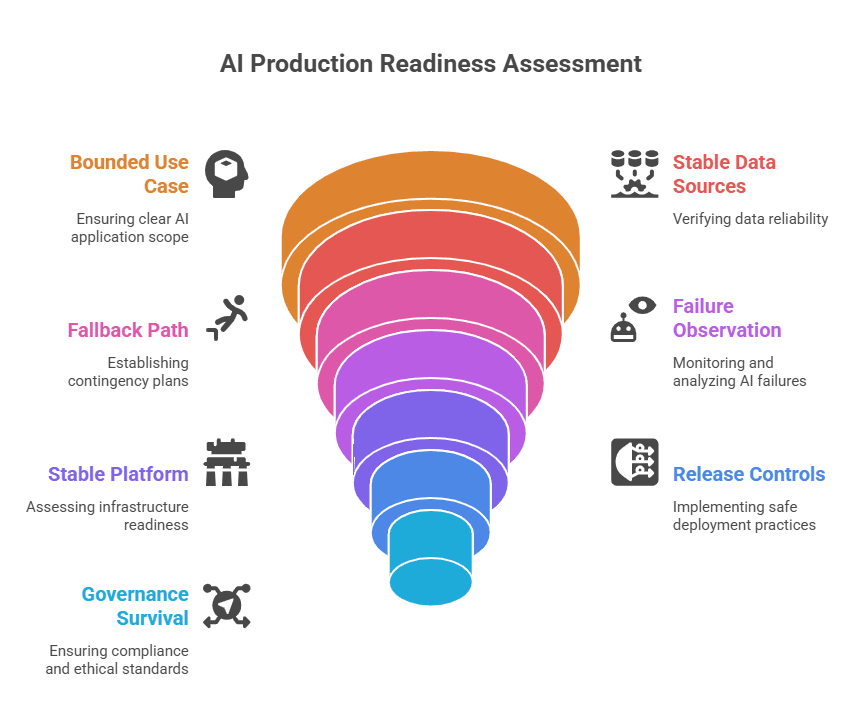
Before pushing AI deeper into production, leadership teams usually need clearer answers to a few practical questions:
Is this use case actually bounded, or are we asking the model to compensate for workflow ambiguity?
Are the relevant data sources stable enough to support reliable output?
Do we have a defined fallback path when the model is uncertain or wrong?
Can we observe failure patterns in a way the business can act on?
Are we introducing AI into a stable platform layer, or into an area that already needs legacy system modernization?
Are release controls mature enough to manage behavior changes safely?
If governance becomes a concern later, will the current design survive that scrutiny?
Those are platform questions before they are AI questions.
The real production lesson
Most AI systems fail in production because organizations treat intelligence as the product when it is really only one component inside a larger operating system.
The surrounding platform decides whether that intelligence becomes useful, governable, and trusted, or whether it becomes another source of ambiguity inside an already stressed environment.
That is why serious AI adoption usually looks less like rapid feature rollout and more like disciplined system design.
Not because the organization is moving slowly.
Because production environments punish uncertainty that has not been architected properly.