A practical guide to modernizing customer communications platforms safely while preserving delivery reliability, template integrity, auditability, integrations, and operational continuity.
Customer communications platforms are rarely simple systems.
What looks, from the outside, like a messaging or document-delivery product often sits at the center of highly sensitive operational workflows. Templates, content rules, approval chains, delivery logic, regulatory constraints, customer preferences, event triggers, and third-party integrations are all tightly connected.
That is why modernization in this category is rarely just a technology upgrade.
It is a controlled change to a platform that may already support billing notices, policy communications, compliance-heavy customer messaging, transactional email, print generation, or regulated document delivery at scale.
In these environments, the main risk is not that the architecture is old.
The main risk is breaking delivery, traceability, or operational trust while trying to improve the system.
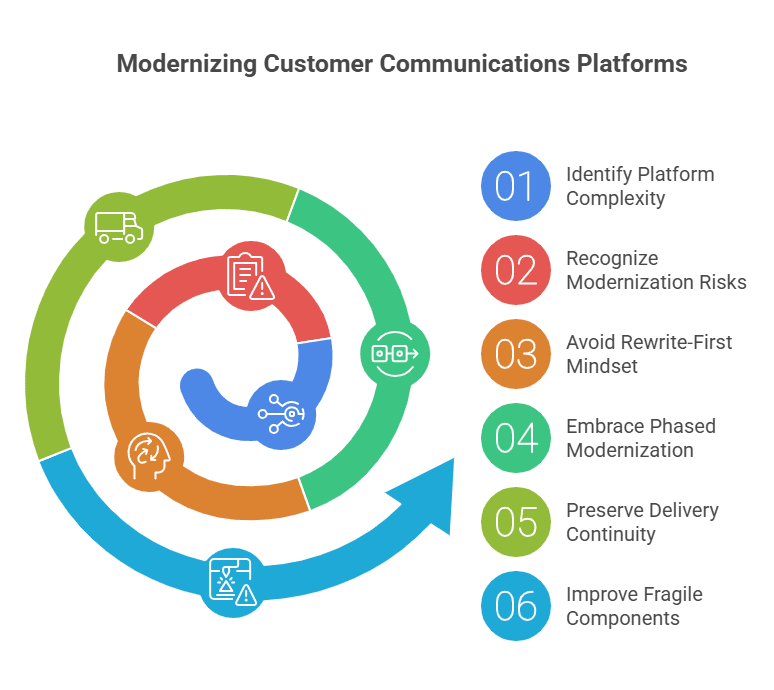
That is why customer communications platforms should not be modernized through a rewrite-first mindset.
The safer path is usually phased modernization: preserving delivery continuity while improving the parts of the platform that are creating fragility, delay, or unnecessary operational cost.
Why modernization is harder in customer communications platforms
Customer communications and messaging platforms often carry a type of complexity that is easy to underestimate.
The platform may generate output across multiple channels. It may depend on customer data coming from upstream systems that are inconsistent, delayed, or only partially normalized. It may support document templates with years of embedded business logic. It may include routing rules, approval workflows, branding variations, archival requirements, or language-specific output behavior.
On top of that, these systems often operate under stronger expectations than ordinary internal software.
A delay, formatting error, missing attachment, duplicate send, broken suppression rule, or incorrect template merge can quickly become a customer issue, a compliance issue, or a reputational issue.
That means modernization cannot be judged only by code quality or architecture goals.
It has to be judged by whether the platform continues to produce correct, traceable, and timely communications while change is underway.
The wrong first move: replacing everything at once
A common failure pattern in this category is attempting full replacement too early.
A team sees that the current platform is monolithic, brittle, difficult to update, or overly dependent on legacy template logic. The natural reaction is to define a cleaner future-state platform and try to move all channels, templates, workflows, and delivery paths into it at once.
On paper, that sounds efficient.
In practice, it usually concentrates too much risk.
Customer communications platforms are rarely held together by technology alone. They are held together by hidden operational assumptions. Support processes, client-specific formatting expectations, downstream document handling, manual interventions, exception paths, and approval behavior all accumulate over time.
A full replacement program often discovers these realities late, when rollback is expensive and delivery confidence is already under pressure.
That is why the better first question is not:
How do we replace the current platform?
It is:
Which parts of the current platform are creating the most risk, drag, or delivery fragility, and how can we improve them without destabilizing the output path?
Start with delivery-critical mapping
Before changing architecture, map the delivery system as it actually works.
That means understanding more than application modules.
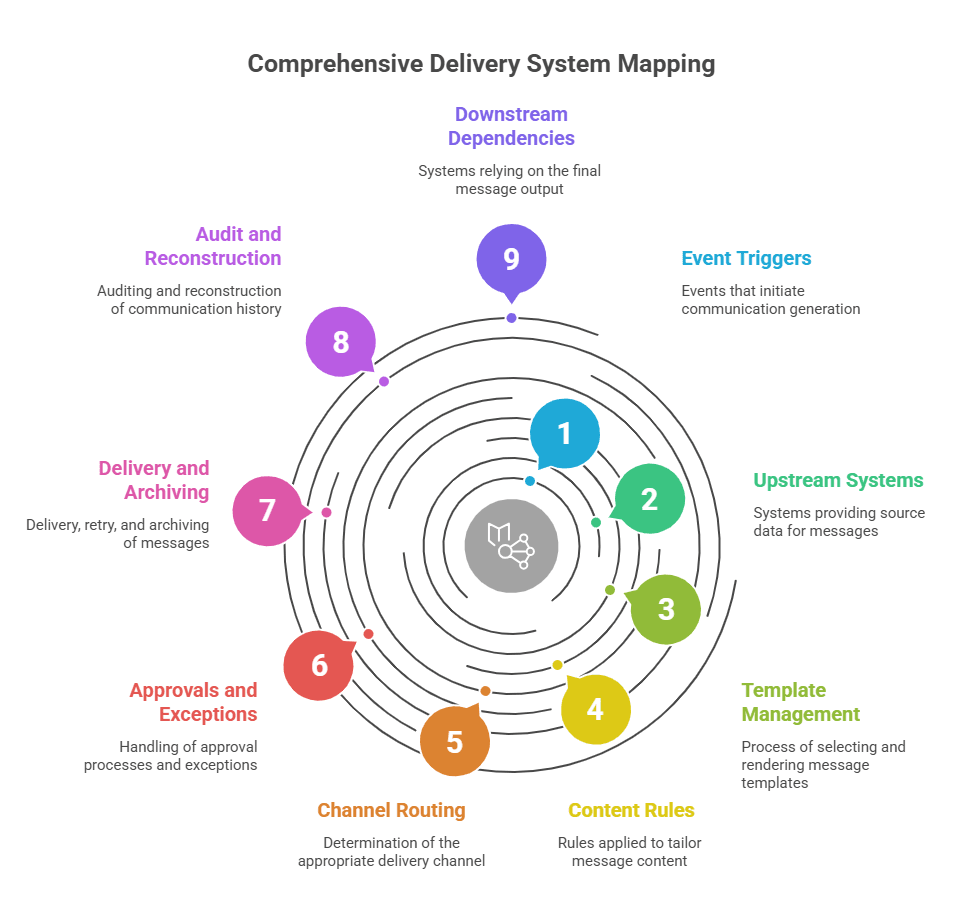
You need to see the full communication lifecycle:
- what events trigger communication generation
- which upstream systems provide the source data
- how templates are selected and rendered
- where content rules are applied
- how channel routing is determined
- how approvals or exceptions are handled
- how messages are delivered, retried, archived, or audited
- what downstream systems depend on the final output
In many platforms, this map reveals that the highest-risk parts of the system are not always where the oldest code lives.
Sometimes the most fragile area is the integration layer. Sometimes it is template management. Sometimes it is status tracking or audit reconstruction. Sometimes it is the operational tooling around retries, failures, and support triage.
Without this map, modernization tends to target visible technical pain while ignoring the delivery path that matters most.
Protect template integrity before touching rendering logic
In customer communications platforms, templates are often where business and compliance complexity accumulates.
A template may contain legal phrasing, customer-specific variations, dynamic blocks, conditional logic, channel behavior, regional rules, language support, or formatting constraints that have evolved over years. Even when the rendering engine is outdated, the template layer often contains the practical truth of how communications are supposed to behave.
That is why template modernization needs to be handled carefully.
Before changing engines, storage models, or composition patterns, teams should understand:
- which templates are actually active
- which are channel-specific or customer-specific
- where business rules live today
- how approvals happen
- how changes are tested before release
- what output must remain identical or materially equivalent
Template integrity is not just a design concern.
It is part of platform trust.
If modernization improves architecture but introduces subtle output variance, broken personalization, or inconsistent formatting, the platform may become technically cleaner while becoming operationally less reliable.
Separate platform concerns before separating services
In many customer communications platforms, the problem is not simply that the system is monolithic.
The deeper problem is that different concerns are tightly tangled together.
For example:
- template management may be mixed with rendering logic
- rendering may be mixed with delivery routing
- delivery tracking may be mixed with support tooling
- business rule evaluation may be mixed with data transformation
- archival and audit behavior may be mixed with communication generation
Trying to extract services before clarifying these responsibilities often turns one fragile platform into several fragile services.
A safer sequence is to separate concerns inside the current platform first.
That can mean isolating template administration, clarifying the event-to-message pipeline, formalizing rendering inputs and outputs, separating channel dispatch from communication composition, or making audit/state transitions explicit.
This kind of preparation reduces coupling before service extraction ever begins.
It also creates a better basis for later modernization decisions.
Modernize the delivery path in layers
In this category, layered modernization is usually safer than wholesale replacement.
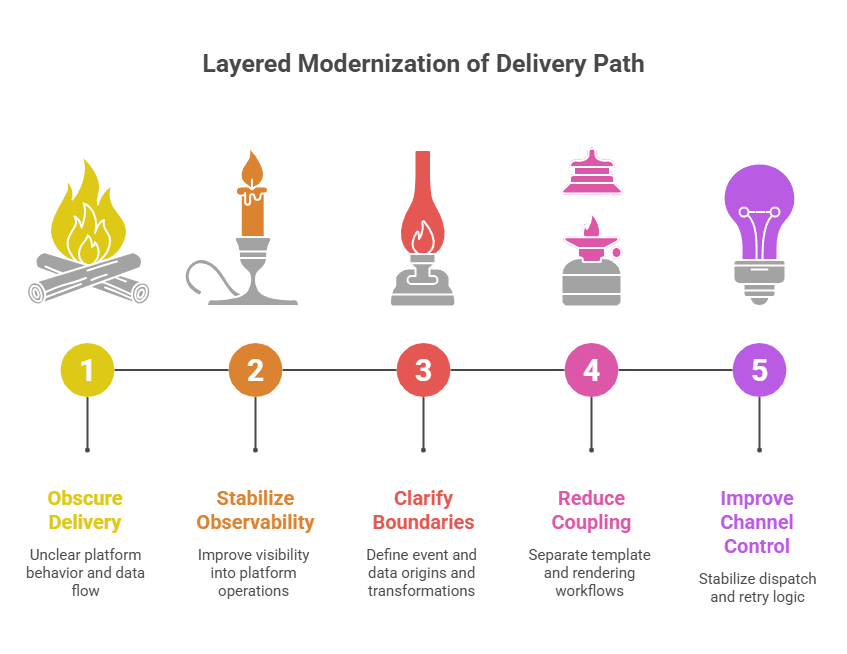
A practical sequence often looks like this:
1. Stabilize observability and delivery visibility
Before changing core behavior, improve the ability to see what the platform is doing.
That includes communication status tracking, failure visibility, retry behavior, audit trails, processing latency, template release tracking, and operational dashboards.
If the team cannot see what is happening clearly, deeper modernization will become harder to validate.
2. Clarify event and data boundaries
Make it easier to understand where communication requests originate, what data is required, and how that data changes before output is generated.
This helps reduce hidden transformation logic and makes future modularization more realistic.
3. Reduce coupling in template and rendering workflows
Separate administration, composition, rendering, and channel-specific formatting where possible.
This creates cleaner seams without forcing immediate platform-wide rearchitecture.
4. Improve channel dispatch and retry control
Email, SMS, print, PDF generation, and other delivery channels often have different operational characteristics. Stabilizing dispatch logic, retries, suppression handling, and failure routing can remove major risk without disturbing the full communication model.
5. Extract carefully chosen capabilities only after the boundary is proven
Once visibility, inputs, outputs, and responsibilities are clearer, the platform can support more confident extraction of specific capabilities.
The first extracted capability should be chosen because it reduces real risk or operational drag, not because it looks architecturally fashionable.
Auditability is not a side feature
Many teams treat audit and traceability as secondary concerns during modernization.
In customer communications platforms, that is a mistake.
For many organizations, it is not enough to say that a communication was sent. They need to know:
- what triggered it
- what template version was used
- what data was merged into it
- what delivery path was selected
- whether it succeeded or failed
- what retries or exceptions occurred
- what final output was generated
- whether it was archived or made retrievable later
This becomes even more important in regulated environments, where the platform may need to support reconstruction, evidence, retention requirements, approval history, or strict change control.
If modernization weakens this chain of traceability, the platform may become less trustworthy even if it becomes more maintainable.
That is why audit behavior should be treated as a core platform concern, not an afterthought.
Integration continuity matters as much as application design
Customer communications platforms are usually integration-heavy.
They often depend on CRMs, policy systems, billing systems, account platforms, customer preference systems, data warehouses, print providers, identity systems, and external delivery providers. In some cases, they also feed archives, reporting tools, support interfaces, or downstream reconciliation processes.
That means modernization has to preserve more than internal behavior.
It has to preserve continuity at the edges.
A platform can appear stable in isolation while quietly breaking assumptions in connected systems.
That is why integration mapping should identify:
- upstream source systems and data contracts
- message ingestion patterns
- downstream dependencies on generated output or status
- delivery provider dependencies
- failure and retry behavior across system boundaries
- monitoring gaps between the platform and connected systems
In many modernization efforts, the integrations become the real source of risk.
Ignoring them early usually creates surprises late.
Choose the first modernization slice carefully
The first change should build confidence, not consume it.
A strong first modernization slice is one that is meaningful enough to improve the platform, but narrow enough to control safely.
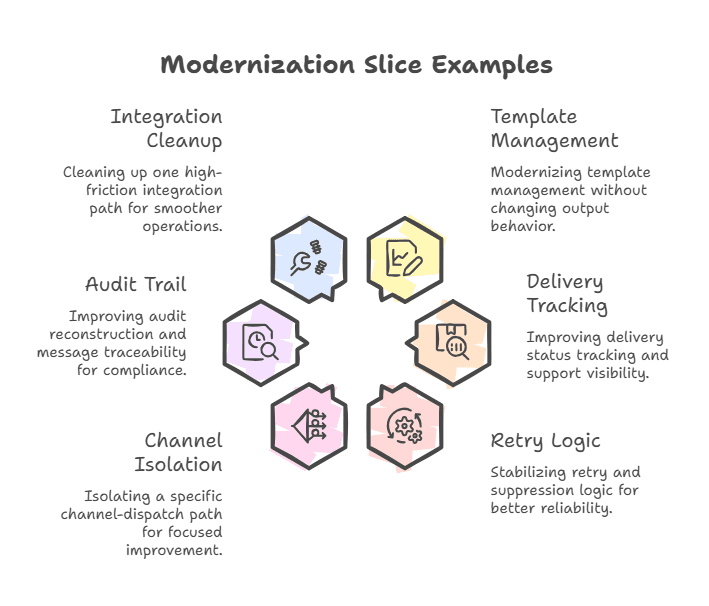
Examples might include:
- modernizing template management without changing output behavior
- improving delivery status tracking and support visibility
- stabilizing retry and suppression logic
- isolating a specific channel-dispatch path
- improving audit reconstruction and message traceability
- cleaning up one high-friction integration path
The point of the first slice is not to prove that the future architecture is complete.
It is to prove that the platform can be improved without disrupting delivery.
That matters far more in this category than architectural ambition.
What not to do
Several patterns repeatedly create avoidable risk in customer communications platform modernization.
Do not begin with broad template migration without output validation
Moving template logic to a new system without strong output comparison creates hidden delivery risk.
Do not treat all channels as if they behave the same way
Email, print, documents, and transactional event streams often have different operational and compliance characteristics.
Do not separate services before clarifying responsibility boundaries
Service extraction should follow understanding, not replace it.
Do not overlook support and exception workflows
Manual interventions, reprocessing paths, and support-side workarounds are often part of the real operating model.
Do not reduce audit depth in exchange for architectural neatness
A cleaner system that cannot reconstruct communication behavior may be a worse platform in practice.
Do not assume integration continuity will take care of itself
Upstream and downstream dependencies must be designed through the transition, not rediscovered during rollout.
A better modernization mindset
Customer communications platforms should be modernized with the same mindset used for other high-consequence production systems:
- understand the real system first
- protect operational trust while changing architecture
- separate concerns before separating services
- improve visibility before deep structural change
- modernize the highest-risk friction points first
- preserve traceability, delivery continuity, and rollback paths throughout the transition
That approach may look slower than a replacement-first plan.
In practice, it is often the faster path to useful progress because it reduces rework, avoids preventable incidents, and lets the team modernize while the platform continues to serve the business.
Final thought
A customer communications platform does not succeed because it uses modern tooling.
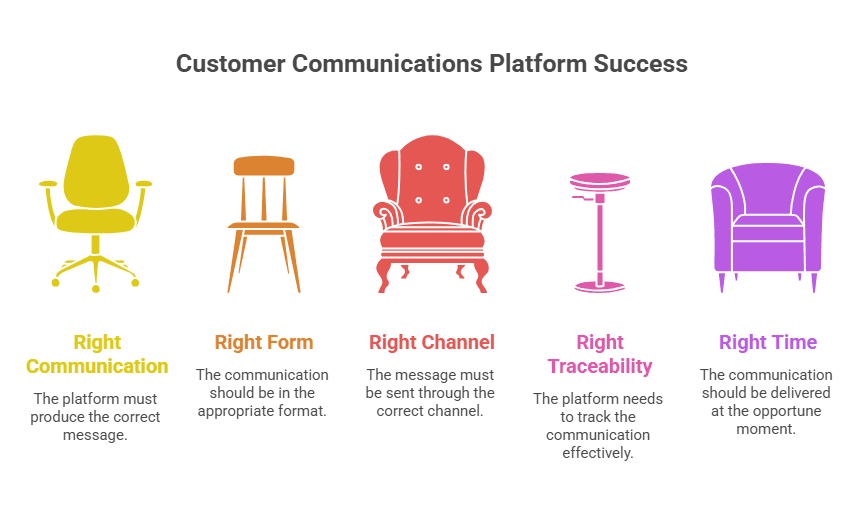
It succeeds because it produces the right communication, in the right form, through the right channel, with the right traceability, at the right time.
Modernization should strengthen that outcome, not put it at risk.
That is why the best modernization work in this category is rarely a dramatic reset.
It is a disciplined sequence of changes that reduces fragility, improves control, and protects delivery while the platform evolves.