
AI does not fail in enterprise platforms because the model is weak. It fails because teams introduce it into live systems without the architecture needed to control behavior, permissions, cost, fallback, and trust.
A lot of enterprise AI work still begins in the wrong place.
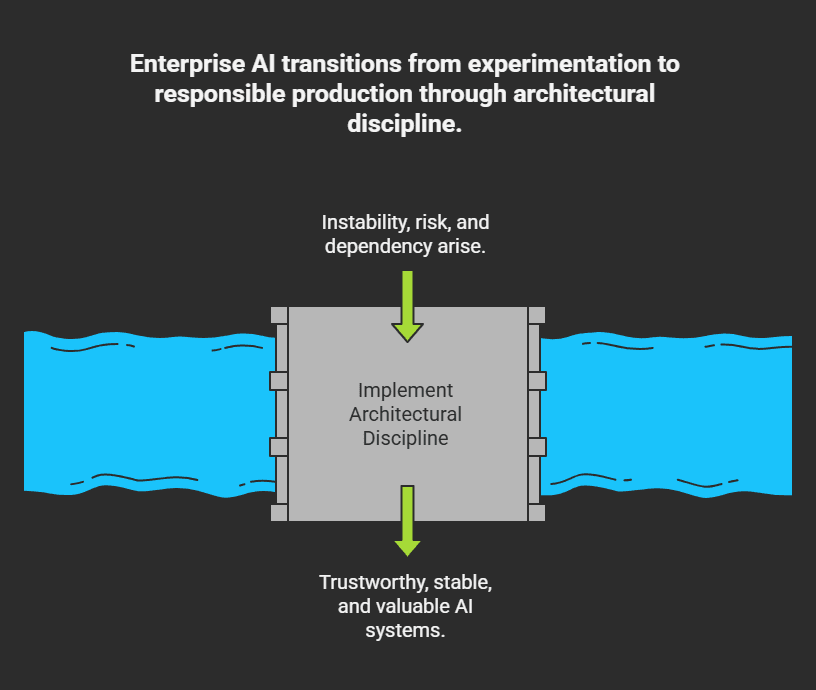
The conversation starts with model choice, prompt quality, or which feature will look most impressive in a demo. But in live production systems, that is rarely the real decision. The harder question is whether the platform has the architectural discipline required to introduce AI without creating new instability, new operational risk, and new forms of dependency.
That is why so many AI initiatives feel expensive long before they feel useful.
The model may work. The prototype may even impress stakeholders. But once the feature meets real workflows, real permission boundaries, real production latency, and real delivery constraints, the weaknesses usually appear somewhere outside the model itself.
The issue is not whether AI can be valuable. It clearly can. The issue is whether the surrounding system is ready to carry it responsibly.
That is the same underlying discipline behind enterprise SaaS modernization, legacy SaaS modernization, and production-safe automation, integrations, and applied AI. In mature platforms, the problem is almost never adding capability in isolation. It is adding capability without making the system harder to trust.
The Mistake Most Teams Make
The most common AI mistake in enterprise platforms is treating AI as a feature shortcut rather than a system change.
A team sees an opportunity to generate summaries, classify records, draft replies, enrich workflows, or automate internal decision support. The idea sounds reasonable. The technical path appears straightforward. An API call is added. A user interface is updated. A proof of concept works well enough to create momentum.
But the surrounding questions stay underdeveloped:
Who owns the workflow if the output is wrong?
What happens if the response is slow?
What happens if retrieval returns stale or restricted material?
What happens if the provider fails?
What happens if costs spike?
What happens if users cannot tell the difference between source truth and generated synthesis?
Those are architecture questions, not prompt questions.
This is one reason Where AI Actually Fits in Enterprise SaaS Platforms (And Where It Doesn’t) matters as a framing piece. The right question is not where AI can be added. The right question is where it can exist safely, usefully, and with enough control to support the platform rather than undermine it.
AI Changes More Than the Product Surface
When AI is introduced into a live system, it does not just add a new output. It changes the operational shape of the platform.
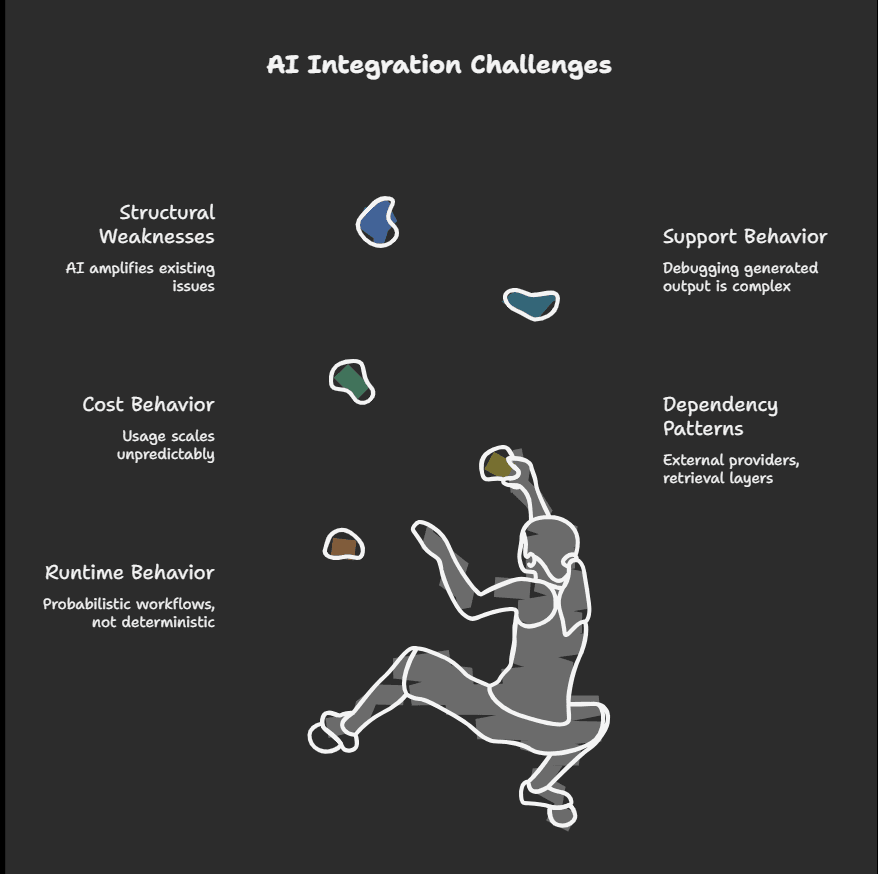
It changes runtime behavior because model-backed workflows are probabilistic rather than fully deterministic. It changes dependency patterns because external inference providers, retrieval layers, and orchestration logic now sit inside or alongside production behavior. It changes cost behavior because usage does not always scale in a clean, predictable way. And it changes support behavior because debugging generated output is not the same as debugging conventional application logic.
That means AI belongs inside architecture discussions much earlier than many teams expect.
A platform that already struggles with brittle releases, unclear service boundaries, weak observability, or fragile integrations will usually not become safer just because a model is added on top. In many cases, AI simply amplifies the same structural weaknesses that were already slowing the team down. That is the same pattern behind Why Most SaaS Rewrites Fail and When Cloud Migration Is the Wrong First Step: changing the visible layer of the system does not fix the underlying constraints.
Where Architecture Actually Has to Exist First
Before AI becomes a production capability, a few architectural layers need to be made explicit.
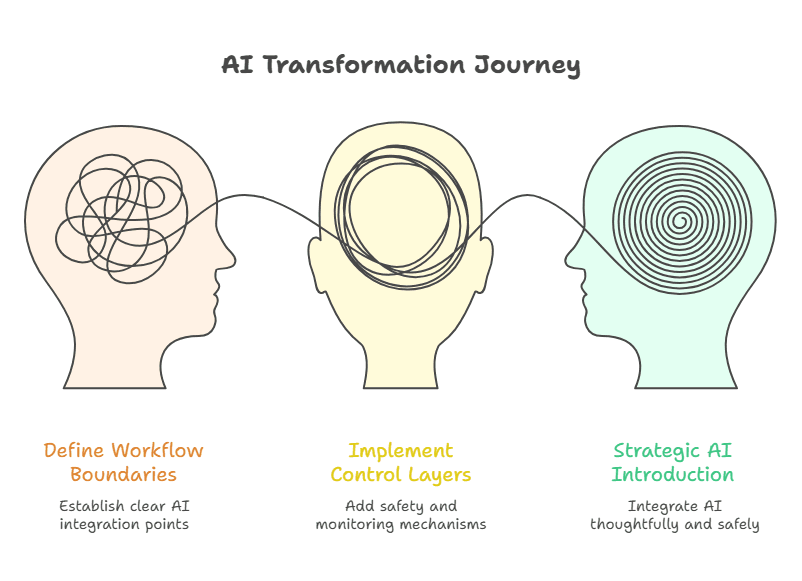
First, the workflow boundary has to be clear. Teams need to know exactly where AI influences the workflow, where human review remains required, and where failure can be tolerated without breaking the larger system. This is closely related to the sequencing logic in What Should You Modernize First in a Live Production System?. The safest first step is rarely the most visible feature. It is the step that improves the platform’s ability to absorb change safely.
Second, the data and permission model has to be trustworthy. Many AI systems fail less because the model is weak and more because the surrounding retrieval and authorization layers are weak. If a platform cannot clearly enforce tenant boundaries, role restrictions, document freshness, provenance, and source quality, then AI output becomes difficult to trust at scale. In enterprise environments, the real challenge is often not generation. It is controlled access.
Third, the orchestration layer has to exist as its own decision-making surface. The model should not quietly become the application. There needs to be a service layer deciding when AI runs, what context is valid, what policy applies, what fallback behavior exists, and how output is validated before it influences a user-facing or business-critical workflow.
Fourth, the platform needs observability that goes beyond conventional uptime metrics. Teams need visibility into response quality, provider latency, retrieval failures, blocked responses, cost behavior, fallback frequency, and human override patterns. Without that, AI becomes hard to evaluate and even harder to improve responsibly.
Fifth, release and rollback discipline matter more, not less. Once AI enters a platform, change becomes harder to reason about because output quality can drift even when application code has not changed much. That is one reason Release Discipline in Production Systems: What Actually Matters and DevOps as Risk Control, Not Speed are directly relevant to AI adoption. The problem is not just shipping the feature. The problem is controlling it after release.
Expensive Experimentation Usually Looks Like This
Most expensive AI experimentation does not look dramatic at first. It often looks productive.
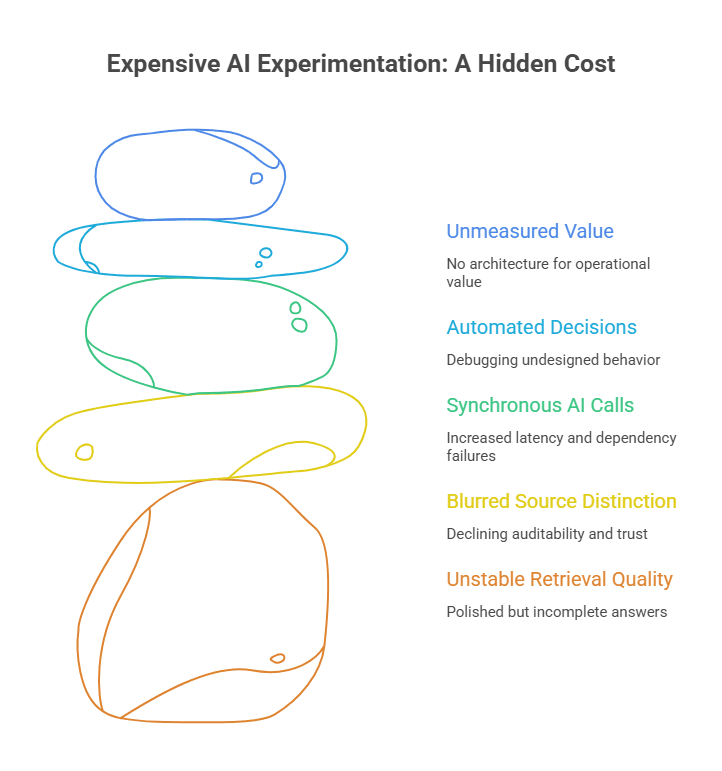
A team launches an assistant into a customer workflow before retrieval quality is stable. Users get answers that sound polished but rely on incomplete or superseded context.
A team merges generated summaries into records without preserving the distinction between source data and machine-generated interpretation. Auditability declines, trust declines, and support complexity rises.
A team places synchronous AI calls inside a critical request path because it feels faster to implement. Customer-facing latency increases, dependency failures become visible, and rollback becomes harder.
A team begins automating decisions before the workflow has clear review points, clear exception handling, or clear ownership. Suddenly the organization is debugging behavior no one explicitly designed to govern.
A team keeps spending because usage looks promising, but there is no architecture for measuring operational value against cost, no boundary around where AI should be used, and no discipline for retiring low-value features.
None of this is really an AI strategy problem. It is an architecture and operating model problem.
This is why the newer Duskbyte thinking around How to Add AI Features Without Destabilizing Production matters. The safest AI path is usually not “move faster and learn in production.” It is “design bounded change, then learn under control.”
A Better Way to Introduce AI
The strongest AI rollouts in enterprise platforms usually start in places where the workflow can benefit without becoming dependent too quickly.
That often means assistive use cases before autonomous ones. Draft generation before direct publishing. Retrieval assistance before decision substitution. Triage and enrichment before irreversible workflow execution. Internal tooling before customer-facing critical paths.
This does not make the work less ambitious. It makes it more survivable.
A platform earns the right to place AI deeper into critical workflows over time. It does not earn that right through a demo. It earns it through bounded rollout, reliable fallback, permission-aware retrieval, observability, and stable release behavior.
That same logic is visible across How We Engage and the broader Duskbyte approach to Platform Audit. Assessment before execution is not caution for its own sake. It is how serious teams prevent excitement from becoming operational drag.
The Real Decision Is Not “Should We Use AI?”
For most mature software teams, that question is already outdated.
The more useful question is this:
Where can AI improve a workflow without creating a larger architecture, trust, compliance, delivery, or operational problem than the business is prepared to absorb?
That is a much better decision lens for CTOs, heads of engineering, and platform leaders.
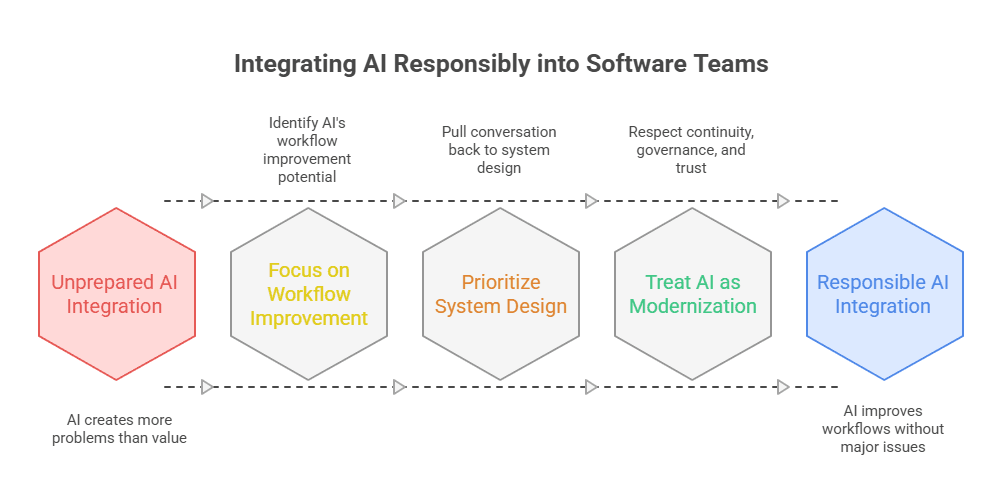
It pulls the conversation away from market noise and back toward system design. It acknowledges that AI may be valuable while still insisting that value has to survive production reality. And it makes room for restraint, which is still one of the most underrated engineering strengths in enterprise environments.
The teams that handle AI well usually do not treat it like a separate transformation program. They treat it like another layer of platform modernization that must respect continuity, governance, and operational trust.
That is also why AI conversations often belong alongside work in enterprise SaaS modernization, legacy system modernization, and even SaaS cloud migration. Once AI is introduced, existing weaknesses in deployment, data design, permissions, observability, and system boundaries become easier to expose. If the platform is already carrying those burdens, AI rarely hides them for long.
Questions Worth Asking Before You Approve the Rollout
Before approving AI work in a live platform, leadership should be able to answer a few uncomfortable questions clearly:
- What workflow is being improved, and what happens if the result is wrong?
- What source systems are being used, and how are freshness and provenance controlled?
- How are tenant, role, and permission boundaries enforced?
- What is the fallback behavior when AI is unavailable, blocked, or low confidence?
- How will the team observe quality, cost, latency, and drift after release?
- What release and rollback controls exist if the feature creates instability?
- Is this helping the platform become more governable, or just more impressive in a demo?
If those answers are still vague, the work is probably still in experimentation territory.
That is not automatically a problem. Early exploration has a place. But teams should be honest about the difference between bounded experimentation and production architecture. One creates learning. The other creates dependable value.
Conclusion
AI without architecture is not really transformation. It is experimentation with a larger bill attached.
In the right place, with the right workflow boundaries and the right control layers, AI can absolutely improve enterprise platforms. It can reduce friction, support internal teams, accelerate understanding, and expand what a product can do safely.
But in the wrong place, or introduced in the wrong order, it simply makes the system harder to reason about.
That is why architecture still comes first.
Not because AI is unimportant. Because it is important enough to introduce properly.