
Legacy SaaS decomposition is not about cutting the system into services as quickly as possible. It is about identifying the right seams, reducing production risk, and changing the platform in a sequence that protects users, data, integrations, and delivery confidence.
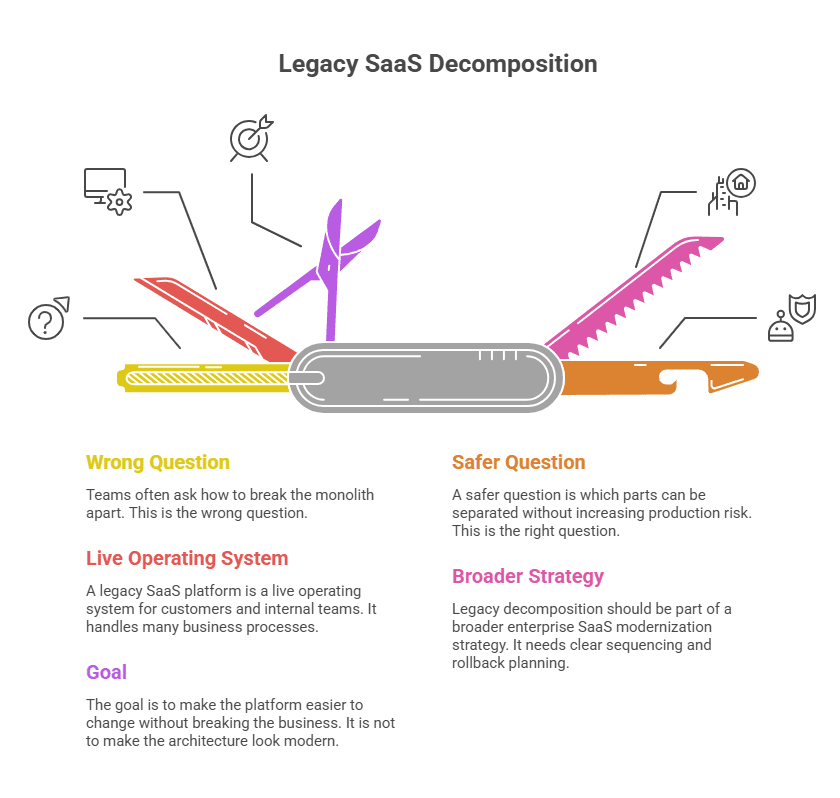
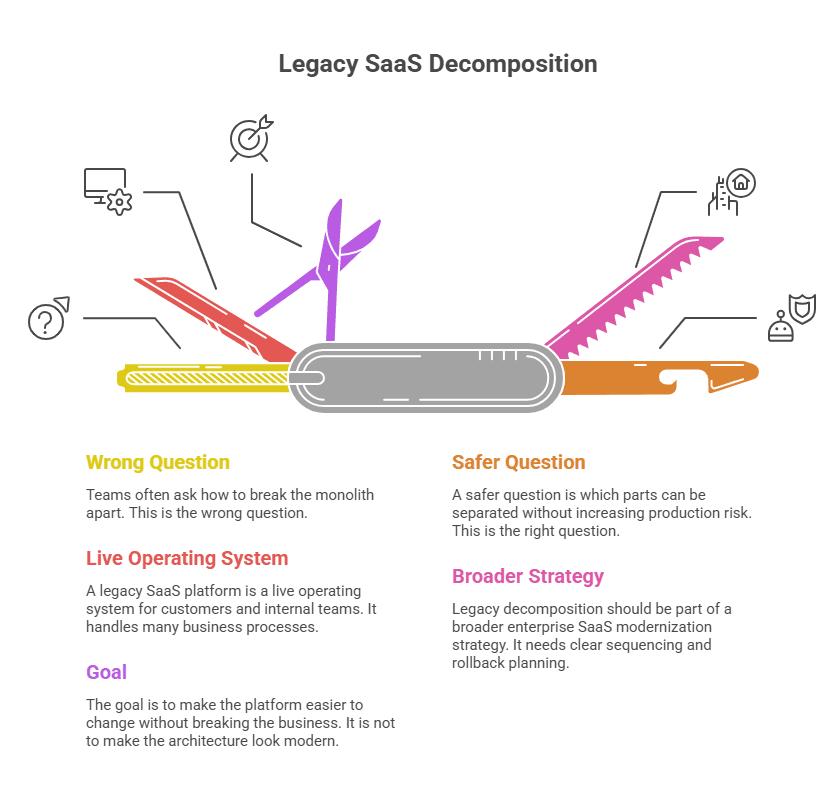
Legacy SaaS decomposition often starts with the wrong question.
Teams ask:
“How do we break this monolith apart?”
A safer question is:
“Which parts of this platform can we separate without increasing production risk?”
That difference matters.
A legacy SaaS platform is rarely just old code. It is usually a live operating system for customers, internal teams, integrations, billing flows, reporting, permissions, support processes, and years of business-specific exception handling. Pulling it apart without understanding those dependencies can create more instability than the original architecture ever did.
That is why legacy decomposition should not be treated as a refactoring exercise alone. It belongs inside a broader enterprise SaaS modernization strategy, supported by clear sequencing, dependency mapping, rollback planning, and production-aware delivery discipline.
The goal is not to make the architecture look modern on a diagram.
The goal is to make the platform easier to change without breaking the business.
The Mistake Most Teams Make
Many decomposition efforts begin with architecture ambition instead of operational evidence.
A team identifies a large legacy codebase and decides it needs to become:
- services
- modules
- APIs
- event streams
- separate databases
- independent deployment units
Those may eventually be useful outcomes.
But they are not a starting point.
The common mistake is treating decomposition as a structural goal rather than a risk-reduction strategy. Teams begin extracting services before they understand which workflows are most fragile, which dependencies are hidden, which data changes are dangerous, and which parts of the system are still business-critical despite being technically unpleasant.
This is how modernization work creates new production risk while trying to remove old risk.
A system can become more distributed, more expensive, harder to debug, and still just as fragile as before. That is why decomposition should begin with the same discipline required for any serious legacy system evaluation: evidence before assumption.
Old code is not automatically the first thing to extract.
The first target should usually be the part of the platform where separation will reduce risk, improve delivery confidence, or make future change easier to control.
Decomposition Is Not the Same as Rewriting
A rewrite replaces.
Decomposition separates.
That distinction is critical.
A rewrite asks the organization to rebuild major platform capability somewhere else and eventually switch over. In mature SaaS systems, that often turns into a long-running parallel product with unclear parity, hidden business rules, delayed cutover, and growing anxiety around what might be missed.
This is why most SaaS rewrites fail. They underestimate the amount of operational knowledge embedded in the existing platform.
Decomposition should work differently.
It should preserve what is stable, isolate what is risky, and gradually create cleaner boundaries around the parts of the system that need to evolve. The legacy platform does not disappear overnight. It becomes better understood, better contained, and less dangerous to change.
A healthy decomposition strategy accepts that some legacy code may remain in place longer than expected.
That is not failure.
In live SaaS environments, removing the right dependency at the right time is more valuable than removing everything quickly.
Start With a Production Dependency Map
Before decomposing anything, the team needs to understand how production actually behaves.
That means looking beyond code structure.
A useful dependency map should include:
AreaWhat to UnderstandCustomer workflowsWhich user journeys cannot fail quietly?Data flowsWhich tables, records, events, or reports are shared across workflows?IntegrationsWhich external systems depend on current behavior?Background jobsWhich async processes mutate state or trigger downstream effects?Operational workaroundsWhere do support, finance, admin, or ops teams compensate manually?Release pathsWhich changes currently require coordination or special handling?Failure modesWhat breaks when timing, retries, or partial updates behave unexpectedly?OwnershipWhich teams understand each part of the system well enough to change it?
This mapping often reveals that the most dangerous parts of the platform are not the oldest parts.
Sometimes the risk sits in a billing workflow.
Sometimes it sits in reporting logic.
Sometimes it sits in a third-party integration.
Sometimes it sits in a shared database table that quietly coordinates half the platform.
This is why integration boundaries matter so much in decomposition work. A bad boundary can make the new architecture dependent on the same fragile assumptions as the old one.
Choose Seams Based on Risk, Not Architecture Taste
A seam is a place where the system can be separated.
But not every visible seam is a safe seam.
A controller, module, folder, database table, or domain label may look like a natural boundary in the code. Production may tell a different story.
The best decomposition seams usually have some combination of these traits:
- the workflow is important but reasonably bounded
- data ownership can be clarified
- external dependencies can be controlled
- the old and new behavior can coexist temporarily
- rollback is possible
- monitoring can prove whether the new path behaves correctly
- the business can tolerate phased migration
- the team can validate the change with real production traffic
Weak seams often look clean in diagrams but fail under operational pressure.
They cross too many data ownership boundaries.
They depend on shared mutation paths.
They require a hard cutover.
They affect too many customer workflows at once.
They cannot be rolled back without manual repair.
They push complexity into integrations or queues instead of reducing it.
That is why the first decomposition target should usually be selected through modernization sequencing, not architectural preference. The useful question is not “Which service should exist first?” It is “Which separation makes the next change safer?”
This connects directly to the broader question of what should be modernized first in a live production system.
Use the Strangler Pattern Carefully
The strangler fig pattern is one of the most useful approaches for decomposing legacy SaaS platforms.
Instead of replacing the system all at once, the team routes selected functionality through a new path while the legacy system continues to operate. Over time, more responsibility moves into the new architecture until the old part becomes smaller, safer, or removable.
Used well, this approach supports modernizing without downtime.
But the strangler pattern is not magic.
It only works when the team is disciplined about:
- which workflows move first
- how traffic is routed
- how data consistency is maintained
- how old and new behavior coexist
- how errors are detected
- how rollback works
- how customer impact is contained
- when the legacy path can be retired
A weak strangler implementation can create two systems that both need to be maintained, both mutate data, and both contain business rules that slowly diverge.
That is not decomposition.
That is duplication with better branding.
The pattern works best when each extraction is small enough to validate, reversible enough to control, and valuable enough to reduce future platform risk.
Do Not Extract Before You Can Observe
A legacy component should not be extracted into a new service if the team cannot observe its behavior.
That includes both the old path and the new path.
Before moving production traffic, the team should be able to answer:
- What does normal behavior look like today?
- What volume, latency, and error patterns are expected?
- Which business metrics indicate that the workflow is healthy?
- Which logs or traces show where a request, event, or job failed?
- Which alerts indicate customer impact rather than technical noise?
- How will the team compare old and new behavior during migration?
Without observability, decomposition becomes guesswork.
A team can move functionality into a new service and still have no reliable way to know whether it is behaving correctly until customers, support teams, or downstream systems report problems.
That is why release discipline in production systems is not separate from decomposition. It is one of the conditions that makes decomposition survivable.
The architecture should not only be easier to draw.
It should be easier to monitor, validate, and recover.
Treat Data Ownership as the Hard Part
Many decomposition efforts underestimate data.
Code is often easier to separate than the data model underneath it.
A legacy SaaS platform may have years of shared tables, overloaded fields, implicit status transitions, reporting dependencies, admin overrides, customer-specific rules, and background jobs that assume direct database access.
Extracting a service without clarifying data ownership can create several problems:
- multiple services writing to the same tables
- duplicated business rules
- inconsistent reporting
- unclear source of truth
- fragile sync jobs
- hidden timing bugs
- difficult rollback after schema changes
- customer-visible inconsistencies
This is where many “service extraction” programs become operationally expensive.
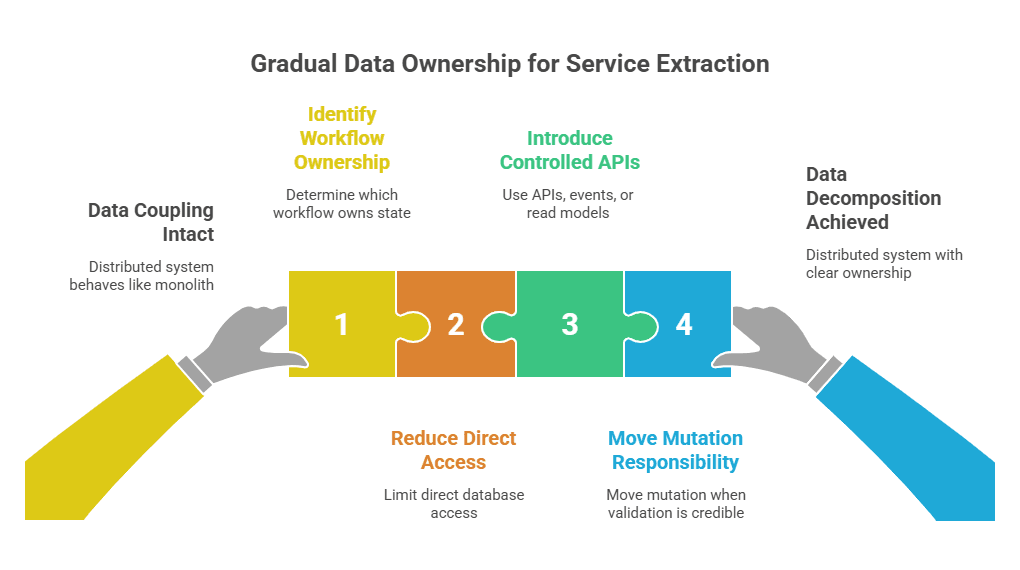
The team separates code but leaves data coupling intact. The result is a distributed system that still behaves like a monolith, except with more network calls and more failure modes.
A safer path is usually to define ownership gradually.
Start by identifying which workflow owns which state. Then reduce direct access. Then introduce controlled APIs, events, or read models where appropriate. Then move mutation responsibility only when validation and rollback are credible.
Data decomposition should move slower than slide decks usually imply.
That is often the right call.
Avoid Creating a Distributed Monolith
A distributed monolith is what happens when a system is split physically but not logically.
The platform gains services, APIs, queues, and deployment boundaries, but teams still cannot change one part independently because the business logic, data assumptions, and release timing remain tightly coupled.
Warning signs include:
- services must be deployed together
- one workflow requires coordinated changes across several repositories
- database ownership is unclear
- service contracts change too often
- events are used as hidden command chains
- rollback requires multi-team choreography
- failures are harder to trace than before
- local development becomes slower without production risk decreasing
This is decomposition without control.
It often happens when teams optimize for architecture appearance instead of operational independence.
A better decomposition strategy asks whether each separation actually improves one of four things:
- Change safety — Can this part evolve with less regression risk?
- Operational clarity — Is ownership and failure behavior easier to understand?
- Rollback confidence — Can the team retreat safely if the change misbehaves?
- Future optionality — Does this make the next modernization step easier?
If the answer is no, the extraction may not be worth doing yet.
Design Rollback Before the Extraction
Rollback is not something to invent after a decomposition release goes wrong.
It should shape the extraction plan from the beginning.
That means deciding:
- whether old and new paths can run in parallel
- whether traffic can be shifted gradually
- whether schema changes are backward-compatible
- whether events can be replayed safely
- whether data written by the new path can still be understood by the old path
- whether feature flags can disable the new behavior cleanly
- whether customers can be migrated in cohorts
- whether failed migration states can be repaired without heroics
In legacy SaaS decomposition, rollback is not just redeploying the previous version.
A service extraction may change data, queue behavior, timing, vendor interactions, permission checks, reporting outputs, or downstream workflows. Rolling back code alone may not reverse those effects.
This is why rollback is a strategy, not a safety net. Reversibility has to be designed into the shape of the change.
If rollback is unclear, the decomposition step is probably too large.
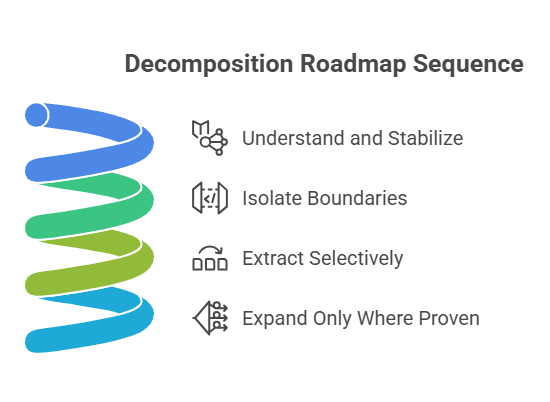
Sequence the Work in Small, Validated Moves
A safe decomposition roadmap usually does not start with “extract user service” or “split billing into microservices.”
It starts with smaller moves that reduce uncertainty.
For example:
Phase 1: Understand and stabilize
map dependencies
document business-critical workflows
improve observability
reduce release risk
identify brittle integrations
clarify data ownership
strengthen test coverage around critical paths
Phase 2: Isolate boundaries
introduce API facades
contain vendor-specific logic
reduce direct database access
separate read models where useful
route selected workflows through controlled boundaries
introduce feature flags and cohort-based rollout
Phase 3: Extract selectively
move one bounded workflow
run old and new paths in parallel where possible
validate behavior under real load
monitor business and technical signals
keep rollback available
retire legacy paths only after evidence supports it
Phase 4: Expand only where proven
repeat extraction around the next safe seam
avoid turning every module into a service
keep platform ownership clear
update operating practices as architecture changes
measure whether delivery confidence is improving
This kind of sequencing may feel less dramatic than a full platform rewrite.
That is usually a strength.
In mature systems, progress should be measured by reduced risk, clearer ownership, safer releases, and improved ability to change the platform — not by the number of new services created.
Where Cloud Migration Fits
Cloud migration and decomposition often overlap, but they are not the same decision.
A team may want to decompose the platform because cloud migration is coming. Or it may want to migrate because decomposition feels difficult on current infrastructure.
Both situations require caution.
Moving a tightly coupled legacy SaaS platform into cloud infrastructure does not automatically make it easier to decompose. In some cases, migration can move the same fragility into a more complex environment.
The stronger question is:
“What needs to be stabilized or separated before cloud migration becomes safer?”
This is the central idea behind cloud migration as a control decision. The cloud can support modernization, but it does not replace sequencing judgment.
Sometimes the right first move is better observability.
Sometimes it is release discipline.
Sometimes it is integration containment.
Sometimes it is database ownership clarity.
Sometimes it is decomposing one workflow before moving infrastructure.
Sometimes it is leaving the legacy system where it is until the risk map is clearer.
Cloud migration should not be used to force decomposition under pressure.
It should be part of a phased modernization path that the platform can actually absorb.
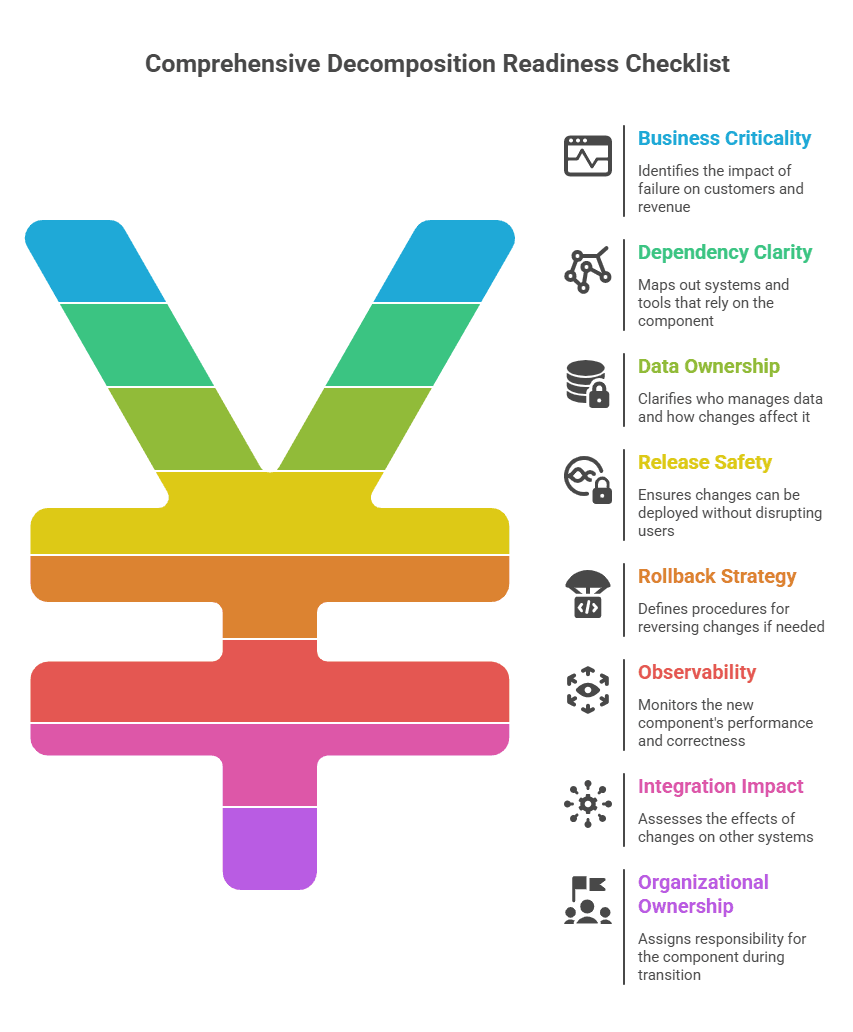
A Practical Decomposition Readiness Checklist
Before extracting a major part of a legacy SaaS platform, leadership and engineering teams should be able to answer these questions.
1. Business criticality
Which customers, teams, or revenue workflows depend on this area?
What happens if it partially fails?
What support or operational load would failure create?
2. Dependency clarity
Which systems call this functionality?
Which jobs, reports, integrations, and admin tools depend on it?
Which dependencies are documented versus tribal knowledge?
3. Data ownership
Who owns the source of truth?
Which tables or events are shared?
What changes if the new component owns writes?
4. Release safety
Can the change be deployed behind a flag?
Can it be released to a subset of users or tenants?
Can old and new behavior coexist?
5. Rollback
What exactly can be reversed?
What cannot be reversed once the new path writes data?
How long would recovery take?
6. Observability
How will the team know the new path is working?
Which metrics show business correctness, not just system uptime?
Who watches the release and owns decisions during rollout?
7. Integration impact
Which internal or external systems must be protected from change?
Are contracts versioned?
Are retries, rate limits, and failure modes understood?
8. Organizational ownership
Which team owns the extracted component?
Which team owns the legacy path during transition?
Who decides when the old path can be retired?
If these questions cannot be answered, extraction may still be possible — but it is not yet safe enough to treat as routine implementation work.
That is where a structured modernization approach becomes valuable.
The Real Goal: Make Change Less Dangerous
The purpose of decomposing a legacy SaaS platform is not to create a more fashionable architecture.
It is to reduce the cost and risk of change.
That means the work should improve practical conditions:
- fewer high-anxiety releases
- clearer ownership
- safer rollback
- better observability
- reduced integration fragility
- more explicit data boundaries
- smaller blast radius
- more predictable delivery
- stronger confidence in future modernization steps
If decomposition does not improve those conditions, the platform may become more complex without becoming healthier.
That is the risk.
Legacy SaaS platforms do not need dramatic change for its own sake. They need controlled change in the right order.
The best decomposition work is often quiet. It creates boundaries before extracting services. It stabilizes workflows before moving them. It protects data before changing ownership. It designs rollback before release. It improves the platform’s ability to absorb future modernization without turning every step into a production event.
That is not slow modernization.
That is survivable modernization.