
Regulated SaaS modernization is not just a technology decision. Platform leaders need to evaluate control, auditability, data responsibility, release discipline, integration risk, and operational continuity before making major platform changes.
Modernization in regulated SaaS environments is rarely just a question of architecture.
It is a question of control.
A platform may need better infrastructure, cleaner services, stronger integrations, faster delivery, or a more maintainable codebase. But in regulated or compliance-sensitive environments, every modernization decision touches something larger than engineering convenience.
It touches data responsibility.
It touches auditability.
It touches access control.
It touches customer trust.
It touches operational continuity.
It touches the organization’s ability to prove what happened when something goes wrong.
That is why regulated SaaS teams should not begin modernization by asking:
“What stack should we move to?”
They should begin by asking:
“What must remain controlled while the platform changes?”
That question leads to a very different modernization strategy.
It is also why many teams benefit from a structured SaaS Modernization & Cloud Readiness Audit before committing to a major rewrite, migration, or platform transformation program.
The Mistake: Treating Modernization as a Technical Upgrade
Many modernization programs start with visible technical pain.
The monolith feels slow to change.
The deployment process is fragile.
The database has years of accumulated complexity.
The cloud footprint is inefficient.
The integration layer has become difficult to reason about.
The engineering team is spending too much time avoiding regressions.
Those are real problems.
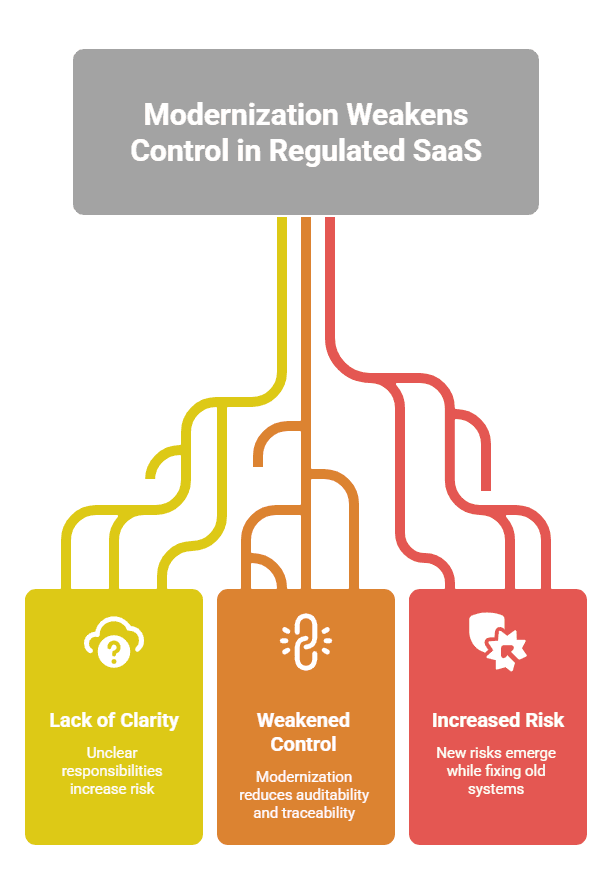
But in regulated SaaS, the deeper issue is often not the age of the system. It is the lack of clarity around what the system is responsible for protecting.
A platform can be old and still controlled.
It can also be modern, distributed, cloud-hosted, API-first, and dangerously unclear.
The risk is not legacy technology by itself. The risk is modernization that weakens control while trying to improve structure.
This is why modernization without clarity often creates new risk while trying to fix old systems.
For regulated SaaS teams, modernization should strengthen the platform’s ability to answer difficult questions:
- Who accessed what?
- Which system changed this data?
- Was the change authorized?
- Can we trace the workflow end to end?
- Can we prove the correct process was followed?
- Can we roll back safely?
- Can we isolate failure without affecting regulated workflows?
- Can we explain platform behavior during an audit, incident, or customer review?
If modernization makes those answers harder, the platform may become technically newer but operationally weaker.
1. Evaluate Data Responsibility Before Changing Architecture
Regulated SaaS platforms usually carry data that has operational, contractual, legal, or compliance significance.
Before changing services, schemas, pipelines, storage layers, or APIs, platform leaders should understand how data responsibility currently works.
This includes:
- where sensitive data originates
- where it is transformed
- where it is stored
- which systems are authoritative
- which workflows depend on historical accuracy
- which records must remain immutable
- which data changes require traceability
- which downstream systems rely on specific timing or format assumptions
The dangerous modernization pattern is to break the platform into cleaner components without clearly defining data ownership.
A service boundary that looks elegant on a diagram can create real risk if no one can explain which service is responsible for final truth.
In regulated environments, data architecture is not just about performance or maintainability. It is about accountability.
Before a team starts decomposing a legacy platform, it should ask:
- Which data domains require strict ownership?
- Which records need full change history?
- Which workflows require non-repudiation?
- Which data cannot be casually duplicated?
- Which reporting outputs depend on legacy assumptions?
- Which database changes could affect audit evidence?
This is where enterprise SaaS modernization must be handled differently from general application refactoring. The goal is not simply to make the system cleaner. The goal is to make ownership, behavior, and accountability clearer than before.
2. Map Compliance Boundaries Before Moving Workloads
Cloud migration is often part of regulated SaaS modernization.
But moving workloads to the cloud does not automatically improve compliance posture. In some cases, it exposes how unclear the current boundaries already are.
Before migration, platform leaders should map:
- regulated data zones
- user access boundaries
- environment separation
- logging and retention requirements
- backup and recovery obligations
- third-party service exposure
- encryption responsibilities
- regional or jurisdictional constraints
- customer-specific compliance commitments
The question is not simply whether the cloud provider has strong compliance certifications.
The question is whether your platform architecture uses cloud infrastructure in a way that preserves the controls your business depends on.
A poorly sequenced migration can move fragile access patterns, unclear data flows, and weak operational controls into a more complex environment.
That is why cloud migration is not the goal — control is.
For regulated SaaS teams, the right question is rarely:
“Can this workload run in the cloud?”
The better question is:
“Can this workload move without weakening control, traceability, availability, or compliance confidence?”
This is also where the organization should review its broader trust, security, and procurement posture, because modernization decisions often affect more than infrastructure. They affect how the business demonstrates readiness to customers, auditors, and enterprise buyers.
3. Review Identity and Access Before Expanding the Platform
Identity is one of the most important modernization areas in regulated SaaS.
It is also one of the most commonly underestimated.
Many mature platforms accumulate access rules over time:
- internal admin roles
- customer admin roles
- support impersonation workflows
- legacy permission groups
- API credentials
- integration tokens
- service accounts
- manual overrides
- environment-specific exceptions
- privileged operational tools
These patterns may be messy, but they often reflect years of business and operational reality.
Modernization can create risk when teams rebuild or replace access systems without fully understanding how those permissions are used in practice.
Before changing identity, platform leaders should evaluate:
- which roles exist today
- which permissions are explicit vs implicit
- where privilege escalation risk exists
- where support teams need controlled access
- which service accounts are over-permissioned
- how access is reviewed and revoked
- how customer-specific permissions are handled
- where authorization logic is duplicated across the codebase
In regulated SaaS, access control is not a feature layer. It is part of the platform’s trust model.
A modernization roadmap should identify whether identity and authorization need to be stabilized before broader architecture changes begin.
4. Check Auditability Before Redesigning Workflows
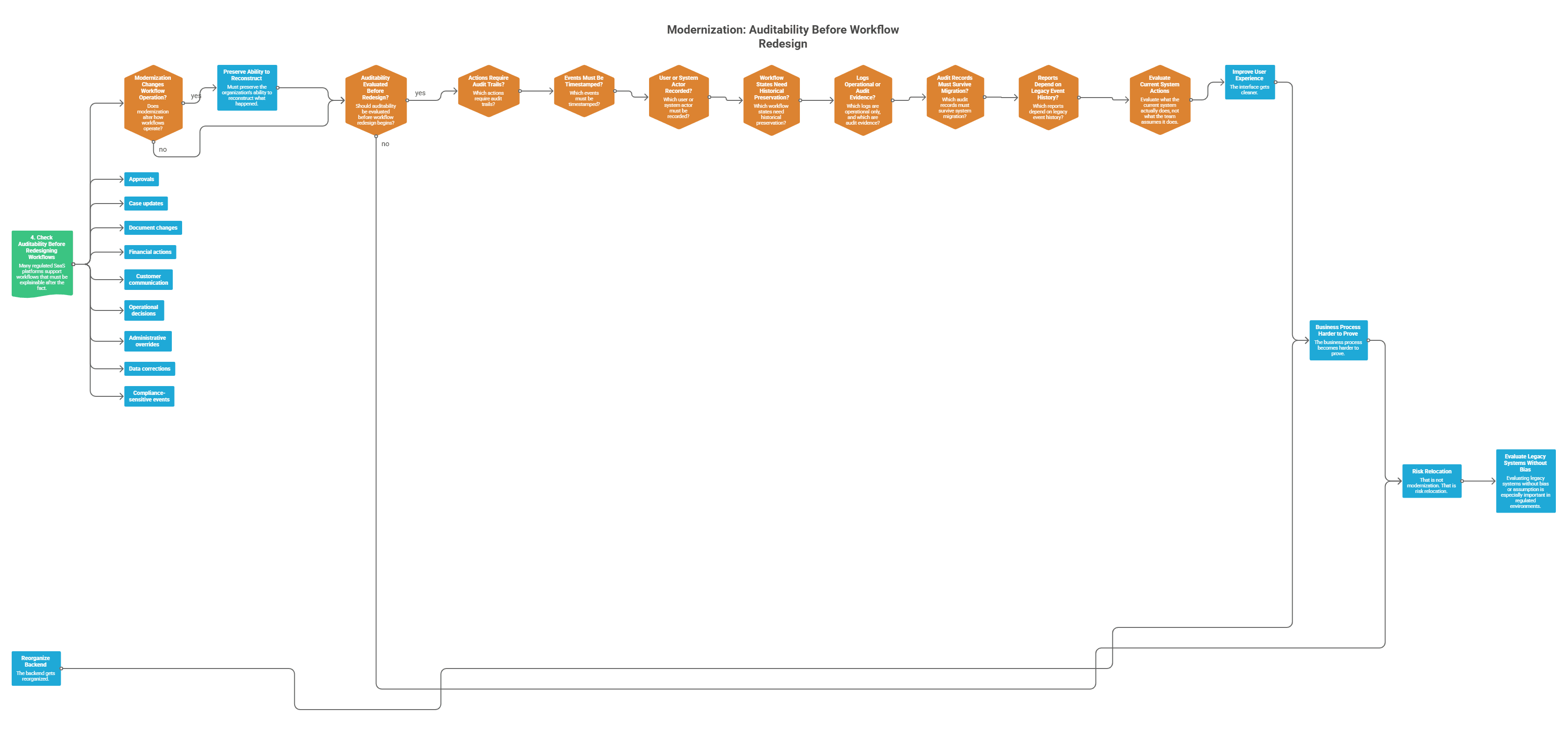
Many regulated SaaS platforms support workflows that must be explainable after the fact.
Approvals.
Case updates.
Document changes.
Financial actions.
Customer communication.
Operational decisions.
Administrative overrides.
Data corrections.
Compliance-sensitive events.
If modernization changes how these workflows operate, it must preserve the organization’s ability to reconstruct what happened.
Auditability should not be added at the end of modernization.
It should be evaluated before workflow redesign begins.
Platform leaders should ask:
- Which actions require audit trails?
- Which events must be timestamped?
- Which user or system actor must be recorded?
- Which workflow states need historical preservation?
- Which logs are operational only, and which are audit evidence?
- Which audit records must survive system migration?
- Which reports depend on legacy event history?
A common failure pattern is to improve user experience while weakening the evidence trail behind the workflow.
The interface gets cleaner.
The backend gets reorganized.
The business process becomes harder to prove.
That is not modernization. That is risk relocation.
A stronger modernization approach starts by evaluating what the current system actually does, not what the team assumes it does. This is why evaluating legacy systems without bias or assumption is especially important in regulated environments.
5. Evaluate Release Discipline Before Increasing Change Velocity
Regulated SaaS teams often want modernization to improve delivery speed.
That is reasonable.
But speed without release discipline can make regulated platforms harder to operate.
Before increasing deployment frequency, teams should evaluate:
- environment reliability
- test coverage around critical workflows
- release approval paths
- rollback confidence
- feature flag usage
- production monitoring
- incident response patterns
- customer communication requirements
- change management expectations
- dependency between releases and compliance controls
A team should not move faster until it knows how to recover.
Modernization should improve the organization’s ability to release with confidence, not merely increase the number of deployments.
This is especially important when platform changes affect regulated workflows, customer data, billing behavior, document handling, reporting, or integrations with external systems.
A safer approach is to strengthen release controls before expanding architectural change.
That may include:
- clearer deployment gates
- better regression coverage
- isolated rollout paths
- controlled feature exposure
- rollback procedures
- release notes tied to operational impact
- stronger observability around critical workflows
In mature platforms, DevOps is risk control, not speed.
6. Understand Integration Risk Before Replacing Core Systems
Regulated SaaS platforms rarely operate alone.
They often connect to:
- payment systems
- identity providers
- customer systems
- document platforms
- reporting tools
- communication services
- data warehouses
- internal operational systems
- compliance or monitoring platforms
- industry-specific external services
These integrations are often where modernization risk becomes operationally visible.
A core system may be technically ready for change, but the integration layer may not be.
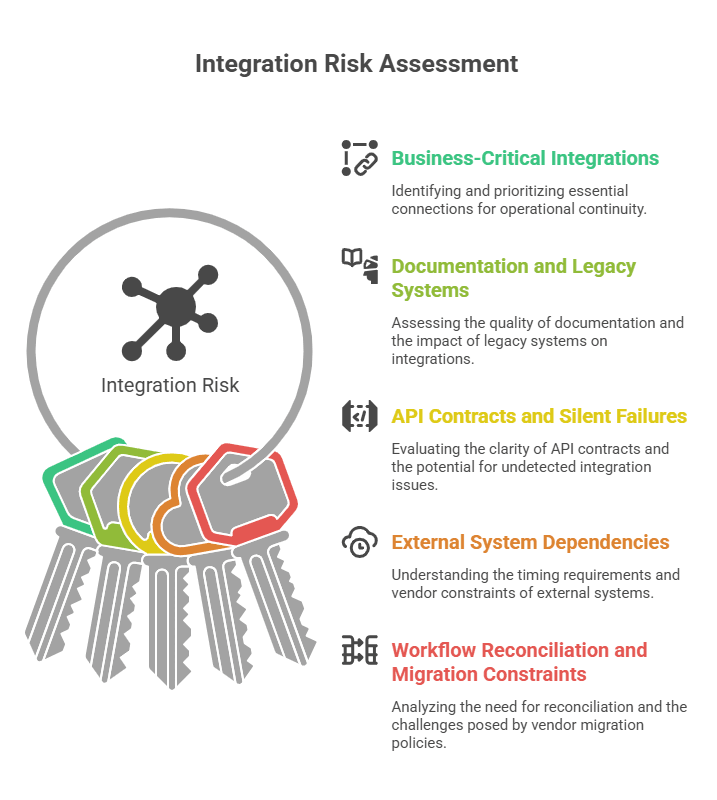
Before modernization, leaders should evaluate:
- which integrations are business-critical
- which integrations are poorly documented
- which systems depend on legacy behavior
- which APIs lack clear contracts
- which integrations fail silently
- which external systems have strict timing requirements
- which workflows require reconciliation
- which vendors create migration constraints
The mistake is treating integrations as edge cases.
In regulated SaaS, integrations are often part of the compliance and operational control surface.
A brittle integration can break reporting, delay customer workflows, corrupt downstream data, or create audit gaps.
That is why integration boundaries need to survive change, especially when regulated platforms depend on external systems, vendors, data feeds, or customer-owned infrastructure.
It is also why integrations often break more systems than core code. They sit between ownership boundaries, timing assumptions, data contracts, vendor behavior, and operational workflows.
7. Review Legacy Constraints Without Assuming Everything Is Bad
Legacy systems are often criticized too broadly.
Some parts are genuinely dangerous.
Some are merely old.
Some are ugly but stable.
Some encode critical business rules that nobody has fully documented.
Some should be replaced.
Some should be contained.
Some should not be touched until surrounding controls improve.
The purpose of legacy SaaS modernization is not to erase the past as quickly as possible.
It is to distinguish between technical discomfort and operational risk.
Platform leaders should evaluate:
- which legacy components block delivery
- which components create compliance exposure
- which areas are hard to test
- which modules carry critical business rules
- which workflows depend on undocumented behavior
- which systems are stable enough to leave alone temporarily
- which areas must be isolated before replacement
In regulated SaaS, a rewrite can be more dangerous than the system it replaces if the team does not understand the behavior being replaced.
This is why most SaaS rewrites fail in mature platforms. They underestimate the operational knowledge, edge cases, and business rules embedded in production behavior.
The safer path is often progressive containment:
First, understand the risk.
Then isolate the dangerous areas.
Then improve testability and observability.
Then modernize in phases.
Modernization should reduce uncertainty before it increases scope.
8. Evaluate Operational Workflows, Not Just Application Code
Regulated SaaS platforms often carry operational complexity outside the codebase.
Support teams may have manual processes.
Compliance teams may rely on exports or reports.
Operations teams may use admin tools.
Finance teams may depend on reconciliation workflows.
Customer success teams may depend on status visibility.
Engineering teams may handle exceptions manually.
Modernization can fail when these workflows are treated as secondary.
Before changing architecture, platform leaders should evaluate how the platform is actually operated.
Key questions include:
- Which internal teams depend on the platform daily?
- Which manual processes compensate for system gaps?
- Which admin actions require special care?
- Which customer-impacting workflows involve human review?
- Which operational reports are trusted by leadership?
- Which exceptions occur frequently enough to deserve product support?
- Which internal tools are risky but business-critical?
This matters because regulated SaaS modernization does not only affect users. It affects the people responsible for keeping the platform compliant, reliable, and commercially usable.
A technically successful migration can still fail if internal operations lose visibility or control.
This is one reason modernization decisions made under pressure often create expensive mistakes. The team moves toward visible change before fully understanding operational dependency.
9. Treat AI and Automation as Governance Questions
Many regulated SaaS teams are exploring AI and automation.
That can be useful, especially around document handling, support workflows, compliance assistance, data classification, operational triage, and internal productivity.
But in regulated environments, AI should not be introduced as a novelty layer.
It should be evaluated through governance.
Platform leaders should ask:
- What decisions can automation support but not own?
- Where does human review remain necessary?
- What data can AI systems access?
- How are prompts, outputs, and decisions logged?
- What happens when an AI-assisted workflow is wrong?
- Can the organization explain how the system behaved?
- Are AI outputs part of the audit trail?
- Can automation be disabled without breaking the workflow?
In regulated SaaS, the question is not “Where can we add AI?”
The better question is:
“Where can intelligent automation improve workflow control without weakening accountability?”
This is the same reasoning behind where AI actually fits in enterprise SaaS platforms. AI is safer when it supports governed workflows rather than taking over sensitive system-of-record behavior too early.
If the platform does not already have clear data boundaries, access rules, audit trails, and operational ownership, AI may amplify confusion rather than reduce it.
10. Define What Should Not Be Modernized Yet
One of the most useful outputs of a modernization assessment is not only what should change.
It is what should wait.
In regulated SaaS, some changes should be delayed until the platform is ready.
Examples include:
- migrating a system before data ownership is clear
- extracting services before audit trails are understood
- replacing workflow logic before business rules are documented
- increasing deployment frequency before rollback is reliable
- adding automation before exception handling is controlled
- moving regulated workloads before access boundaries are mapped
- rebuilding admin tools before operational dependencies are known
Saying “not yet” is not resistance to modernization.
It is often what makes modernization survivable.
A phased roadmap should separate work into clear categories:
- what should be stabilized now
- what can be modernized safely next
- what requires dependency cleanup first
- what should remain unchanged for now
- what should be retired only after replacement behavior is proven
This is especially important when leadership pressure is high. The more urgent modernization feels, the more important sequencing becomes.
In many cases, the first question should be whether cloud migration is even the right first step. As discussed in When Cloud Migration Is the Wrong First Step, moving infrastructure before stabilizing platform assumptions can make existing fragility harder to unwind.
What Safer Modernization Looks Like in Regulated SaaS
A safer modernization path usually begins with assessment rather than implementation.
Not because implementation is unimportant.
Because implementation without clarity can create expensive, difficult-to-reverse risk.
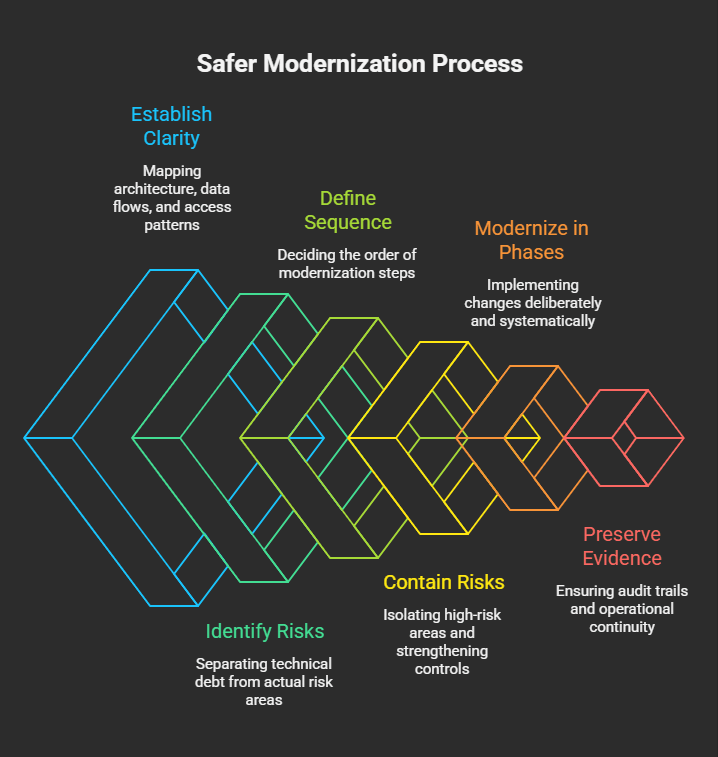
A better path often looks like this:
1. Establish Current-State Clarity
Map the architecture, data flows, access patterns, integrations, delivery process, operational workflows, and compliance-sensitive areas.
2. Identify Control Risks
Separate visible technical debt from actual risk areas: audit gaps, brittle integrations, weak rollback paths, unclear ownership, hidden data dependencies, or fragile access controls.
3. Define Modernization Sequence
Decide what should happen first, what should wait, and which changes depend on stabilization work.
4. Contain High-Risk Areas
Isolate dangerous workflows, improve observability, strengthen release paths, and reduce blast radius before larger platform change.
This containment mindset is also visible in multi-account AWS architecture, where the value is not just scale but clearer control boundaries, reduced blast radius, and safer operational separation.
5. Modernize in Phases
Move deliberately through architecture improvement, cloud readiness, integration remediation, workflow redesign, and platform hardening.
This aligns with Duskbyte’s broader risk-first modernization approach, where the goal is not to create movement for its own sake, but to reduce fragility while the system continues serving real users.
6. Preserve Evidence and Continuity
Ensure modernization does not weaken audit trails, operational reporting, customer trust, or regulated workflow behavior.
That means designing for failure, recovery, and reversibility from the start. In regulated platforms, rollback is a strategy, not a safety net.
Final Thought
Regulated SaaS modernization should not begin with a preferred architecture pattern, cloud target, or rewrite plan.
It should begin with a clear understanding of what the platform must continue to protect.
That includes customer data, audit trails, workflow integrity, compliance confidence, system availability, operational visibility, and the organization’s ability to explain platform behavior under scrutiny.
Modernization is valuable when it improves those things.
It is dangerous when it makes them harder to reason about.
For platform leaders, the goal is not simply to make the system newer.
The goal is to make the platform more controlled, more explainable, more resilient, and easier to evolve without creating avoidable risk.
That is the difference between modernization as a technical project and modernization as responsible platform leadership.